





 Portuguese
  English
  Spanish
  5 min of reading
  0 comments


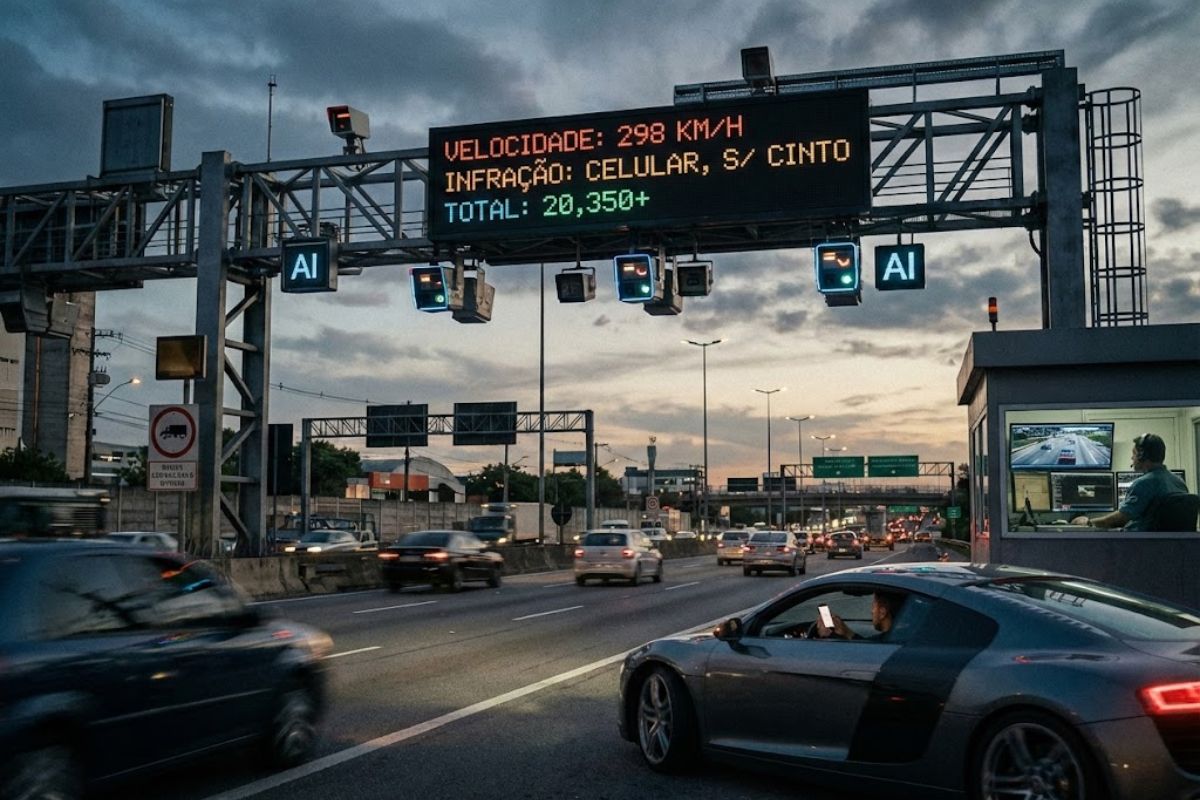
AI Radars Are Being Installed at Strategic Points on Highways to Identify Cell Phones in Hand and Lack of Seatbelt with Ultra-Defined Images and Real-Time Analysis. The System Operates Day and Night, Capturing Vehicles at 300 km/h and Only Issues Citations After Confirmation by Human Agents.
Fantástico showed how AI radars have strengthened enforcement on highways by recording drivers without seatbelts and with cell phones in hand. The special report featured catches and described the context referred to as the “distraction epidemic,” associated with messages being typed while driving.
In the same coverage, it was detailed that artificial intelligence analyzes images in real time and only signals possible violations, which must be confirmed by human agents before any citation. The goal is to expand enforcement with technology, but with human validation to reduce errors and ensure the process’s safety.
What Are AI Radars and Why Have They Become the Response to the “Distraction Epidemic”

The term “distraction epidemic” was used to describe the increased risk when drivers not only talk on the phone but also start typing messages while driving.
-
He sold his share for R$ 4 thousand, saw the company become a giant worth R$ 19 trillion, and missed the opportunity of a lifetime.

-
Elon Musk’s Starship megafrocket puts $8 billion at risk, raises alarms in the market, and could affect technology, mining, and space internet startups in the coming years.

-
Airfare prices may rise with increasing fuel costs, and the government is considering urgent measures to avoid a direct impact on the wallets of Brazilians.
-
Chocolate prices soar nearly 15% and become a luxury item for Easter 2026, with increases surpassing inflation and changes in Brazilian consumption habits.


The warning was made by Alessandro Pereira, operations manager at a concessionaire, explaining that distraction increases the potential for accidents.
In this scenario, AI radars come in as an attempt to reposition enforcement: the technology does not rely solely on checkpoints or constant physical presence and supports itself with automated image analysis to identify risky behaviors, such as a cell phone in hand and lack of a seatbelt.
How the Technology Works: Ultra-Defined Cameras, Real-Time Analysis, and 24-Hour Operation
AI radars use cameras installed at strategic points on highways, with ultra-defined resolution.
According to the description, they can identify details even with vehicles traveling at 300 km/h and operate day and night, without interference from reflections or low light.
The core of the system is the artificial intelligence analyzing images in real time and signaling possible violations.
The operation is based on training: the tool receives a dataset, learns patterns, and begins to recognize situations in images it has not seen before, as explained by Cassio Vinícius Carletti Negri, operational management coordinator.
Human Validation Before Citation: The Filter That Defines Fine and Avoids Error
A central point in the architecture of AI radars is that the citation does not arise automatically from the algorithm.
The captured information is confirmed by human agents before it becomes a fine.
The PRF inspector Fábio Rocha de Souza described this role as verification to ensure that there weren’t errors in the work of artificial intelligence.
In practice, the officer reviews the record and only confirms the violation when he believes the evidence is sufficient.
The Measured Impact in Ribeirão Preto: 20,000 Violations and 30% Decrease in Accidents
In Ribeirão Preto, in the interior of São Paulo, the report indicated one of the first concessionaires to adopt the system and presented numbers from the period between July and November 2025.
During this period, more than 20,000 violations were recorded.
Within this total, over 1,000 violations were for cell phone use and nearly 17,000 for lack of a seatbelt.
The same concessionaire reported a 30% reduction in accidents after the installation of the equipment, and Ana Caetano, operations manager, stated that the perception of the risk of fines increases the level of safety on the highway.
Why Cell Phone Use While Driving is So Dangerous, According to Traffic Medicine
Antonio Meira, president of Abramet, stated that the use of a cell phone causes three types of distractions: manual, visual, and cognitive.
This division helps to understand why the violation is not just “taking your hand off the wheel,” but also taking your eyes off the road and your attention away from driving.
The example given was straightforward: at 80 km/h, reading a message can mean driving blind for up to 100 meters.
In this context, AI radars act as a deterrent tool because they increase the chance of detecting a behavior that typically occurs in just a few seconds.
Drones in Rio and Enforcement of Other Serious Violations
The report also mentioned another technological front in Rio de Janeiro: drones used to identify drivers trying to evade the Breathalyzer Law.
The described practice includes stopping the car before the checkpoint and switching places with passengers to evade the breathalyzer.
There were also mentions of attempts to return the wrong way or cross the central strip, with aerial images allowing for rapid approach.
In this context, Anthony Lima, superintendent of PRF/Ceará, emphasized that changing behaviors and attitudes is necessary to preserve lives.
What Changes in Enforcement with AI Radars and What is the Limit of the System
The set of information suggests a clear operational change: AI radars expand enforcement by combining continuous image capture with automated analysis and human validation.
This increases the scale of monitoring without relying on permanent physical approaches.
At the same time, the system is described as dependent on training, data, and verification by agents, indicating an important limit: technology signals, but the final decision requires human confirmation to avoid undue citations.
The case presented by Fantástico on 01/04/2026 exposes how AI radars are being installed on highways to address cell phone use while driving and lack of seatbelt, within the diagnosis of the “distraction epidemic.”
With ultra-defined cameras, day and night operation, and the ability to identify details at 300 km/h, the system has already recorded more than 20,000 violations in Ribeirão Preto between July and November 2025, with reports of a 30% reduction in accidents.
For the driver, the practical consequence is direct: the risk of being caught increases and the citation only occurs after human validation.
For public policy, the challenge is to maintain transparency, constant training, and review of criteria, because enforcement scales up when AI radars become routine.
Are you in favor of AI radars with human validation to penalize cell phone use and lack of seatbelts on highways, even if this significantly increases the number of fines?








-

-

2 pessoas reagiram a isso.