





 Portuguese
  English
  Spanish
  5 min of reading
  0 comments


Did Money Land in Your Account by Mistake? Understand When This Becomes a Legal Problem and How to Return It Correctly to Avoid Fines and Fraud
The Pix payment method has become part of the daily routine for millions of Brazilians. It’s quick, works every day, and facilitates both small and large payments. However, with so much haste and daily use, mistakes happen. One common issue is when a sum unexpectedly appears in your account. This raises a question that many people are embarrassed to admit: Can I keep this money? If I don’t return it, can I have problems?
The direct answer is that keeping a mistakenly received Pix can become a crime and could also lead to a legal process. Therefore, understanding how the law views this situation helps you act correctly and avoid headaches.
What It Means to Receive a Pix by Mistake
First, it’s important to separate two things. Receiving a wrong Pix is not a crime. You didn’t ask for that money and often you don’t even know who sent it. The mistake usually happens because someone typed in the wrong key, chose a similar contact, or got confused in the application.
-
IPTU exemption for seniors in 2026: see how to secure the benefit.

-
The institute that trained the greatest aerospace engineers in Brazil has just opened its first campus outside São Paulo after 75 years: ITA Ceará will have R$ 445 million, new courses in energy and systems, and classes are expected to start in 2027.

-
Luciano Hang, owner of Havan, goes to Juiz de Fora after the tragedy in February, brings R$ 1 million, hands out R$ 2,000 cards, and donates up to R$ 15,000 to victims in the region.

-
The Brazilian passport allows legal residence in dozens of countries without the need for a prior visa, and most Brazilians are unaware that they can apply for residency directly upon arriving in nations in South America, Africa, and even Europe.


The problem arises when the person realizes that the amount was not meant for them and still decides to keep it. In other words, it’s not the receipt that matters. It’s the decision to appropriate the money after understanding that there was a mistake.
Is Not Returning a Wrong Pix a Crime?
Yes, it can be. The Brazilian Penal Code provides for a situation similar to this. It states that appropriating something received by mistake can be a crime. In simple terms, it’s when someone receives money that isn’t theirs, realizes it was a mistake, and chooses not to return it.
In this case, the penalty is imprisonment from one month to one year, or a fine. Not every case ends in incarceration, but it can lead to a police report, criminal investigation, and trial. And even if the punishment ends up being mild, the headache of dealing with a criminal charge is significant.
It’s worth emphasizing the central point. Receiving by mistake is not a crime. Keeping the money knowing it isn’t yours is a crime.
Besides the Crime, There Is an Obligation to Return
Even outside of the criminal pathway, there is a civil aspect. This means that whoever sent the Pix may seek the courts to recover the amount. And the rule here is very clear. Whoever receives money that isn’t theirs has the duty to return it.
If the case ends up in court, the person may be ordered to return the amount with correction and interest. In some situations, there may also be claims for moral damages if the mistake causes significant distress to the sender. Thus, besides being illegal, holding onto the Pix can end up being costly.
Why Do So Many People Think They Can Keep It?
Many people believe that if the money entered their account, it automatically became theirs. But this does not apply when the deposit happens by mistake. It can be compared to a daily situation. It’s like finding a lost phone. You can’t keep it just because you found it. The right thing to do is return it.
With Pix, there’s an extra detail. Everything is recorded at the bank. The system shows the date, time, amount, and details of the sender. So, if the person can prove they made a mistake, it’s easy to show that the money landed in your account and hasn’t been returned.
How to Return It Correctly and Safely
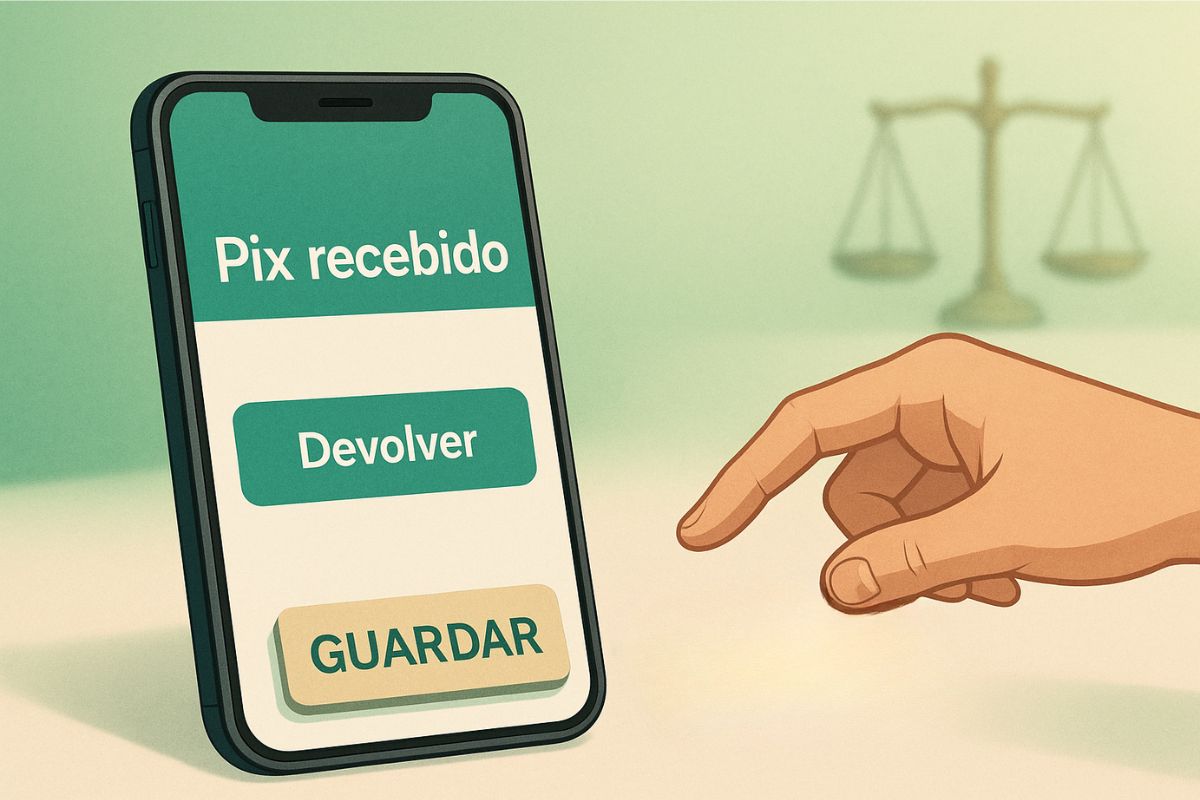
The right way is simple. Use the return function of the Pix itself in your bank’s application. When you open the receipt for the received transfer, almost always the “return” button appears. This option sends the money back to the sender and leaves a clear record that you acted in good faith.
Avoid returning it in other ways, such as a standard transfer or deposit. And, most importantly, don’t return it to a different key from the original. The return through Pix is the method that protects you and also the one who made the mistake.
Be Careful with the Wrong Pix Scam
This brings an important warning. There is a scam that is becoming increasingly common. It works like this: the scammer sends a Pix to you, then says it was a mistake and asks for the return. However, they ask you to return it to a different key, from another account. If you do this, they try to cancel the original Pix or contact the bank saying you participated in fraud. Result: you lose money.
Therefore, keep this rule in mind. Never return a Pix to an account different from the one that sent it. And never return it outside the system. The return should always be done through the official Pix button.
What If I Think It’s Fraud?
If something seems off, do not touch the money. Don’t use, transfer, or withdraw it. Contact your bank immediately. Explain what happened and ask for guidance. Banks have tools to analyze suspicious cases, and the Central Bank offers a mechanism called MED, used for return attempts when there are signs of fraud.
If you try to resolve it yourself through messaging, you might end up falling into a trap. The bank is the safest route.
How Much Time Do I Have to Return It?
The law doesn’t specify an exact timeframe, such as “24 hours” or “7 days”. What counts is good faith. The sooner you return it, the better. If the person delays, uses the money, or ignores the request, that can be interpreted as an intention to keep the amount. And then the risk of a problem increases.
Even if you’re trying to determine whether it was a real mistake or fraud, the ideal is to notify the bank right away. This already shows that you want to resolve it correctly.
The Safest Thing Is to Return It
Receiving a wrong Pix is not the end of the world. But choosing to keep it can lead to a big problem. You could face criminal charges and be sued to return the amount with interest. Not to mention the risk of falling for a scam if you act outside the official pathways.
In the end, the rule is simple. If a Pix that wasn’t meant for you comes in, don’t use it. Check and return it through the app. If you suspect fraud, talk to the bank. This way, you avoid stress, financial loss, and stay at ease.









-

Uma pessoa reagiu a isso.