Portuguese
  Spanish


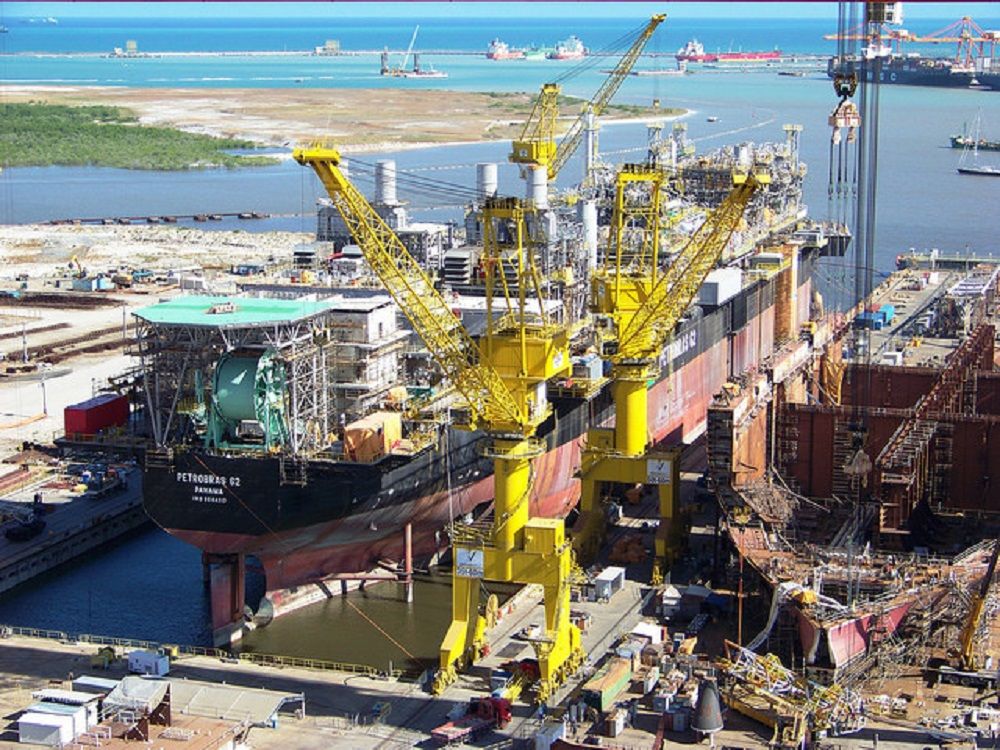

Despite the Lack of Orders from the Offshore Market, Shipyards Receive Orders for Ships and Shipbuilding Focuses on Opportunities That Will Arise in the Coming Years
Our century-old and once-lauded shipbuilding industry is gradually coming out of the “ICU” where it was “breathing with the help of machines.” After financing was approved and granted to the Enseada Shipyard in Maragogipe (BA), optimism is slowly returning to the entire shipbuilding sector.
Check the Contracts Obtained and Negotiations of Each Shipyard
Enseada, Maragogipe (BA)
Will build 2 container ships of 2,000 tons for Petrocity Portos S. The financing was approved by the National Merchant Marine Fund last July and amounted to R$ 617 million for both vessels. The expectation is to generate 750 direct job positions, reaching 3,000 vacancies with indirect positions.
-
Abandoned Factory in Rio’s North Zone Becomes Urban Hazard with Standing Water and Debris

-
The U.S. Navy Conducts Submarine Tests in Idaho Lake to Detect Underwater Noises Hidden by the Ocean

-
British Factory Transitions from Mechanical Parts to Producing 420,000 Electric Power Units Annually, Supplying 70% of Ford’s Electric Cars Sold in Europe
-
France Launches Network to Recycle 20 Million Cookware Pieces by 2027, Accepting All Brands for Aluminum and Coating Separation


Oceana Shipyard, Itajaí (SC)
Will build 4 Tamandaré-class frigates for the Brazilian Navy and is undoubtedly the largest contract of this new phase of Brazilian shipbuilding. Estimated at R$ 6 billion, the contract has already progressed with the acquisition of the Itajaí shipyard by German Thyssenkrupp, and hiring for engineering detailing has already begun. It is estimated that two thousand workers will be hired and an additional 6,000 indirect jobs will be created in the naval cluster of Itajaí.
Negotiations at Brasfels Shipyards (RJ), Jurong (ES), ERG, and EBR (RS)
In terms of negotiations, we can mention high-probability projects, such as the resumption of the drill ships from Sete Brasil, sold to an investor group formed by Magni Partners and Mubadala, with construction halted at Brasfels Shipyards in Angra (RJ) and Jurong in Aracruz (ES), along with the few services in the offshore sector which are the modules MV-31 and MV-32 acquired by Brasfels (RJ) and EBR (RS).
We also highlight the negotiation between ECOVIX, the controller of the Rio Grande shipyard in Rio Grande (RS), and the Chilean group ASMAR for the construction of a polar ship for the Brazilian Navy that could generate 5,000 job vacancies in the southern naval hub.
Not to mention ongoing projects such as those at ICN shipyard in Itaguaí (RJ) that is building 4 conventional submarines and 1 nuclear submarine with a Metal Structure Factory installed on site.
As you can see, folks, work is happening at shipyards, not at the pace we would like and not generating jobs as before, but slowly the recovery of Brazilian shipbuilding is leaving all who depend on it optimistic.
By Renato Oliveira
Instagram: @Renatonavalnews
Youtube: Renatonavalnews
Linkedin: Renato Oliveira