





 Portuguese
  English
  Spanish
  3 min of reading
  1 comment


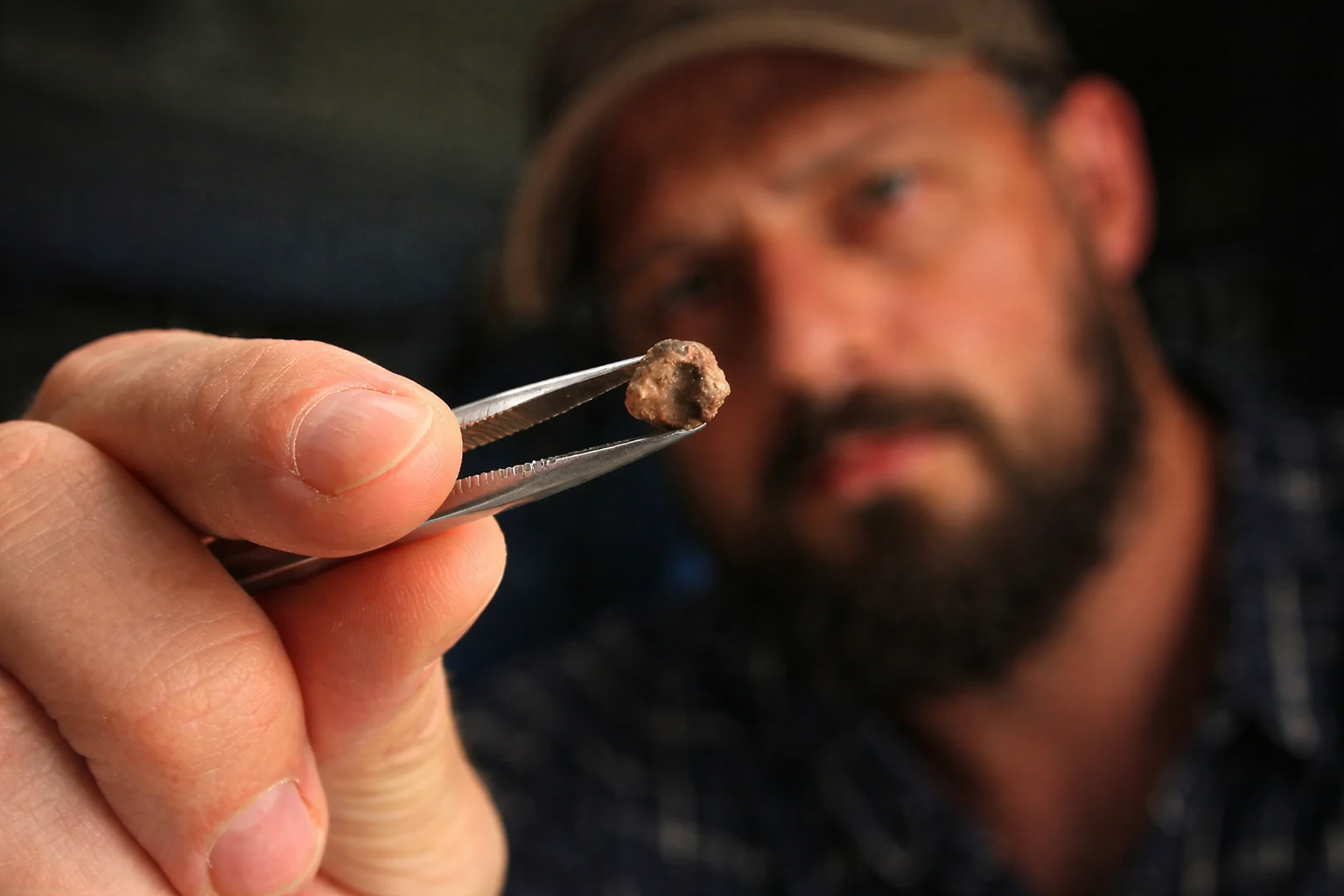


A Skull Smaller Than a Human Fingernail Revealed a New Species of Triassic Reptile in Southern Brazil and Expanded Understanding of Terrestrial Life 240 Million Years Ago
Right from the start, a microscopic finding caught the attention of paleontology. Researchers identified a fossilized skull measuring only 9.5 millimeters, smaller than a human fingernail, which revealed a new species of extinct reptile from the Middle Triassic, a period dated to about 240 million years ago. The fossil emerged in Novo Cabrais, in the interior of Rio Grande do Sul, and researchers from Federal University of Santa Maria conducted the analysis.
Published Study Reinforces International Relevance
In 2026, the team published the results in the scientific journal Scientific Reports. Even though it is extremely small, the skull preserves enough anatomical details to allow for the identification of a new animal for science, named Sauropia macrorhinus.
Smallest Tetradactyl of the Triassic Ever Recorded in the Region

Already, the finding stands out because it represents the smallest tetradactyl ever recorded in Triassic deposits of South America. Tetradactyls include vertebrates with four limbs, such as amphibians, reptiles, birds, and mammals. Thus, the fossil expands the record of small animals in a period known for the predominance of larger species.
-
INMET danger alert: heavy rains between the 3rd and 4th may drop up to 100 mm/day and winds of 60 to 100 km/h in several regions of Brazil require extra caution.

-
The parts crisis may bring back the drop notch and microSD in 2026; while Windows 11 promises to become lighter, leaks mention batteries of up to 10,000 mAh and 200 MP cameras.

-
In Kenya, engineer Nzambi Matee created “bricks 2.0” using packaging plastic: a mixture with sand, heated and pressed; they are 5 times more resistant, already have official licensing, and are being used in streets and construction projects.

-
More than 20,000 positions could be opened, and thousands of technicians are starting to be trained in Brazil, as the expansion of data centers creates an urgent race for professionals to keep the internet, cloud, and artificial intelligence running 24 hours a day.


Terrestrial Life After the Largest Extinction in History
Between 251 and 201 million years ago, terrestrial ecosystems were recovering from the largest mass extinction in Earth’s history, which occurred at the end of the Permian. At that time, the continents were still forming the supercontinent Pangaea, while large herbivores and predators that were not dinosaurs dominated terrestrial environments.
Appearance and Habits of the New Reptile
Even so, the new fossil shows that tiny organisms also integrated these ecological chains. Based on the size of the skull, researchers estimated that the Sauropia macrorhinus reached about 5 centimeters in total length. In life, the animal likely resembled a very small lizard, moving on four legs and with relatively large eyes.
Diet Indicated by Skull Anatomy
Moreover, proportionally wide nostrils and simple, straight, pin-like teeth indicate a diet based on insects and small invertebrates. This dietary pattern aligns with the behavior of small reptile species from the Triassic.
Advanced Technology Allowed Detailed Analysis
However, the small dimensions of the fossil posed significant technical challenges. The team manually cleaned the skull with needles, always under magnifying glasses. Even so, direct observation did not reveal all internal structures. Therefore, researchers applied high-resolution computed tomography and produced detailed three-dimensional models.
Surprising Evolutionary Classification
Based on the 3D models, scientists identified a unique set of anatomical features, absent in other known species. Thus, they confirmed the inclusion of the new reptile in the group Procolophonoidea, belonging to the lineage of parareptiles.
Rare Group Survived Mass Extinction
Parareptiles were neither dinosaurs nor pterosaurs. They formed a distinct lineage that evolved in parallel to these more well-known groups. According to paleontologist Rodrigo Temp Müller, the study’s leader, this group stands out for having survived the largest extinction in the history of life on Earth.
Ecological Role Helps Understand Food Chains
In the Middle Triassic of South America, procolophonoids appear rarely in the fossil record. Until now, researchers had described only two species for this time interval. The team also considers that the analyzed specimen represents a young individual, a hypothesis that inspired the name Sauropia, while macrorhinus refers directly to the large nostrils.
Small Reptile May Have Been Prey to Local Predators
Finally, the finding helps reconstruct the ecological relationships of the Triassic in Rio Grande do Sul. According to the study, the Sauropia macrorhinus likely formed part of the diet of small predators, such as Parvosuchus aurelioi, a reptile related to crocodiles recently described for the same region, clarifying who preyed on whom in the ecosystems of that remote period.








Gostaria de saber como esse fósil foi encontrado e identificado como tal. Sendo tao pequeno , somente gente especializada poderia reconhecer que se trata de um cerebro fossilizado.