





 Portuguese
  English
  Spanish
  4 min of reading
  0 comments


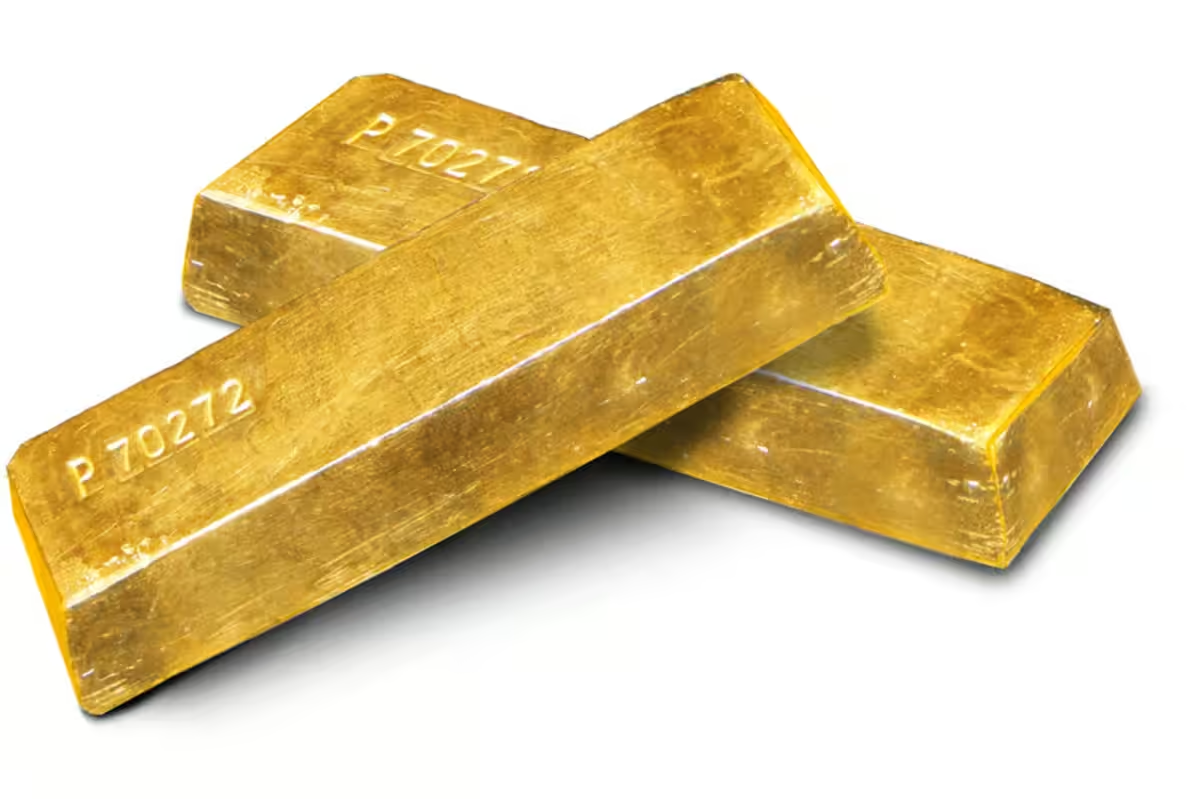
Study Reveals There Is Enough Gold in Earth’s Core to Cover the Entire Planet, but This Wealth Remains Beyond Human Reach
A group of scientists from the University of Göttingen in Germany made an impressive discovery. They identified what could be the world’s largest gold deposit.
According to the researchers, it is such a massive amount that it makes the famous Fort Knox vault look insignificant. According to data from the New Atlas portal, it represents 99.999% of all the precious metal on the planet. The problem? This gold is in the Earth’s core — inaccessible with current technology.
The Eternal Fascination with Gold
Gold has always occupied a special role in human history. From ancient empires to the modern financial market, it is a symbol of power, security, and wealth.
-
Archaeologists use satellite technology and find a mysterious structure of 500 m² buried up to 6 meters beneath an ancient city in Egypt.
-
Supercomputer calculates when humanity may disappear from Earth, predicts a scorching supercontinent, temperatures of up to 70 degrees, and a planet moving towards becoming uninhabitable.
-
INMET danger alert: heavy rains between the 3rd and 4th may drop up to 100 mm/day and winds of 60 to 100 km/h in several regions of Brazil require extra caution.
-
The parts crisis may bring back the drop notch and microSD in 2026; while Windows 11 promises to become lighter, leaks mention batteries of up to 10,000 mAh and 200 MP cameras.


Much more than a shiny metal, gold is seen as a means of freedom and protection. In the words of Ralph Waldo Emerson: “The desire for gold is not for gold. It is for means of freedom and benefit.”
This fascination is not just cultural. Gold has unique properties. It is easy to refine, resistant to corrosion, non-toxic, and solid at stable temperatures. Moreover, it conducts electricity and heat well. These characteristics make it a valuable resource both in industry and in the economy.
How Much Gold Has Been Extracted?
Since ancient times, humanity has extracted about 216,000 tons of gold. This would create a solid cube measuring 22 meters on each side. Most of this gold is still in circulation, as it is nearly indestructible.
Much of what we use today may have been shaped thousands of years ago. Even so, it is still a small amount compared to what exists inside the planet.
This “known” gold doesn’t account for secret deposits, family heirlooms accumulated over generations, or hidden stocks. But all these collections together represent just a fraction of the gold existing in Earth’s core.
The Discovery in the Planet’s Core
The research led by the Göttingen team analyzed rocks from places like Hawaii, the Galápagos, Baffin Island, and the Reunion Islands. The scientists studied the isotopes of ruthenium and tungsten found in these formations. One result stood out: the unexpected presence of the ruthenium-100 isotope.
This discrepancy indicated something unusual. The rocks, according to experts, seemed to originate from the boundary between the Earth’s core and mantle. The conclusion was straightforward: part of the core material is migrating, albeit slowly, to more accessible regions.
Gold Can Rise to the Surface
Gold, like other heavy metals, concentrates in the Earth’s core. This occurred during the formation of the planet, about 4.5 billion years ago. Gold is a “siderophile” element — meaning it likes iron — and ended up joining with it, sinking into the depths of the Earth.
But there is a process underway. The research suggests that elements like gold are not completely trapped in the center of the planet.
They slowly move through thermal plumes. These currents carry materials from the core to the mantle and, eventually, to the crust, through volcanic activity.
According to the gathered data, there is enough gold in the core to cover the entire Earth’s surface with a layer of almost half a meter in depth. But for now, this wealth remains beyond human reach.
An Alternative Plan: Asteroids
For those who do not want to wait millions of years for gold to rise to the crust, there is another way: space. Some asteroids are composed of high levels of precious metals. One of the most famous is Psyche, which contains so many mineral resources that its theoretical value reaches US$ 10,000 quadrillion.
Unlike Earth, these celestial bodies do not have a dense core covering the gold. This makes them potential sources for space mining in the future.
The Inaccessible Value of a Real Treasure
The discovery made by the University of Göttingen sheds new light on the hidden resources in the center of the planet. Although we cannot reach them now, knowing there is so much gold down there transforms the way we understand the geology of the Earth — and the potential hidden beneath our feet.
For now, the world’s largest gold deposit remains untouched, but the data obtained reinforces the idea that the planet still holds many secrets. And, perhaps, this gold that seems unattainable today may one day come to light — even if it takes several hundred million years.
With information from New Atlas.






Seja o primeiro a reagir!