





 Portuguese
  English
  Spanish
  4 min of reading
  2 comments


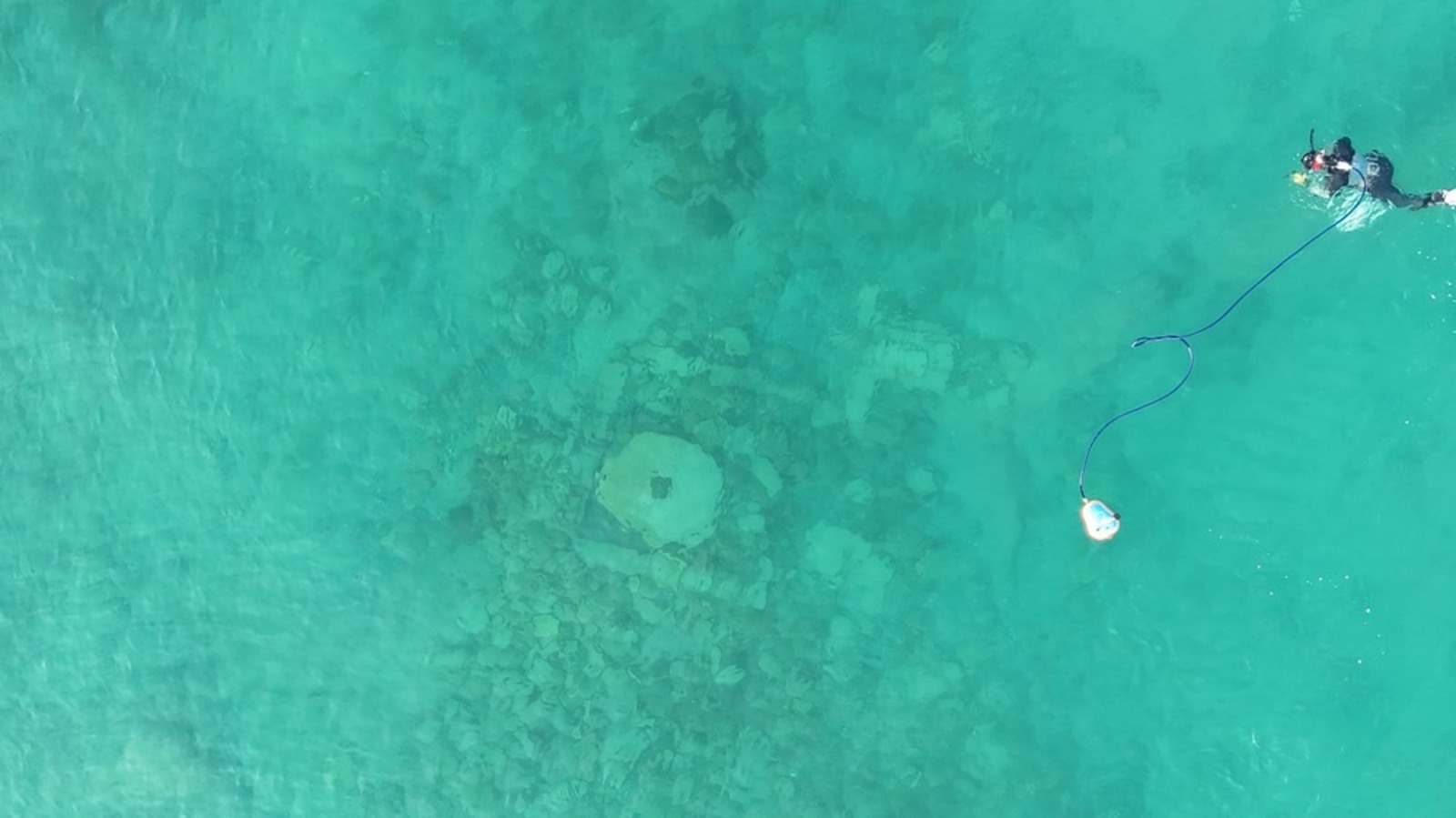


Archaeological Exploration in Issyk-Kul Lake Reveals Submerged Medieval Complex and Expands Evidence of Ancient Settlement That Thrived Between the 10th and 13th Centuries in Central Asia
An archaeological study conducted in 2025 identified new remains of a submerged medieval settlement in Issyk-Kul Lake, Kyrgyzstan. The research on the submerged city utilized underwater robots to map ancient structures, expanding knowledge about a complex that sank around the 15th century.
Initial Mapping of the Submerged City in Issyk-Kul Lake
The first phase of the expedition took place in July and was part of the celebrations for the 200th anniversary of explorer P. P. Semenov-Tyan-Shansky.
During this phase, archaeologists tested an underwater robotic system to investigate the submerged city located at the bottom of Issyk-Kul Lake.
-
The robust smartphone from Oukitel comes with a 20,000 mAh battery, satellite communication, walkie-talkie, and thermal camera to tackle mountains, deserts, offshore platforms, and disaster zones in a single device designed for extreme operations.

-
Wastewater from steel and cement industries can capture 30 million tons of CO2 per year in a discovery that transforms a common industrial waste into a low-cost climate weapon, with technology already available and direct application in factories.
-
Extinct for over 100 years and considered one of the rarest birds in Brazil, a legendary species reappears in the Northeast, resumes breeding in the wild, and surprises researchers in 2026.
-
7,000-year-old bonfire in southern Israel reveals a rare scene from the past and uncovers ostrich eggs prepared by nomads in the desert.

Researchers from the Institute of Archaeology of the Russian Academy of Sciences and the B. Dzhamgerchinov Institute of History, Archaeology and Ethnology participated in the study.
The operation utilized the underwater vehicle Trioniks-6M connected to the hydroacoustic positioning system RWLT.
The technological setup was guided by geopositioning buoys that allowed continuous real-time monitoring of the robot.
This eliminated blind spots and ensured up to four hours of daily operation during the archaeological survey.
Throughout the exploration, approximately 20,000 m² of the lake’s bottom was analyzed. The mapping revealed remains of a medieval brick structure that included a millstone.


Digitization of Historical Remains and Archaeological Records
During the same scientific campaign, researchers also located submerged tree bases and marked points for sample collection. These materials will be analyzed in future research related to the submerged city.
Meanwhile, another team worked on digitizing the petroglyphs located near the village of Ornok, on the northern shore of Issyk-Kul Lake.
The scientists produced an orthophotomap, photogrammetric models, and a Geographic Information System that compiles all data obtained during the activities.
According to a statement from the Institute of Archaeology of the Russian Academy of Sciences, this system could serve as a basis for future conservation efforts and for the creation of the first comprehensive digital replica of the archaeological monument located in the region.
Submerged Medieval Complex of Toru-Aygyr
Between September and early October, research focused on the submerged complex of Toru-Aygyr, located in the northwestern part of Issyk-Kul Lake.
This site contains remains of a large medieval settlement that thrived between the 10th and 13th centuries. The settlement eventually became submerged in the 15th century.
Researchers point out that tectonic events, environmental changes, or variations in lake levels may have contributed to the disappearance of this ancient submerged city.
At the first of the four sites investigated in Toru-Aygyr, where baked brick buildings are concentrated, the team expanded the photogrammetric model of the so-called Site 9.
During the work, a unique architectural brick element was recovered. The piece suggests the existence of an important public building that possibly had decorative elements.
Archaeological Discoveries and Medieval Necropolis
The second site explored revealed a Muslim necropolis dated between the 13th and 14th centuries. Currently, this area shows heavy erosion caused by the lake’s waters.
The graves occupy an estimated area of 300 × 200 meters. Some of them were exposed to the level of the skeletons.
The positioning of the bodies facing the city of Mecca confirms the Islamic funerary ritual. To prevent the complete destruction of the remains, two graves were removed for anthropological studies.
One of the graves belongs to a man and the other to a woman. Both will be analyzed in future research.
At the third site investigated, archaeologists found three graves that may have belonged to an older cemetery. Subsequently, new structures of the settlement were built over this space.
This finding indicates that land use changed over the centuries within the ancient submerged city.
Preserved Structures and Underwater Drilling
The fourth site explored is located in the western part of Toru-Aygyr and has shallow waters. This condition likely contributed to the preservation of several rectangular structures at the bottom of the lake.
At this location, archaeologists performed underwater drilling to obtain a stratigraphic column of the sediment.
The team collected samples from adobe walls and soil. These materials are expected to help reconstruct stages of occupation and construction techniques used in the ancient submerged city medieval.
According to researchers, the discoveries of 2025 reinforce the significance of Toru-Aygyr as one of the most important submerged archaeological complexes in Central Asia.
They state that each new excavation season reveals additional fragments of the preserved medieval past beneath the waters of Issyk-Kul Lake, allowing for a gradual reconstruction of the story of this ancient submerged settlement.
With information from Galileu Magazine.






Ótima reportagem. Lamentável não poder ver as imagens.
Na Terra há ainda muitos mistérios à ser desvendados.são bem comentados acontecimentos como Atlântida,sucumbida,Pompeia e Herculanoetc.sempre tive curiosidade em saber sobre esses fatos.e agora pra mim é novidade esse caso de cidades adormecida e sucumbida ISSYK-KUL noKuingstãol