





 Portuguese
  English
  Spanish
 3 min of reading


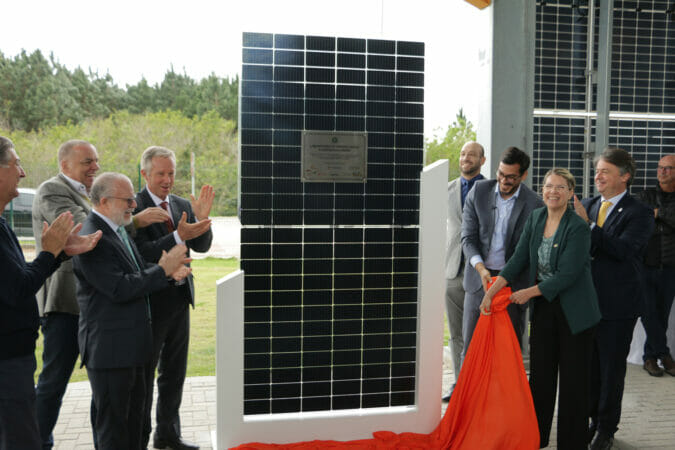
The Federal University of Santa Catarina (UFSC) Receives Its First Green Hydrogen Plant Capable of Generating 4.1 Nm3/h of Fuel of the Future.
The first green hydrogen plant is already operational at the Photovoltaic Laboratory of the Federal University of Santa Catarina (UFSC), at Sapiens Park, in Florianópolis. Green hydrogen is seen as the fuel of the future due to the sustainable way it is produced, coming from a renewable energy source, being an important precursor of the energy transition for being versatile and not emitting greenhouse gases.
Santa Catarina Is the Only State with a Framework for Addressing the Energy Transition
The Secretary of Science, Technology and Innovation, Marcelo Fett, who attended the inauguration, reminded that Governor Jorginho Mello recently announced important investments in infrastructure for electric mobility, and green hydrogen is one item that operates at the frontier of knowledge in the electricity sector.
According to Fett, Santa Catarina is the only state that has a legal framework specifically to address the energy transition. This subject is a priority for the government, which is working on developing a major energy transition program based on experiences like the green hydrogen plant at UFSC, which will contribute to the economic, social, and environmental advancement of Santa Catarina and Brazil.
-
Scientists create a “molecular sponge” that transforms dirty water and even water from the Dead Sea into potable water using only sunlight and without consuming any electrical energy.
-
Chinese company creates solar cell that breaks the physical limit of silicon with 34.85% efficiency and promises to revolutionize electricity bills with panels that generate 20% more energy starting in 2026.
-
For the first time in over half a century, humans have seen the Moon up close and returned to tell the tale, and the technology that brought them back makes Apollo look like a toy.

-
From 1969 to 1972, only 12 human beings set foot on the Moon, and then the world simply stopped going, until this week when NASA showed that the journey back has finally begun.

Partnerships in the energy sector with other countries, mainly Germany, are essential in the energy transition process. According to Professor Ricardo Ruther, coordinator of the Laboratory with a history of pioneering solar energy generation, partnerships with companies complete the financing model for scientific and technological research conducted in the laboratory and the training of qualified human resources. The technological showcase and technological and scientific development are the main activities carried out in this space.
Details About the Green Hydrogen Plant at UFSC
The plant has a maximum generation potential of 4.1 Nm3/h of green hydrogen and a maximum production of 1 kg/h of ammonia. The daily production of the green hydrogen plant at UFSC will depend on solar irradiation and, consequently, on the photovoltaic generation each day.
Both ammonia and green hydrogen play a crucial role in the decarbonization of the Amazon, as they are produced sustainably, aligned with global expectations for production and energy generation.
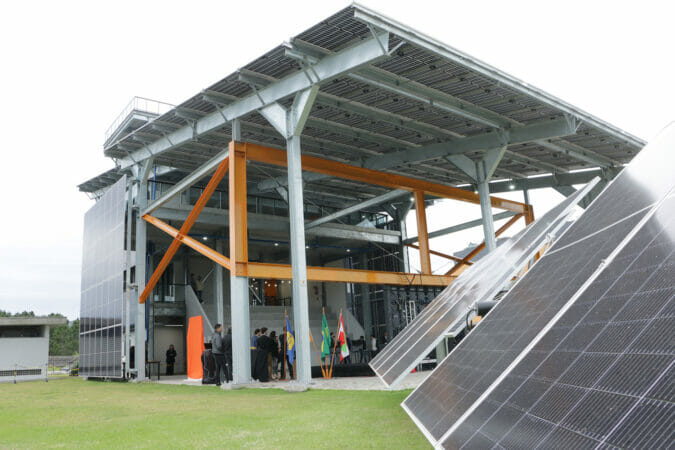
The space inaugurated in Santa Catarina includes laboratories on the lower floors, classrooms and research rooms on the upper floors, and a solarimetric station on the terrace, where it is possible to measure solar parameters.
Moreover, the solar panels are the roof and wall coverings, unlike the other two blocks of the UFSC laboratory, where they were installed on the roof. There is even an observation deck at the top of the building for viewing the equipment.
Green Hydrogen Plant Uses Pioneering Technology
The inauguration ceremony was attended by representatives from the Ministry of Mines and Energy (MME), the Minister-Counselor and Chief Sustainability Officer, Petra Schmidt, and representatives from Deutsche Gesellschaft für Internationale Zusammenarbeit (GIZ), a German company implementing cooperation projects in Brazil. Fábio Wagner Pinto, president of Fapesc, and Tarcísio Rosa, president of Celesc, also participated in the event.
Professor Ruther explains that green hydrogen is that obtained using a renewable energy source in the water electrolysis process that separates it from oxygen in that molecule. According to the professor, it is possible to use hydrogen to do various things, from using it in a fuel cell to converting it into electricity. Rockets, for example, are all powered by hydrogen.









Seja o primeiro a reagir!