





 Portuguese
  English
  Spanish
  2 min of reading
  0 comments


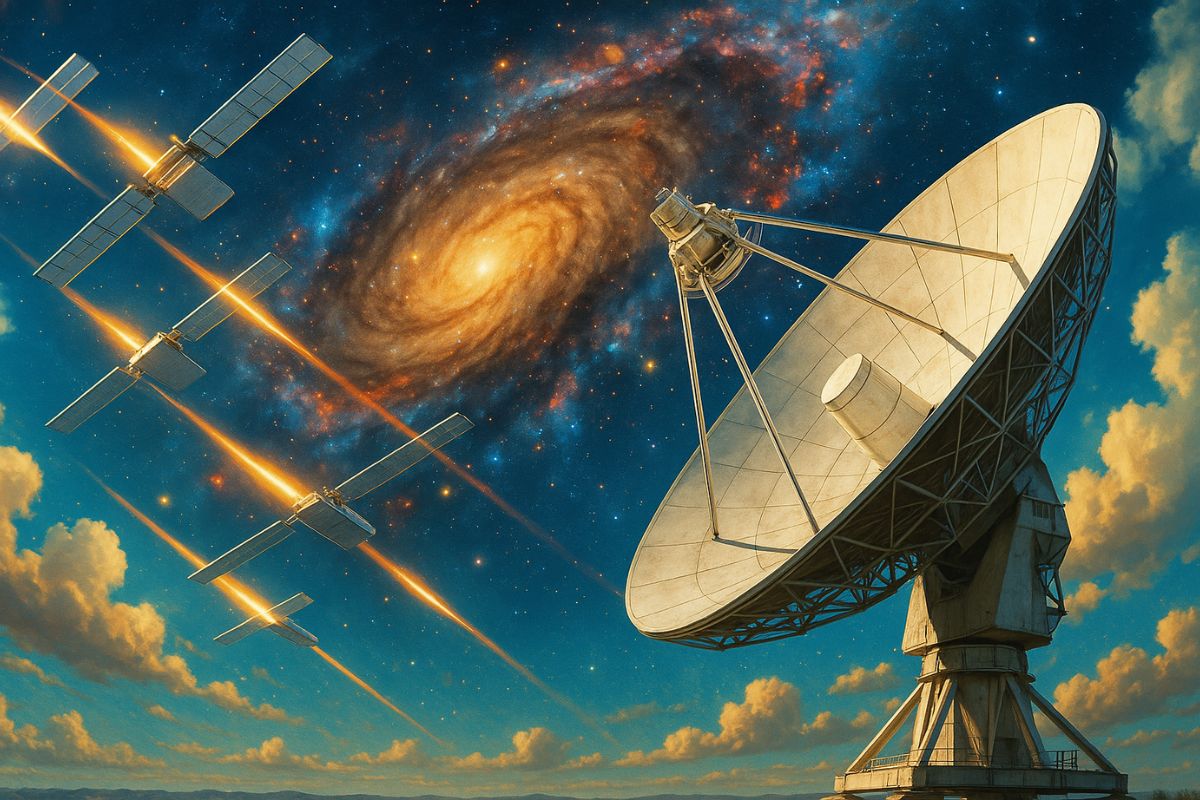
International Study Finds That Unintentional Emissions from Satellites Interfere with Radio Astronomy and May Compromise Discoveries About the Universe
Researchers from Curtin University in Australia claim that Starlink satellites are emitting unintentional radio signals that interfere with radio astronomy observations. The discovery was published in the journal Astronomy and Astrophysics and represents the largest study ever conducted on low-frequency emissions from satellites.
The survey was conducted by the International Center for Radio Astronomy Research (ICRAR) and analyzed data from over 1,800 Starlink satellites, part of a fleet that already exceeds 7,000 units in low orbit. According to the scientists, up to 30% of the astronomical images analyzed showed interference signals, making it difficult to capture extremely weak radio waves from deep space.
What the Study Found
The researchers detected 112,000 radio emissions coming from SpaceX satellites, many of which were in frequencies that should be protected for exclusive radio astronomy use. One example is the 150.8 MHz band, in which 703 satellites were identified transmitting signals, despite lacking authorization to use those bands.
-
Scientists have finally discovered where the plastic that disappeared from the oceans went, and the answer is frightening: it fragmented into such tiny particles that they became invisible and now there are 27 million tons of nanoplastic just in the North Atlantic.

-
The Artemis II mission will take the Orion capsule back to the vicinity of the Moon with four astronauts, a private bathroom with a curtain, a system adapted for men and women, and a level of comfort that highlights how the Apollo era operated at the rawest limits of space exploration.

-
Giant structures on the seabed precisely control oil and reveal how high-tech underwater valves work.

-
China has just tested a giant drone the size of a fighter jet with a wingspan of 25 meters that carries 6 tons, flies for 12 hours, and the most frightening part: it can launch entire swarms of smaller drones directly from the air.


The interference is not intentional but caused by leaks from onboard electronic components. This prevents astronomers from easily predicting or filtering out the noise during observations. The study leader, Dylan Grigg, emphasizes that Starlink was the main source of interference during the analyzed period, with 477 launches in just four months of data collection.
Why This Concerns Science
Radio astronomy relies on extremely quiet environments to capture subtle cosmic signals. These data are essential to answer fundamental questions about the formation of the first stars, the nature of dark matter, and the validity of theories such as Einstein’s.
Professor Steven Tingay notes that the future Square Kilometer Array (SKA) radio telescope, with structures in Australia and South Africa, will be the largest in the world and could transform our understanding of the Universe. However, to achieve this, any artificial interference must be minimized.
And SpaceX?
The researchers assert that SpaceX is not violating current regulations and maintains open dialogue to find solutions. Among the proposed discussions are technical adjustments to satellites and updates to international policies to protect frequency bands used by science.
The authors argue that it is possible to reconcile the benefits of global connectivity provided by constellations like Starlink with the preservation of scientific research, but for this, a balance between innovation and protection of the cosmos’ observation windows will be necessary.
And you, do you think satellite companies like Starlink should have stricter rules to avoid scientific interference? Or should the priority be to expand global access to the internet? Share your opinion in the comments.










Seja o primeiro a reagir!