






 Portuguese
  Spanish


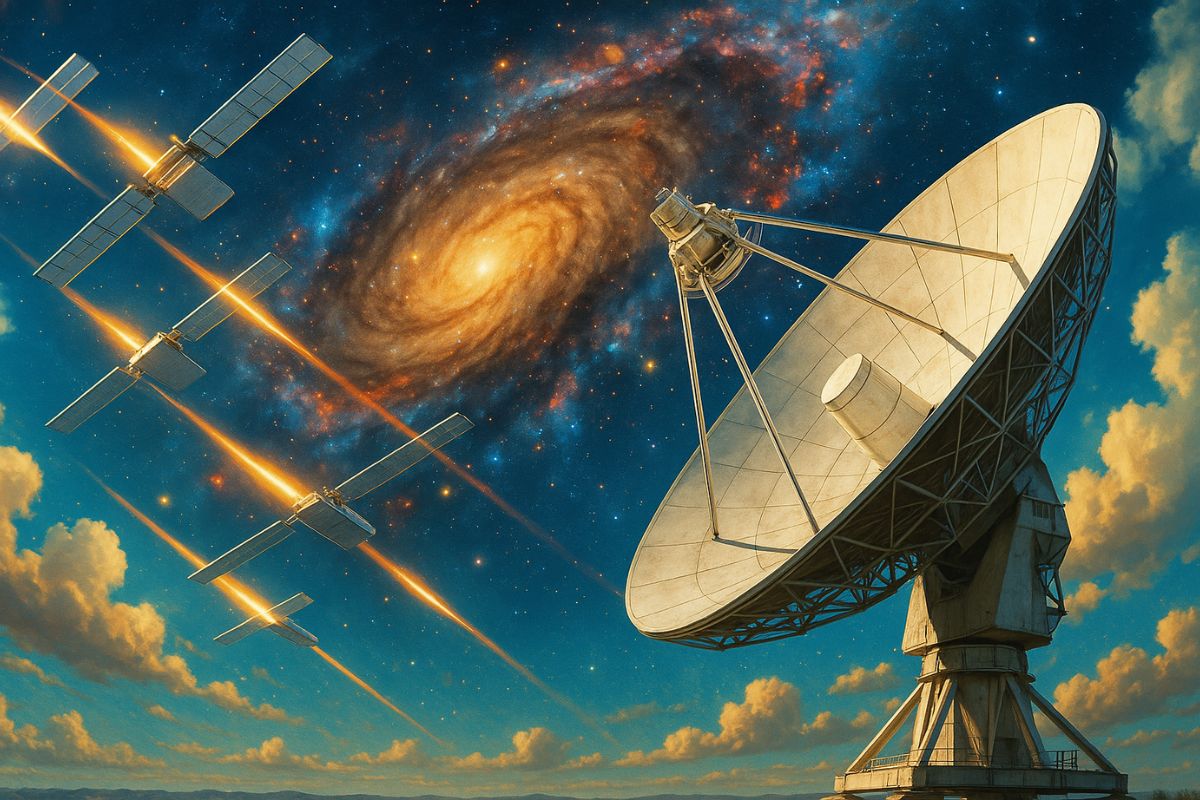

International Study Finds That Unintentional Emissions from Satellites Interfere with Radio Astronomy and May Compromise Discoveries About the Universe
Researchers from Curtin University in Australia claim that Starlink satellites are emitting unintentional radio signals that interfere with radio astronomy observations. The discovery was published in the journal Astronomy and Astrophysics and represents the largest study ever conducted on low-frequency emissions from satellites.
The survey was conducted by the International Center for Radio Astronomy Research (ICRAR) and analyzed data from over 1,800 Starlink satellites, part of a fleet that already exceeds 7,000 units in low orbit. According to the scientists, up to 30% of the astronomical images analyzed showed interference signals, making it difficult to capture extremely weak radio waves from deep space.
What the Study Found
The researchers detected 112,000 radio emissions coming from SpaceX satellites, many of which were in frequencies that should be protected for exclusive radio astronomy use. One example is the 150.8 MHz band, in which 703 satellites were identified transmitting signals, despite lacking authorization to use those bands.
-
Brazilian Students Transform Passion Fruit Peels into Moisture-Retaining Material, Compete at World’s Largest Science Fair

-
Brazilian Student Invents Low-Cost Rainwater Harvesting System Using Recycled Materials, Showcased at World’s Largest Science Fair

-
Italy Considers Next-Gen Nuclear Reactors for Warships, Aiming to Boost Naval Autonomy and Join Elite Maritime Powers

-
Extreme Heat in Antarctica Sets Record 15.4°C at Esperanza Base in June, Raising Concerns Among Scientists with Temperatures 20°C Above Normal, Rain Instead of Snow, and Unusual Melting Transforming the White Continent’s Landscape



The interference is not intentional but caused by leaks from onboard electronic components. This prevents astronomers from easily predicting or filtering out the noise during observations. The study leader, Dylan Grigg, emphasizes that Starlink was the main source of interference during the analyzed period, with 477 launches in just four months of data collection.
Why This Concerns Science
Radio astronomy relies on extremely quiet environments to capture subtle cosmic signals. These data are essential to answer fundamental questions about the formation of the first stars, the nature of dark matter, and the validity of theories such as Einstein’s.
Professor Steven Tingay notes that the future Square Kilometer Array (SKA) radio telescope, with structures in Australia and South Africa, will be the largest in the world and could transform our understanding of the Universe. However, to achieve this, any artificial interference must be minimized.
And SpaceX?
The researchers assert that SpaceX is not violating current regulations and maintains open dialogue to find solutions. Among the proposed discussions are technical adjustments to satellites and updates to international policies to protect frequency bands used by science.
The authors argue that it is possible to reconcile the benefits of global connectivity provided by constellations like Starlink with the preservation of scientific research, but for this, a balance between innovation and protection of the cosmos’ observation windows will be necessary.
And you, do you think satellite companies like Starlink should have stricter rules to avoid scientific interference? Or should the priority be to expand global access to the internet? Share your opinion in the comments.


