





 Portuguese
  English
  Spanish
  5 min of reading
  2 comments


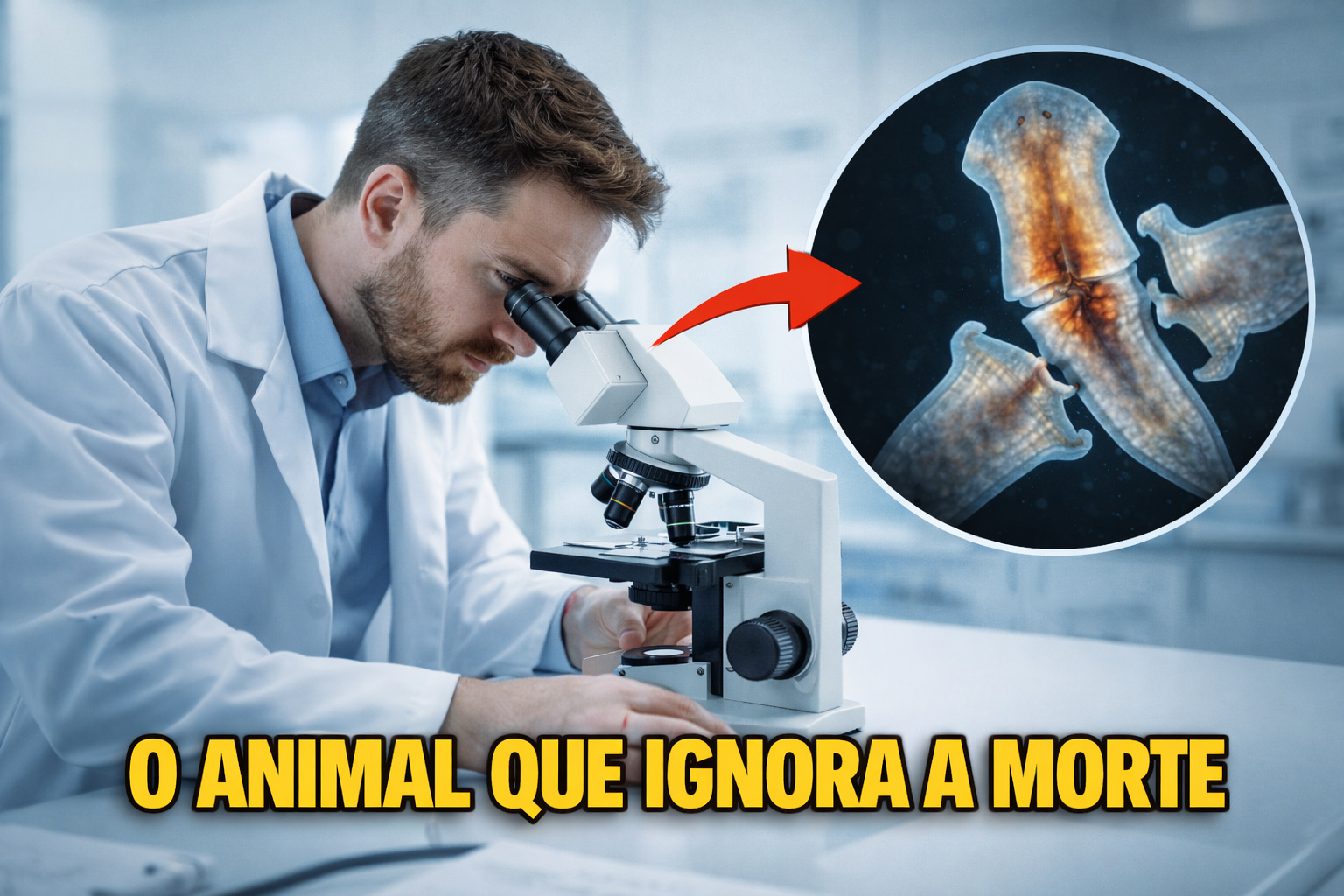


Capable of Regenerating Brain and Organs Indefinitely, the Planarian Schmidtea Mediterranea Challenges Aging and Became Key to Modern Biology.
The Schmidtea mediterranea, a small planarian a few centimeters long found in aquatic environments, is one of the most puzzling organisms ever studied by science. While most animals suffer irreversible wear over time, this species seems to completely ignore the rules of biological aging. It can have its body divided into multiple parts, and still, each fragment is capable of regenerating an entire, functional, and complete organism, including head, brain, nervous system, and internal organs.
What makes this phenomenon even more extraordinary is the fact that this process can be repeated countless times, without clear signs of progressive degeneration. For modern biology, the Schmidtea mediterranea is not just a curious animal but a true living paradox.
Complete Regeneration Redefines Known Limits of Animal Life
Regeneration is not something exclusive to planarians, but in Schmidtea mediterranea it reaches a level that borders on the unbelievable.
-
The reactors of the aircraft carrier Gerald R. Ford produce 600 megawatts and could power an entire city.

-
As if a faucet had been opened in the ocean, warm water begins to reach Antarctica, breaks through the natural protection of the ice shelves, and intrigues scientists about the upcoming impacts on the global climate.

-
3.5-billion-year-old rocks in Australia reveal that Earth’s crust was already moving early in the planet’s history, with displacement comparable to current plates, and indications that the process that creates mountains, oceans, and sustains life emerged hundreds of millions of years earlier than could previously be proven.

-
Mysterious green lights in the sky leave astronomers in search of answers





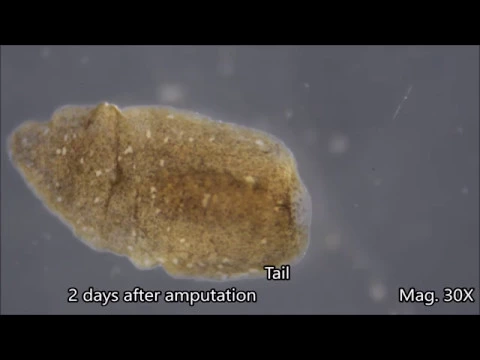
If the animal is cut transversely, the anterior part regenerates a complete new body, while the posterior part forms a new head, with functional brain, integrated nervous system, and normal behavior.


This process is not limited to simple tissues. Complex structures, such as neural circuits and internal organs, are reconstructed with impressive precision. After regeneration, the animal resumes feeding, moving, and responding to environmental stimuli as if it had never been injured.
Pluripotent Stem Cells Sustain Functional Immortality
At the core of this extreme ability is a special type of cell known as neoblast. These pluripotent stem cells represent a significant portion of the Schmidtea mediterranea’s body and have the capacity to differentiate into practically any necessary cell type.
Unlike human stem cells, which are rare, highly regulated, and lose efficiency over time, neoblasts remain active throughout the animal’s life. They continuously divide, replace damaged tissues, and maintain the organism in a constant state of renewal.
It is this virtually inexhaustible cell reservoir that allows the planarian to repeatedly regenerate entire organs without showing cumulative failures.
Reconstructing a Functional Brain Challenges Neuroscience
One of the most disturbing aspects of the biology of Schmidtea mediterranea is its ability to regenerate the brain.
After decapitation, a new brain is formed from scratch, with organized neurons, functional connections, and the ability to process information.
Experiments have shown that regenerated planarians recover learned behaviors, suggesting that aspects of memory may be distributed outside the central brain or be reconstituted in a way not yet fully understood. This phenomenon challenges classical concepts of neuroscience, which associate memory and identity exclusively with the original brain structure.
Almost Nonexistent Aging Breaks Traditional Biological Models
In most animals, aging is associated with the accumulation of cellular damage, telomere shortening, metabolic failures, and loss of regenerative capacity. The Schmidtea mediterranea seems to escape this fate.
Studies indicate that its cells maintain stable telomeres and efficient genetic repair mechanisms. In ideal laboratory conditions, some planarian lineages have been kept alive and regenerating for decades, showing no clear signs of senescence.
This has led many researchers to describe the species as biologically “immortal” — not in the sense of invulnerable, but in the fact that it does not present a clear internal limit to aging.
A Body Constantly in Controlled Reconstruction
Contrary to what it might seem, the planarian’s body is not in chaotic regeneration. The entire process is rigidly controlled by molecular signals and chemical gradients that instruct the cells exactly where to form head, tail, organs, and specific tissues.
Genes responsible for body orientation, symmetry, and spatial organization are activated in a coordinated manner. This ensures that even after repeated cuts, the animal always reconstructs the correct anatomy, avoiding deformations or structural failures.
This precision is one of the aspects that most intrigue developmental biology, as it demonstrates that the information about body shape is not located at a single point, but distributed in a systemic manner.
A Central Model for Regenerative Medicine
The Schmidtea mediterranea has become one of the main model organisms for the study of regeneration and stem cells. Research published in journals like Science uses the planarian to understand how tissues can be rebuilt without chronic inflammation, scarring, or functional loss.
These studies have direct implications for areas such as nerve regeneration, recovery from brain injuries, treatment of degenerative diseases, and even strategies to slow cellular aging in humans.
Although human biology is much more complex, understanding how the planarian maintains absolute control over its cells offers a valuable conceptual map for the future of medicine.
Identity, Memory, and What Defines an Individual
Perhaps the deepest question raised by the Schmidtea mediterranea is not just biological, but philosophical. If an animal can lose its head, regenerate a new brain, and continue living normally, what defines its identity? Where does the original individual end and another begin?
These questions have turned the planarian into a study object not only for biologists but also for neuroscientists and philosophers of the mind, interested in understanding how consciousness, memory, and identity may be more distributed than previously thought.
A Small Organism That Exposes the Limits of Human Science
The Schmidtea mediterranea shows that biological death, aging, and the inability to regenerate are not universal laws of life but specific evolutionary choices.
In a simple body, nature has demonstrated that it is possible to maintain continuous cellular renewal, reconstruct complex organs, and escape the deterioration associated with time.
By studying this seemingly insignificant planarian, science confronts an uncomfortable truth: many of the limits we believe to be inevitable may, in fact, be merely limits of our own body — and of our current understanding of life.


A Lula perdeu um dedo e parte do cérebro
Não regenerou
Mas se tornou presidente de uma nação
Devia ser estudado também
7 dias para regeneração total ! Sugestivo, não?