






 Portuguese
  Spanish
  4 min of reading
  2 comments


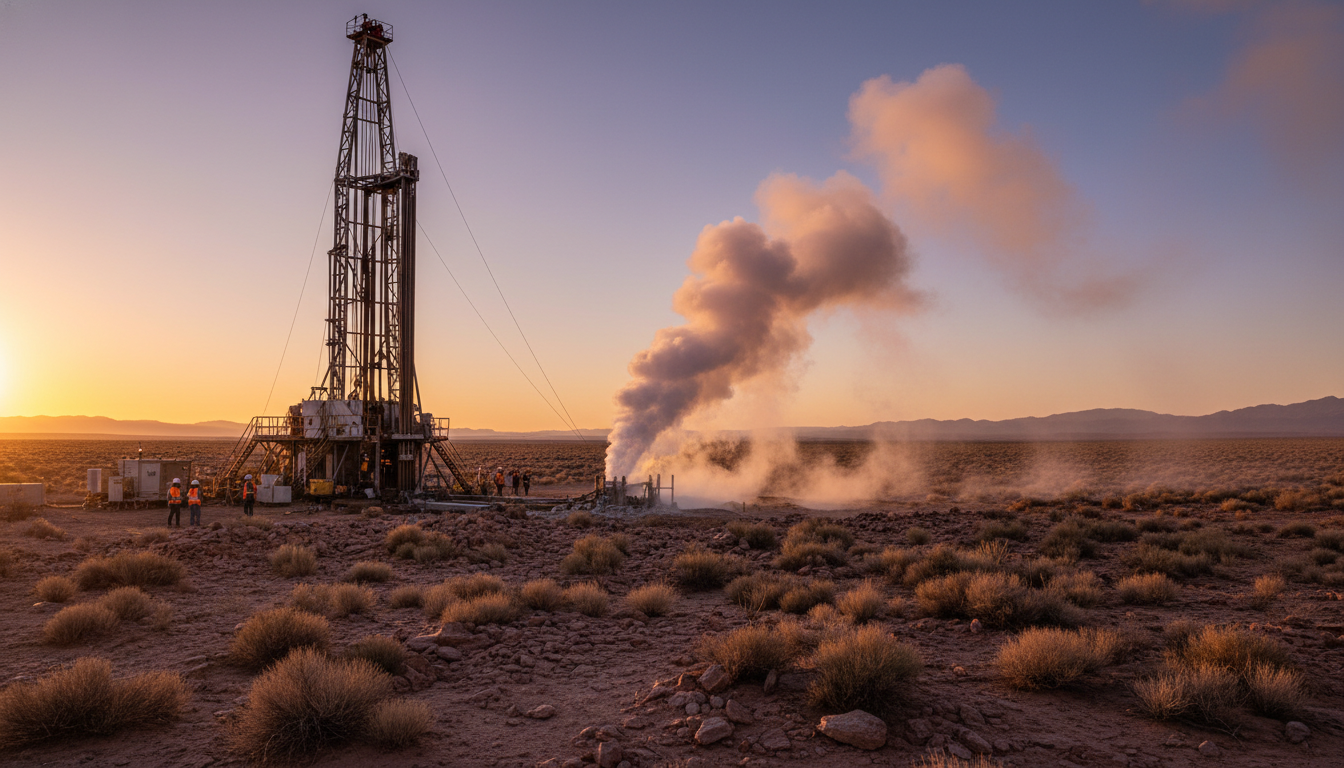


A company that used oil fracking techniques drilled more than 4 kilometers into rock in the Utah desert and found 290 degrees Celsius heat — now it’s building the world’s first new-generation commercial geothermal power plant
Fervo Energy, an American startup founded by petroleum engineers, has just reached the hottest well in its history: 555°F (291°C) at approximately 3,400 meters deep in the Utah desert.
According to Fervo Energy, the exploratory well at the Blanford Project, in Millard County, Utah, was drilled in less than 11 days — a company record.
But the most important milestone is not the depth. It’s what comes next: Fervo is building Cape Station in the same state, which will be the world’s first commercial-scale enhanced geothermal system (EGS) power plant, with 100 MW of capacity connected to the grid by June 2026.
-
Brazilian scientists are simultaneously advancing two research projects on clean hydrogen and driving solutions that could transform the energy matrix, enhance industrial competitiveness, and accelerate large-scale emission reduction targets.

-
IEA reduces forecast for global oil demand in 2026 after impacts of the Middle East crisis
-
Advancement in renewable energy: A R$ 150 million project launched by Petrobras and Finep aims to create state-of-the-art electrolyzers for green hydrogen, strengthening national research and preparing Brazil to compete in a billion-dollar energy market.
-
Bank of Japan raises interest rates to 1%, reaching the highest level in over three decades





It’s proof that the Earth’s infinite heat can compete with solar, wind, and natural gas — 24 hours a day, without depending on sun or wind.
What is enhanced geothermal — and why it’s different from everything that existed before
Traditional geothermal relies on natural underground hot water reservoirs. These are rare. They only exist in places like Iceland, Kenya, or northern California, where the Earth’s heat is close to the surface.
Enhanced Geothermal Systems (EGS) solve this limitation. Instead of searching for hot water, engineers create the reservoir.
They drill into hot, dry rock kilometers deep. They inject water under pressure to open fractures in the rock. The water circulates through the fractures, absorbs the heat, and returns to the surface as steam, which spins a turbine.
It’s the same hydraulic fracturing technique used in oil — but instead of extracting oil, it extracts heat.
The crucial difference: the Earth’s heat doesn’t run out. As long as there’s a planet, there will be heat a few kilometers deep. It’s renewable energy in the most literal sense.

From 365°F to 555°F: how Fervo is heating up faster and faster
Fervo’s trajectory shows an impressive escalation of temperatures:
- Red Project (Nevada): 365°F (185°C) — first commercial test
- Cape Station (Utah): 400°F (204°C) — 100 MW plant under construction
- Blanford Project (Utah): 555°F (291°C) — company record, February 2026
Fervo’s deepest well so far reached 15,765 feet (4,806 meters) at Cape Station, with a projected temperature of 500°F (260°C).
Every advance in depth and temperature increases generation efficiency. The hotter the rock, the more steam, the more energy per well drilled.
Cape Station: 100 MW by June 2026 — and 400 MW by 2028
The first phase of Cape Station, in Beaver County, Utah, is scheduled to connect 100 MW to the grid by June 2026. It will be the world’s first commercial EGS at utility scale.
Expansion to 400 MW is planned for 2028. When complete, Cape Station will generate enough energy for hundreds of thousands of homes — with no emissions, no fuel, no intermittency.
The plant operates 24 hours a day, 365 days a year. Unlike solar and wind, it does not depend on weather conditions. Unlike nuclear, it produces no radioactive waste.

US$ 421 million and unicorn status: Wall Street bets on geothermal
Fervo Energy raised US$ 421 million in non-recourse debt for Cape Station — the largest financing ever secured by an enhanced geothermal company.
The company achieved unicorn valuation (above US$ 1 billion) after investment rounds led by Google and Breakthrough Energy Ventures (Bill Gates’ fund).
The superconducting magnets from partner company Commonwealth Fusion Systems, which operate at 20 Tesla — 40 times stronger than a hospital MRI — are also being tested for future ultra-deep geothermal applications.
From oil to heat: the transition that makes sense
Fervo was founded by people who spent their careers drilling oil wells. They brought everything the O&G industry learned in 100 years to geothermal: directional drilling, hydraulic fracturing, downhole sensors, and field logistics.
The irony is powerful. The same techniques that extracted billions of barrels of oil — and contributed to climate change — are now being used to generate infinite clean energy.
For oil sector workers facing the decline of fossil fuels, enhanced geothermal offers a natural transition: same skills, same equipment, different purpose.

Challenges that enhanced geothermal still needs to overcome
Despite the enthusiasm, EGS is still a maturing technology.
Drilling 5 kilometers deep is expensive — much more than conventional wells. Every well that doesn’t find sufficient temperature is money lost.
Pressure-induced fracturing can cause microseisms. Although generally imperceptible, previous projects in Basel (Switzerland) and Pohang (South Korea) were canceled after tremors were felt by the population.
Scale is also a challenge. 100 MW is impressive for EGS, but small compared to a nuclear power plant (1,000 MW) or a large solar farm (500+ MW).
Still, if Cape Station works as planned, it will pave the way for hundreds of similar installations. Heat exists everywhere — you just have to dig deep enough.
The question the oil sector needs to answer: if the same drill that extracts oil can extract infinite clean energy, why keep drilling for oil?





Mobility, that petrol or gas provides for cars, is one reason. Unless EV can be made cheaper and more reliable.
Wann, that’s a great point. The energy transition depends heavily on making EVs more affordable and reliable for everyday use. Until then, oil and gas will remain essential for mobility — which is exactly why companies like the one in this article are exploring geothermal as a bridge between fossil fuels and clean energy. Thanks for reading!