






 Portuguese
  Spanish


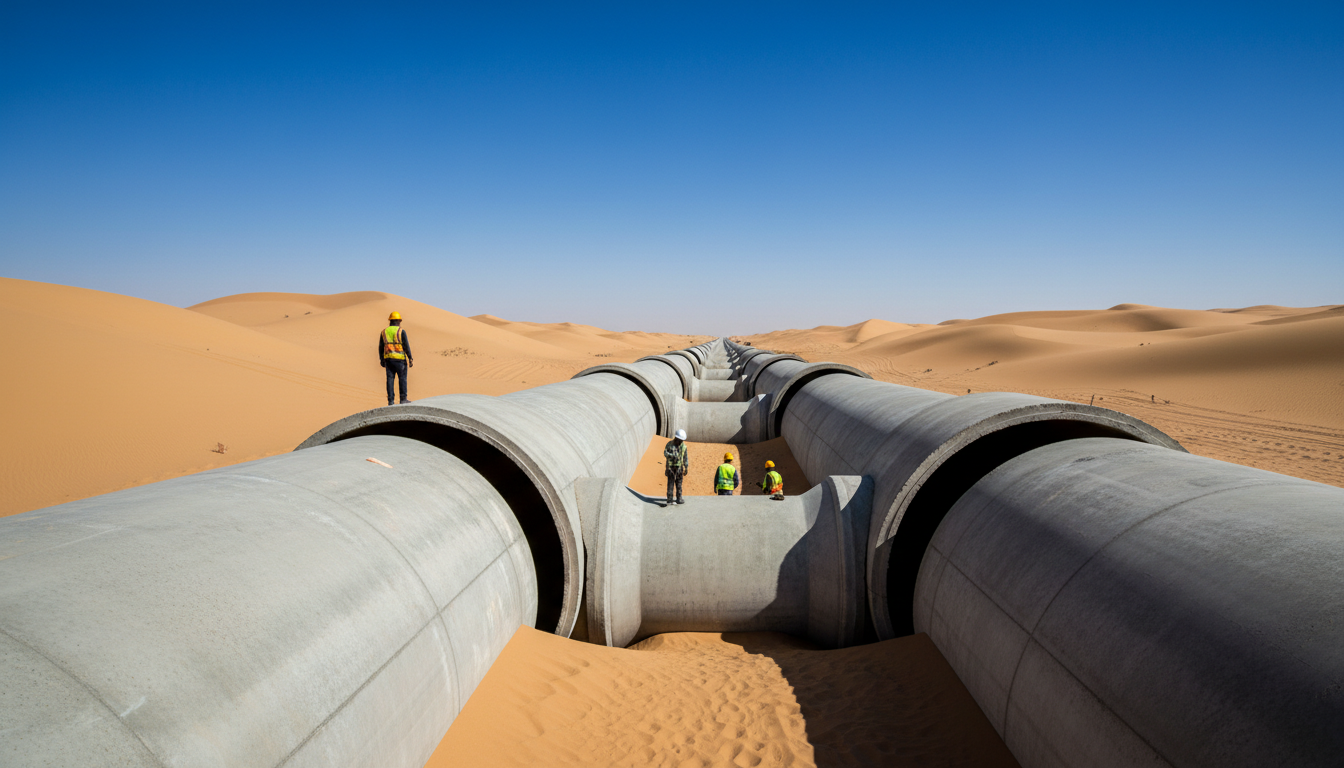


The Great Man-Made River is the planet’s largest irrigation project — 4,000 km of giant pipelines buried beneath the Sahara Desert, pumping water that fell as rain 40,000 years ago
In the early 1980s, Libyan leader Muammar Gaddafi announced what he called “the eighth wonder of the world”: an artificial river hidden beneath the planet’s largest desert. According to the Encyclopaedia Britannica, Libya’s Great Man-Made River is the largest irrigation project ever built by humanity.
The project consists of 4,000 kilometers of underground pipelines that transport fresh water from deep aquifers in the southern Sahara to the northern coastal cities, where millions of people live.
Furthermore, the water flowing through these pipes is not just any water. It is fossil water from the Nubian Sandstone Aquifer, accumulated during the last ice age — approximately 40,000 years ago.
-
Brazil’s Busiest Port to Triple Soybean Loading Speed with $1.1 Billion Investment in Paraná Terminal, Reaching 8,000 Tons per Hour

-
Lonely? This Chinese humanoid robot with soft skin and AI offers 24/7 conversation and stress detection.
-
Advanced Crash Test Dummies with Fake Bones and Organs Can Cost Up to $1 Million, Mostly Produced by U.S. Firm Humanetics

-
In a Los Angeles workshop in 1935, a man invented the peel-off label, laying the foundation for the world’s largest label manufacturer, now generating $8.8 billion and embedding chips in clothing.


In practice, Libya is drinking rain that fell when humans still shared the planet with Neanderthals.
The numbers that make this artificial river a project unparalleled in modern engineering

According to data compiled by Wikipedia based on official Libyan sources, the project was divided into five phases and involved figures that defy imagination.
The total projected cost exceeds US$ 25 billion. Therefore, we are talking about a project more expensive than the expanded Panama Canal.
At its maximum capacity, the artificial river can transport 6.5 million cubic meters of water per day. To give you an idea, this volume would be enough to fill 2,600 Olympic swimming pools every 24 hours.
Moreover, each pre-cast concrete pipe has a 4-meter diameter — wide enough for a car to drive through.
The first phase of the project required the excavation of 85 million cubic meters of earth. Consequently, the volume of earth removed exceeds that of many of the world’s largest dams.
Most impressively, Libya financed all of this without international loans. The money came entirely from the country’s oil revenues.
The water comes from an underground ocean hidden beneath four African countries

The Nubian Sandstone Aquifer is one of the largest underground water reservoirs in the world. In fact, it extends beneath four countries: Libya, Egypt, Chad, and Sudan.
According to geologists, this water accumulated during periods when the Sahara was a green savanna, with rivers, lakes, and abundant vegetation. Just as oil is a fossil fuel, this water is a fossil resource — it is not being replenished by current rainfall.
This means that, technically, Libya’s artificial river is consuming a finite resource. In this sense, scientists estimate that the aquifer could last between 60 and 100 years at the current extraction rate.
However, other researchers warn that depletion could be faster if neighboring countries also increase their extractions.
A project that took decades — and transformed the desert into farms
Construction of the artificial river began in 1984 and spanned over two decades. The first phase, which brought water to the city of Benghazi in eastern Libya, became operational in August 1991.
Subsequently, the second phase connected the system to the capital Tripoli in September 1996. In turn, subsequent phases expanded the network to cover practically the entire inhabited coastal strip of the country.
The impact on agriculture was immediate. Desert areas that had never seen irrigation began to produce wheat, barley, and fruits.
According to Libyan government reports, the project also supplied entire cities with potable water that previously depended on expensive desalination or imports.
To understand the scale, the 1,300 wells that feed the system reach depths between 500 and 800 meters below the desert surface.
The civil war almost destroyed the artificial river — and millions were left without water
Despite this, the system faced its biggest crisis during the Second Libyan Civil War, between 2014 and 2020. Fighting damaged pipelines, pumping stations, and collection wells.
According to reports from Interesting Engineering, 101 of the 479 wells in the western system had been dismantled by July 2019.
In comparison, imagine if more than 20% of São Paulo’s water treatment plants stopped working at once. Still, the system continued to operate partially thanks to the redundancy designed by engineers in the 1980s.
Even with the damage, the artificial river remains the main source of fresh water for most of Libya’s 7 million inhabitants. Therefore, the reconstruction of damaged sections has become a national priority.
While the world builds desalination plants, Libya opted for a solution that doesn’t need electricity

One of the most notable features of the artificial river is that it operates partially by gravity. The aquifers in the south are at a higher altitude than the coastal cities in the north. Therefore, part of the water flows naturally through the pipes without needing electric pumps.
In other words, while countries like Jordan and Saudi Arabia spend billions on desalination plants that consume enormous energy, Libya built a system that takes advantage of natural topography.
Similarly, water diversion projects like the São Francisco River in Brazil — which moves water for 477 kilometers — seem modest compared to Libya’s 4,000 kilometers.
The difference is that the Brazilian diversion takes river water, which is renewed by rain. Libya’s artificial river consumes a finite stock that will never be replenished.
The dilemma: Africa’s largest engineering project is drinking water that will run out
Mainly for this reason, the future of the Great Man-Made River is uncertain. Scientists debate whether the Nubian Aquifer can sustain current extraction for another 60 years — or if depletion will come sooner.
Equally concerning is the lack of investment in maintenance since Gaddafi’s fall in 2011. The system was designed to operate for decades but requires constant care with sealing, pumps, and wells.
Despite this, the artificial river remains one of the greatest demonstrations of civil engineering of the 20th century. In summary, it is a project that transformed a desert country into a place where people can live, farm, and drink potable water.
Should other nations with deserts and underground aquifers copy the Libyan model before the water runs out? Or should the world invest in renewable solutions, such as solar desalination, before projects like this become relics of an era that exhausted its resources?
Finally, the Great Man-Made River proves that humanity is capable of extraordinary works when there is will and resources. However, it also serves as a warning: even the greatest engineering in the world has an expiration date when the resource it exploits is not renewed.






Vilken styrka du visar
Detta ger mig så mycket hopp
Such an inspiring message shared here today! Love it