






 Portuguese
 Spanish


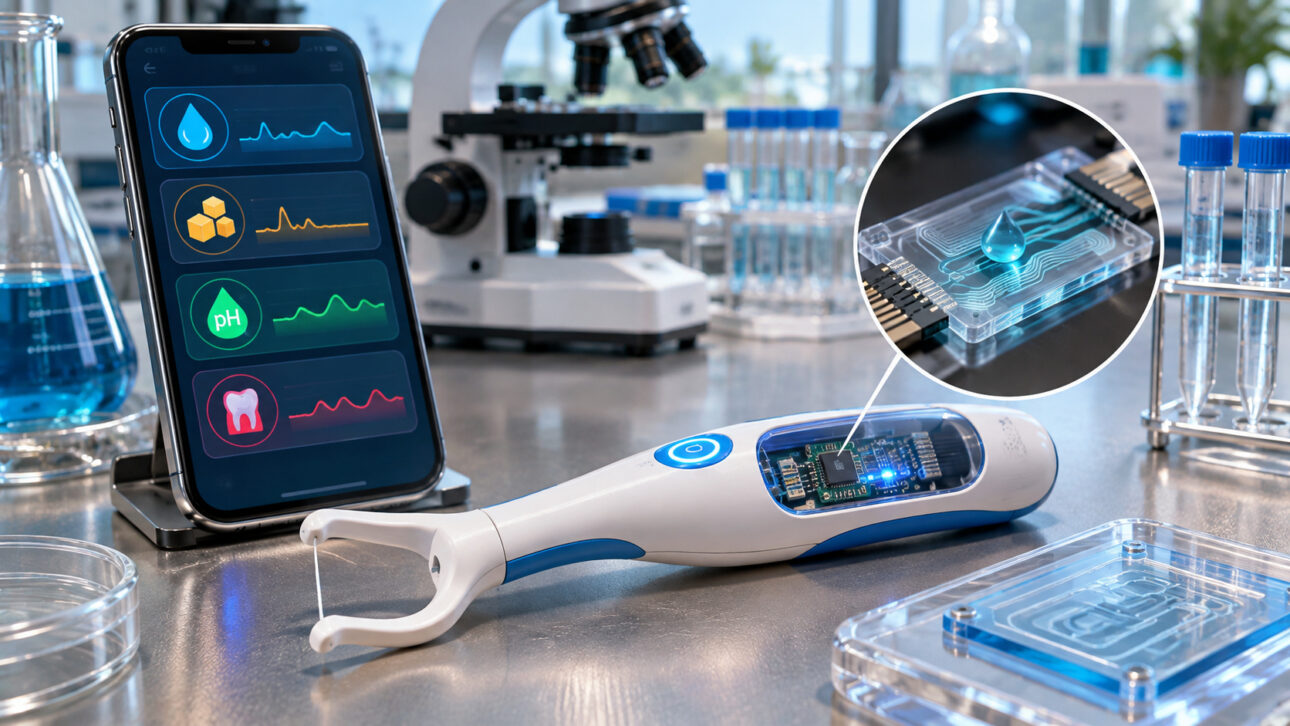

Developed by researchers at the Hong Kong University of Science and Technology, the device uses microscopic sensors to analyze fluid between the teeth and gums. The technology can identify four health indicators in just three minutes, without a blood draw, and showed promising results in tests with volunteers.
A smart floss that can measure glucose and uric acid in just three minutes was developed by researchers at the Hong Kong University of Science and Technology (HKUST) in China. The device uses microscopic sensors to analyze small amounts of fluid collected between the teeth and gums, turning a routine oral hygiene practice into an experimental health-monitoring tool.
The technology can track four different indicators: glucose, uric acid, pH and hydrogen peroxide. A microchip processes the results and sends them wirelessly to a smartphone, where users can view information related to metabolism and gum inflammation.
The discovery was presented in a study published on November 20, 2026, in the scientific journal Science Advances. The work attracted international attention after a report by ScienceAlert, published on November 19.
-
After 60 years of attempts, scientists accidentally discover three molecules once considered unstable, turn them into crystals at room temperature and open a new path for modern chemistry

-
After 174 years, scientists develop an algorithm that colors maps with just four colors, cuts processing time, and could speed solutions to complex computing problems
-
Physicist creates artificial black hole with 604 million bits, discovers information can escape simulated horizon
-
Scientists destroy ‘forever chemicals’ at just 110 °C, nearly ten times below incineration temperatures, opening a path to treating waste that contaminates water


The initial tests included healthy participants and people with diabetes, changes in uric acid levels and a range of oral health conditions.
The researchers found correlations between the floss measurements and blood test results. The device is still experimental and will require larger clinical studies before it could be used routinely.
How does the floss analyze health in three minutes?
The device was designed to collect a fluid little known outside dentistry: gingival crevicular fluid, found in the small space between the teeth and gums.
This fluid contains substances linked to both oral health and metabolic processes in the body.
The challenge is that the amount is usually extremely small, making it difficult to collect and analyze with conventional equipment.
To overcome this limitation, the scientists developed floss made of two pectin-coated fibers. Pectin is a natural substance also used in the food industry.
During about 20 seconds of use, the floss’s movement draws out a small amount of gingival fluid.
Surface tension traps the liquid between the fibers, forming a microscopic bridge.
After collection, a pulley mechanism draws the floss into a sealed chamber inside the device’s handle.
In this compartment, electrochemical sensors perform the analysis.
An electronic system measures the volume of liquid collected and adjusts the calculations to account for differences between samples.
The full process takes about three minutes, according to the Hong Kong University of Science and Technology, which officially introduced the device on November 19, 2026.
The information is transmitted to the phone wirelessly.
Sensors can identify four health-related indicators
The technology’s distinguishing feature is its ability to simultaneously analyze different substances in gingival fluid.
Each indicator provides specific information about the body.
| Indicator analyzed | What the researchers are investigating |
|---|---|
| Glucose | Relationship to blood sugar levels |
| Uric acid | Relationship to metabolic changes, including hyperuricemia |
| pH | Changes in the acidity of the gingival environment |
| Hydrogen peroxide (H₂O₂) | Signs associated with local inflammatory processes |
Glucose and uric acid were selected because they can provide important information about metabolic conditions.
Monitoring glucose is especially relevant for people with diabetes, while elevated uric acid levels may be associated with hyperuricemia and gout.
The pH and hydrogen peroxide indicators make it possible to investigate changes related to gingival inflammation.
This combination is an important feature of the project: the same device gathers information about oral health and systemic metabolic indicators.
The technology uses a layered microfluidic sensor structure, allowing it to analyze very small volumes of liquid.
The process also incorporates electronic corrections to improve measurement consistency.
Volunteer tests show correlation with blood tests
The researchers evaluated the device in studies involving human participants.
The volunteers included healthy people, people with diabetes, participants with elevated uric acid levels, and people with various gingival conditions.
The results showed significant correlations between the concentrations of certain substances in gingival fluid and in blood.
Preliminary test results
The researchers compared measurements from the smart floss with results from capillary blood samples.
Glucose: 0.89, a strong correlation.
Uric acid: 0.78, a positive correlation.
These values are Pearson correlation coefficients (r). The closer the value is to 1, the stronger the association between the measurements. The results are promising, but they do not yet show that the device can replace conventional clinical tests.
Data presented in the scientific study A floss-based platform for native gingival crevicular fluid analysis enables noninvasive systemic and oral health monitoring indicate that glucose measurements had a correlation of 0.89 with blood test results.
For uric acid, the coefficient was 0.78.
The researchers also found that changes in pH and hydrogen peroxide helped distinguish inflamed areas of the gums from healthy areas.
These results are significant because they show that fluid collected during oral hygiene can provide information related to different aspects of health.
Correlation, however, is only one of the steps required to validate a diagnostic method. Replacing conventional tests requires further assessments of accuracy, safety, and clinical performance.
Technology still faces challenges before reaching the market
The device showed promising results, but researchers identified factors that need to be improved.
One of the main challenges involves the composition of the collected fluid.
During the experiments, about half of the sample collected could contain saliva, which has different chemical properties from gingival fluid.
Small amounts of blood can also interfere with the measurements.
These factors call for further studies to determine how different oral conditions affect the device’s accuracy.
Researchers will also need to assess the repeatability of the results and how the sensors perform during everyday use.
Another important step will be to demonstrate that floss-based monitoring offers tangible benefits for patients who need to track metabolic conditions.
The research points to a possible way to complement traditional tests, especially in situations where frequent monitoring of certain indicators may be useful.
For now, people with diabetes should continue using the monitoring methods recommended by their health care providers.
University plans to expand testing and develop industrial-scale manufacturing
The research was led by Professor Hnin Yin Yin Nyein of HKUST’s Department of Chemical and Biological Engineering, with participation from researchers at the University of Hong Kong.
The team plans to conduct larger clinical studies to assess the device’s reliability and improve its suitability for home use.
Another goal is to develop large-scale manufacturing methods, including automated quality-control systems.
This step will be important in determining whether the sensors and microfluidic components can be produced at a cost that works for a device intended for frequent use.
The project also involves improving the user experience, so fluid can be collected as part of a routine similar to conventional flossing.
The advance points to a growing trend in medical technology: turning everyday activities into opportunities to collect health information.
In this case, the distinguishing feature is the integration of oral hygiene, electrochemical sensors and data transmission to mobile devices.
The next step will be to show that results from preliminary tests can be replicated in larger populations and under different conditions of use.
If these steps are successful, smart floss could become a complementary tool for metabolic and periodontal monitoring, bringing health tracking closer to an activity already part of the routine of millions of people.


