





 Portuguese
  English
  Spanish
  4 min of reading
  0 comments


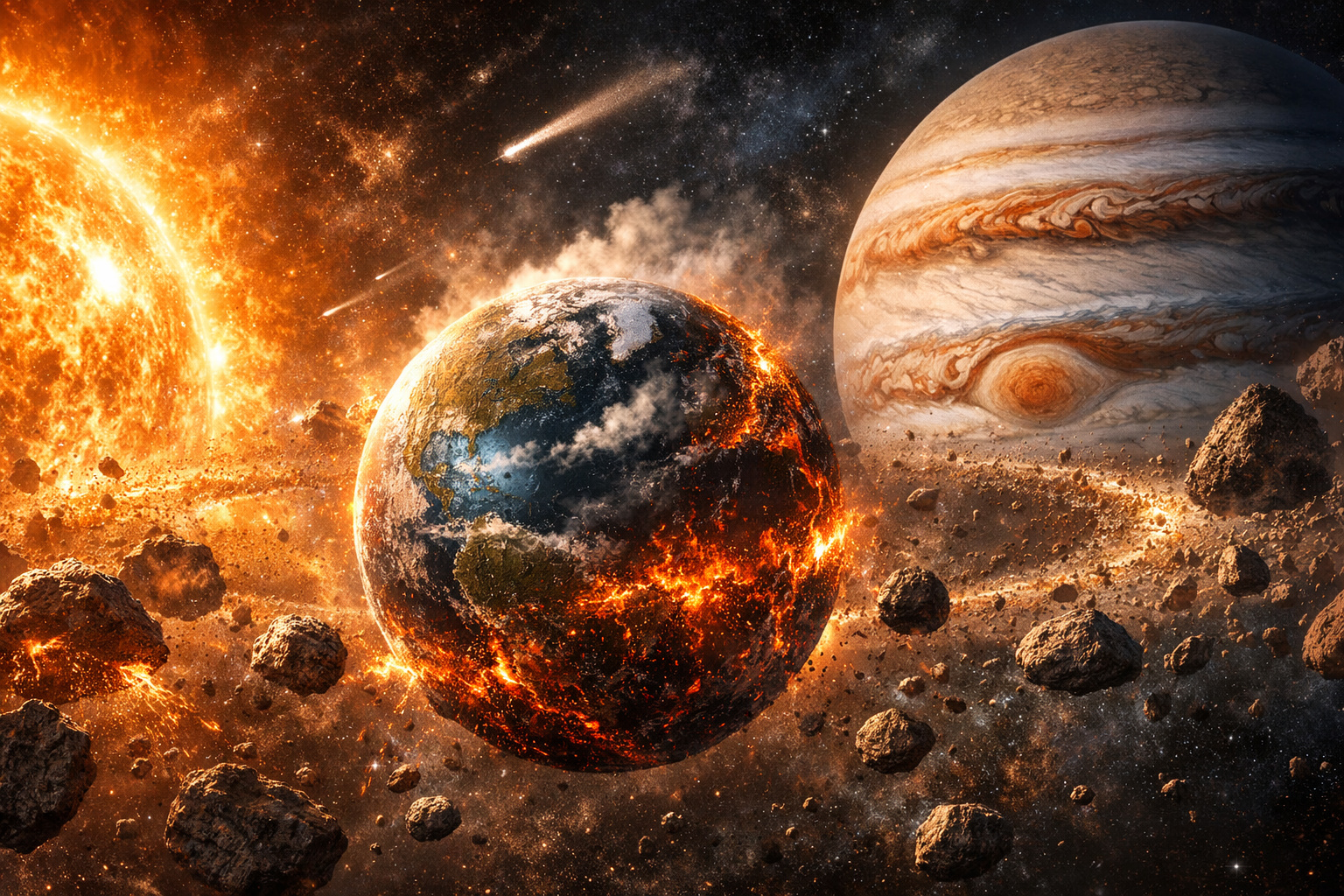
Study on the origin of Earth shows formation with local material, near the Sun, and brings direct impact on the understanding of water and energy on the planet
A new explanation about the origin of Earth has caught the attention of the scientific community and may change what many people have learned until now. The latest idea suggests that the planet may have formed almost entirely with material close to the Sun, without relying on parts coming from distant regions of space.
This changes the way we understand how water, minerals, and other materials important for energy and life originated on Earth. The discovery also opens up new research on how other planets may have formed in systems similar to ours.
Old theory about the formation of Earth loses strength
For many years, the most accepted explanation stated that Earth formed from a mixture. Most of it came from regions close to the Sun, but an important part was thought to be formed by materials from colder and more distant areas of the Solar System.
-
Brazilian beaches are among the most contaminated in the world by cigarette butts, with levels up to 40 times above the global average and areas where this waste already represents the majority of all the trash found.

-
2,000-Year-Old Machine Gun: Roman weapon found in Pompeii fires arrows at 109 m/s with an automatic gear mechanism, leaving perfect geometric patterns on the walls and proving its real use in the siege of 89 B.C.
-
Petrobras builds inverted bridge and the project becomes a tourist attraction: unique structure allows the river to flow over the road and replaced precarious crossings.

-
Archaeologists find in Egypt mummies with tongues made of gold buried over 2,000 years ago, a rare discovery surprises researchers and reveals an unusual funerary practice.



These cold regions are known to favor the formation of substances that evaporate easily, such as water. Therefore, the presence of these elements on Earth has always been used as an argument to explain the arrival of external material to the planet.
Now, the new analysis shows that this external contribution may be much smaller than previously thought, calling into question the need for this mixture to explain the formation of Earth.
Meteorites help reveal where the materials came from
To reach this conclusion, scientists studied meteorites, which are pieces of rocks from space. Some of these materials originate from Mars and from an asteroid known as Vesta, which helps compare different regions of the Solar System.
These rocks carry information called isotopes, which act as a kind of identification of the elements. This analysis allows us to discover whether two materials came from the same place or from different regions.
The results show that the composition of Earth is very similar to that of materials from the inner Solar System, reinforcing the idea that the planet formed almost entirely with local matter.
The findings were published by Nature Astronomy, an international scientific journal specialized in astronomy, which detailed the main results of the study.
Contribution of distant material is very small
The comparison of the data showed that the presence of material coming from external regions of the Solar System is extremely low. The numbers indicate that less than 2% of Earth may have originated from these more distant areas.
This result is important because it contradicts the idea that a significant part of the planet came from outside. Thus, the hypothesis grows that the materials necessary to form Earth were already available closer to the Sun.
Even so, there is still an important point to understand. The presence of water on Earth remains a factor that requires more studies to explain its origin completely.
Jupiter may have influenced the formation of Earth
One explanation for this scenario involves Jupiter, the largest planet in the Solar System. Its gravitational force is very intense and may have influenced the path of materials during the formation of the planets.
There is a possibility that Jupiter acted as a natural barrier. This would have prevented rocks and particles from more distant regions from reaching the area where Earth formed.
This hypothesis helps explain why most of the planet’s material seems to have local origins, without significant mixing with elements from other regions.
Nature Astronomy, the international scientific journal specialized in astronomy, also highlighted that this influence of Jupiter is still being analyzed in new studies.
Discovery impacts studies on energy and materials
Understanding the origin of Earth’s materials is not just a scientific curiosity. It also directly influences areas such as energy, mining, and the study of natural resources.
The way the elements formed and organized over time helps explain the presence of minerals, water, and other substances essential for life and human activities.
This new perspective may help researchers better understand how planets with characteristics similar to Earth arise, which also impacts studies on energy and space exploration.
Scientists are still seeking more complete answers
Despite the discovery providing a new explanation, the topic is still not fully settled. The researchers themselves indicate that new analyses will be conducted to better understand all the details involved.
One of the main questions is whether there was a sufficient amount of water and other elements in the inner region of the Solar System to form Earth as we know it today.
This scenario shows that science continues to evolve and that new discoveries may arise at any moment, expanding the understanding of the origin of Earth and its natural resources.
The new explanation reinforces the importance of continuing to investigate space and the materials that form planets.
Did you find this topic interesting? Leave your opinion in the comments and share it with others who enjoy science.









Seja o primeiro a reagir!