





 Portuguese
  English
  Spanish
  3 min of reading
  0 comments


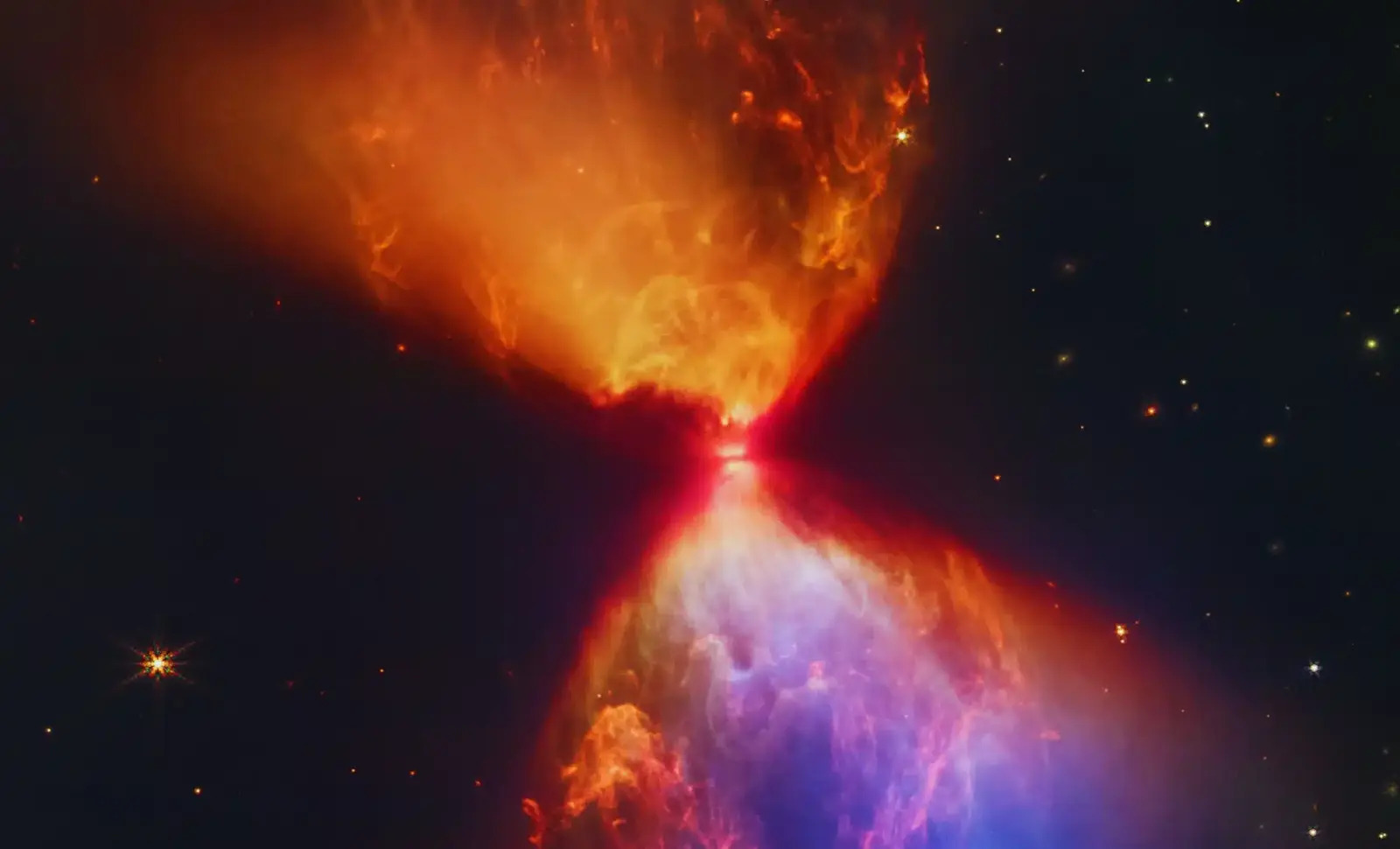
Observation of a protostar only 200 years old reveals bursts of gas and energy in the Taurus Cloud and may change models of star formation
A protostar about 200 years old has been observed ejecting gas and energy in bursts in the Taurus Molecular Cloud, 450 light-years from Earth, in behavior compared to a “sneeze” that could change the understanding of star formation.
Rare observation at the beginning of formation
The formation of stars remains one of the most persistent enigmas in astronomy. Scientists know that they arise in dense regions of gas and dust, where several solar masses collapse into a compact area smaller than 0.1 light-years.
What happens right after ignition is still poorly understood. This initial stage is difficult to observe because young stars are surrounded by thick protostellar disks, which block much of the light emitted during these early moments.
-
After being stalled for seven years in the desert, the 1 km skyscraper in Saudi Arabia has resumed construction, rising one floor every three days, and is now on track to surpass the Burj Khalifa by 2028.

-
Scientists create a “molecular sponge” that transforms dirty water and even water from the Dead Sea into potable water using only sunlight and without consuming any electrical energy.

-
Chinese company creates solar cell that breaks the physical limit of silicon with 34.85% efficiency and promises to revolutionize electricity bills with panels that generate 20% more energy starting in 2026.
-
For the first time in over half a century, humans have seen the Moon up close and returned to tell the tale, and the technology that brought them back makes Apollo look like a toy.
Therefore, researchers turned to the ALMA Observatory in Chile to study objects in the MC 27 region. The analyzed area is about 450 light-years from Earth and revealed new clues about this process.
Protostar is estimated to be 200 years old
The central object of the study drew attention for its extreme youth. While the Sun is about 4.6 billion years old, this protostar is thought to have formed only about 200 years ago, making it one of the youngest ever observed.
The findings were reported in The Astrophysical Journal Letters. The case is considered rare because most newborn stars studied by astronomers are already nearly 100,000 years old.
Here, the team was able to observe a protostar almost immediately after the ignition phase. This increases the chance of tracking phenomena that tend to disappear or change before being clearly recorded.
Professor Masahiro N. Machida from the Faculty of Science at Kyushu University highlighted ALMA’s role in this type of investigation. According to him, the radio telescope allows the identification of different materials present in stellar nurseries.

Hot ring suggests large-scale process
Using ALMA, researchers detected a defined gas ring. The structure extends approximately 1,000 astronomical units from the stellar object and appeared slightly warmer than the surrounding region.
Kazuki Tokuda from Kagawa University stated that this temperature difference suggests ongoing activity.
The hypothesis raised by the team is that the ring was produced by a magnetic field crossing the protostellar disk.
In the interpretation presented, this mechanism would be linked to the “sneezes” observed earlier, but now on a larger scale.
Previous observations by the same team had already revealed smaller structures, about 10 AU, associated with magnetic activity in the disk.
These earlier structures were interpreted as brief expulsions of energy. The newly observed ring seems to reflect a similar but broader process, reinforcing the idea that the protostar redistributes magnetic gas shortly after its birth.
Magnetic fields, shock, and redistribution
The main explanation involves the interaction between magnetic fields and the protostellar disk.
This encounter could generate shock waves capable of heating the surrounding gas and reorganizing matter and energy around the newborn star.
This process may help young stars release excess energy as they evolve. The hypothesis is still under investigation, and new observations with ALMA will be necessary to better examine the inner regions of these rings.
Machida stated that the team will continue gathering data to strengthen the hypothesis and encourage rigorous debates about the results.
He emphasized that the movement of gas in star formation is orderly but also very chaotic.
The researcher added that it took ten years to reach these conclusions.
Now, the group intends to continue studying the protostar to understand the origin of these bursts, these shock waves, and this unusual behavior.
With information from Daily Galaxy.







Seja o primeiro a reagir!