





 Portuguese
  English
  Spanish
  4 min of reading
  0 comments


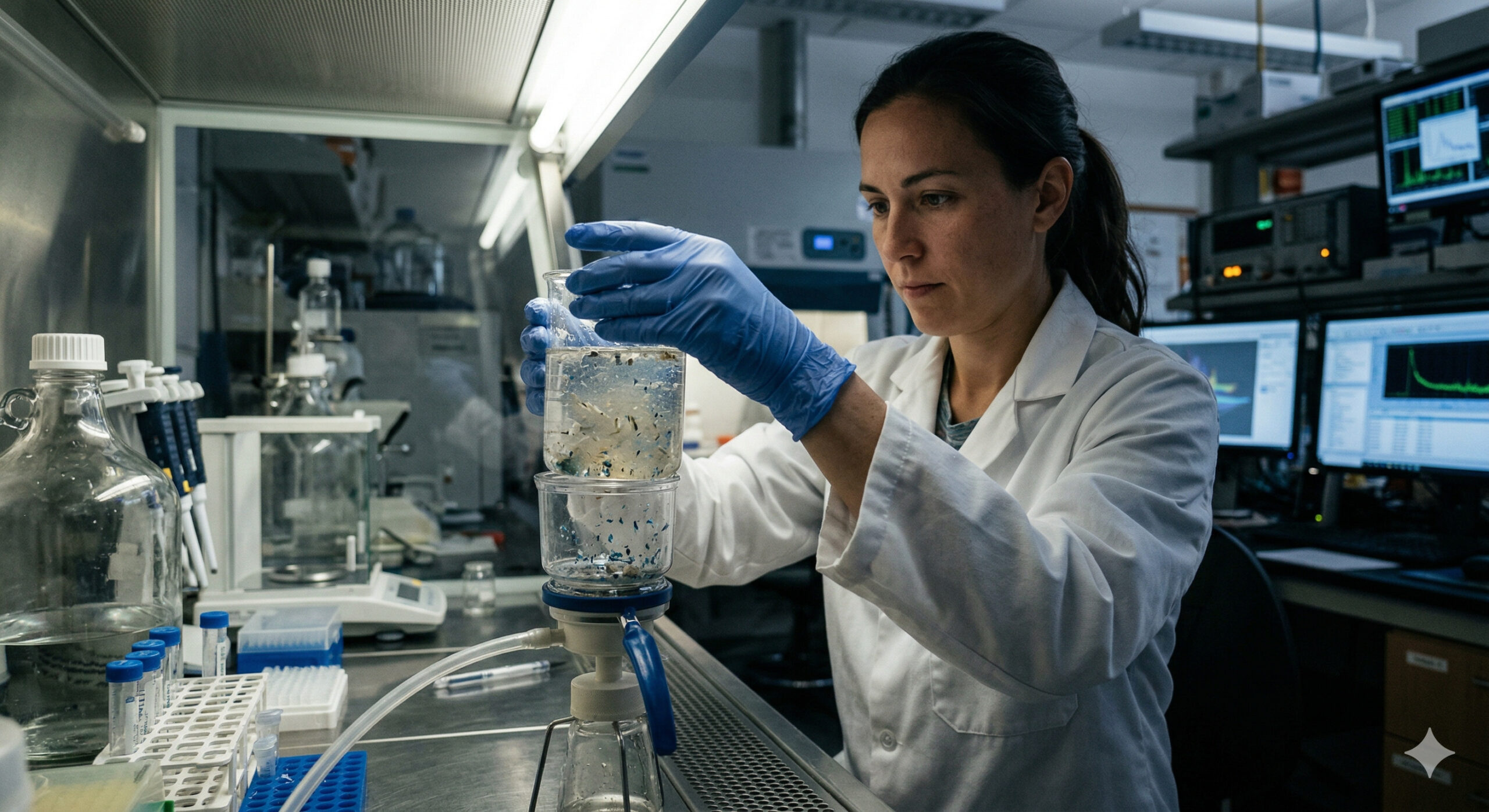
Study from the University of Michigan reveals that laboratory gloves may have inflated data on microplastics for decades by contaminating samples.
Microplastics have already been found in oceans, in the air, in human blood, in the brains, in the testicles of dogs, and even in the clouds over Mount Fuji. With each new study, the numbers seem more alarming. But a group of researchers from the University of Michigan identified a factor that may have distorted a significant portion of these measurements: the gloves used in laboratories.
According to a study published in March 2026 in the journal RSC Analytical Methods (DOI: 10.1039/D5AY01801C), reported by the university itself and by outlets such as ScienceDaily and ZME Science, nitrile and latex gloves release compounds called stearates. These salts exhibit chemical behavior and spectroscopic signatures very similar to polyethylene, one of the most common microplastics in the environment.
The practical effect is direct: particles released by the gloves can be identified as microplastics during laboratory analyses, generating large-scale false positives.
-
NASA reveals unprecedented image of the far side of the moon during the Artemis II mission, captures a rare solar eclipse, and takes humans to the farthest point ever reached in space.

-
Chinese AI satellite images are helping Iran target US bases in the Middle East, and reports indicate that the technology is already accelerating missile and drone attacks.

-
Exemption from the Enem 2026 fee has a defined deadline; see how to apply.

-
Why fighter pilots never return after ejecting: the seat launches the body at 600 km/h in 1 second, compresses the spine, reduces G tolerance, and leads to medical disqualification, not punishment.

Discovery began with anomalous results in atmospheric study of microplastics
The discovery began during a project led by doctoral student Madeline Clough, who was investigating the presence of microplastics in the atmosphere of the state of Michigan.
Using air samplers and spectroscopy techniques to identify particles, the team strictly followed the recommended protocols: avoiding plastic materials, using controlled environments, and minimizing external sources of contamination.
Even so, the results showed concentrations thousands of times higher than those recorded in previous studies. This deviation led the team to initiate a detailed investigation to identify the source of the contamination.
Nitrile and latex gloves identified as main source of false positives in laboratory
After ruling out multiple hypotheses, the researchers identified that the contamination came from one element present in practically all experiments: disposable gloves.
During manufacturing, nitrile and latex gloves receive coatings of stearates to facilitate their removal from molds. These compounds are transferred to surfaces upon contact, including filters, slides, and substrates used in laboratory analyses.
The problem is that these stearates produce signals that are practically indistinguishable from microplastics when analyzed by vibrational spectroscopy.
Experiments show up to 7,000 false positives per square millimeter on handled surfaces
To quantify the impact, the team tested seven types of gloves under simulated laboratory conditions. The results indicated an average of approximately 2,000 false positives per square millimeter. In some cases, latex gloves exceeded 7,000 false particles per square millimeter.
Cleanroom gloves, which do not use stearate coatings, showed significantly lower levels of contamination. The difference between glove types can drastically alter the interpretation of the collected data.
Additional tests using optical and electron microscopy showed that it is not possible to visually differentiate stearates from real microplastics on a micrometric scale.
This means that analyses based on visual observation may have included contaminating particles as if they were legitimate microplastics.
The problem does not stem from individual methodological error, but from a structural limitation of the protocols adopted in the field.
Global data on microplastics may be inflated and impact public policies
The implication of the discovery is broad. Studies that identified microplastics in natural environments and even in living organisms may have overestimated the actual quantities due to contamination from gloves.
These data have been used to support public policies, environmental regulations, and industrial decisions in various countries.
The discovery does not invalidate the presence of microplastics in the environment, but suggests that levels may have been inflated under certain experimental conditions.
Researchers develop methods to correct data contaminated by stearates
The team from the University of Michigan also developed methods to differentiate the chemical signatures of stearates and real microplastics. These techniques allow for the re-evaluation of already collected data and adjustment of concentration estimates.
Spectral libraries have been made available so that other laboratories can recalibrate their results.
The main practical recommendation is the replacement of conventional gloves with cleanroom gloves, which do not use stearates.
These gloves produce significantly fewer particles but cost between two and five times more than standard gloves. For laboratories with limited budgets, adoption may represent a significant financial challenge.
Difference between latex and nitrile reveals economic impact on the quality of scientific data
The study identified that latex gloves generate more contamination than nitrile gloves.
This raises a structural question: laboratories with lower financial capacity tend to use cheaper materials, which may affect the quality of the data produced. Economic inequality can, therefore, directly influence the accuracy of environmental measurements.
The authors of the study advocate for the updating of protocols used in microplastics research.
Among the recommendations are the mandatory inclusion of contamination control by gloves and the requirement for transparency regarding the materials used. Scientific journals may also begin to require this information as a validation criterion for studies.
Now we want to know: how many studies on microplastics may need to be reviewed?
The discovery raises a central question for contemporary environmental science. If part of the data was influenced by unidentified contamination, what is the real extent of microplastic pollution on the planet?
And more importantly: how many studies will need to be re-evaluated to reflect this new understanding?










Seja o primeiro a reagir!