





 Portuguese
  English
  Spanish
  2 min of reading
  0 comments


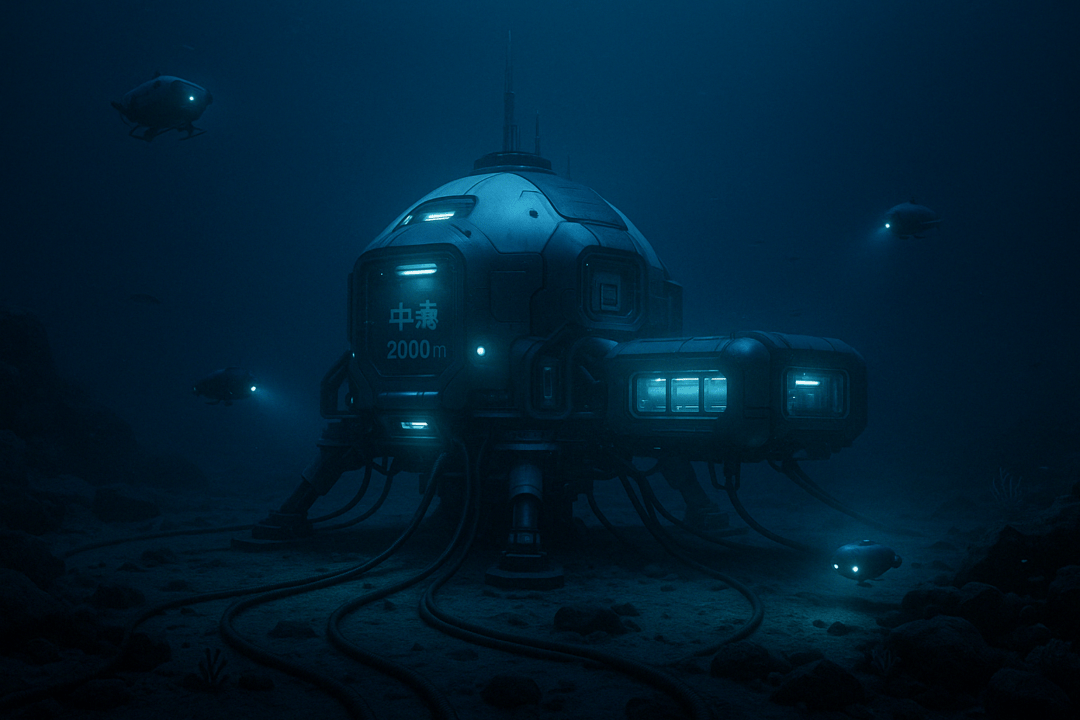
With State-of-the-Art Technology and Bold Missions, China Inaugurates a New Era of Underwater Exploration
China is advancing in the construction of an ambitious underwater scientific station, located more than 2,000 meters below the ocean surface. The goal is for six researchers to remain on-site for over 40 days. The initiative, seen by many as a kind of underwater “space station,” aims to unravel the secrets of marine ecosystems at great depths.
One of the main focuses of the project is the study of so-called cold seeps, a natural phenomenon that releases large quantities of methane hydrate — a compound considered a less polluting energy alternative compared to fossil fuels. However, its extraction at extreme depths presents significant technical and environmental challenges.
The underwater laboratory is being deployed in the South China Sea, a strategic area and target of geopolitical disputes. According to China Daily, the station is located in deep waters close to Guangzhou and will be crucial both for studying marine biodiversity and researching mineral resources such as nickel, cobalt, and rare earth elements, essential for energy and technology sectors.
-
They were brilliant! Scientists discover that our ancestors in China were already making super advanced tools 160,000 years ago, changing everything we knew.

-
Scientists unveil 3 million years of climate secrets hidden in the ice of Antarctica.

-
Ancient farmers created “aggressive plants” that changed nature forever.

-
Astronomers find a “backward” solar system that ignores all the rules of space and leaves scientists scratching their heads!


The extraction of these resources from the ocean floor, however, can cause severe and irreversible damage to ecosystems. So far, there is no clear international regulation for these activities, although the International Seabed Authority (ISA) is discussing guidelines. Environmental groups have been pushing for greater protection of the oceans in the face of increasing commercial exploration.
Geopolitics and Technology at Stake
Although China claims that the center will be open to international collaborations, its growing presence in the South China Sea heightens tensions in the region. According to Global Times, the project aligns with the United Nations Decade on Ecosystem Restoration, but critics point out that the underwater base could serve as a justification for expanding China’s military presence.
According to the newspaper El Confidencial, the station will be connected to an underwater fiber optic network and will have the capacity to withstand pressures up to 200 times greater than at the surface. Scientists will live under extreme conditions, without natural light, for periods ranging from 30 to 45 days. The site will be equipped with advanced submersibles, support vessels, and equipment for dynamic and three-dimensional monitoring of the region.
What sets this station apart from existing technologies is the ability to conduct experiments directly in such a hostile environment, something that is not yet possible with the use of artificial intelligence or autonomous vehicles. Chaolun Li, the project director, stated to Global Times that the base will allow for real-time observations and testing, significantly contributing to the advancement of human knowledge about extreme environments.









-

Uma pessoa reagiu a isso.