





 Portuguese
  English
  Spanish
  6 min of reading
  0 comments


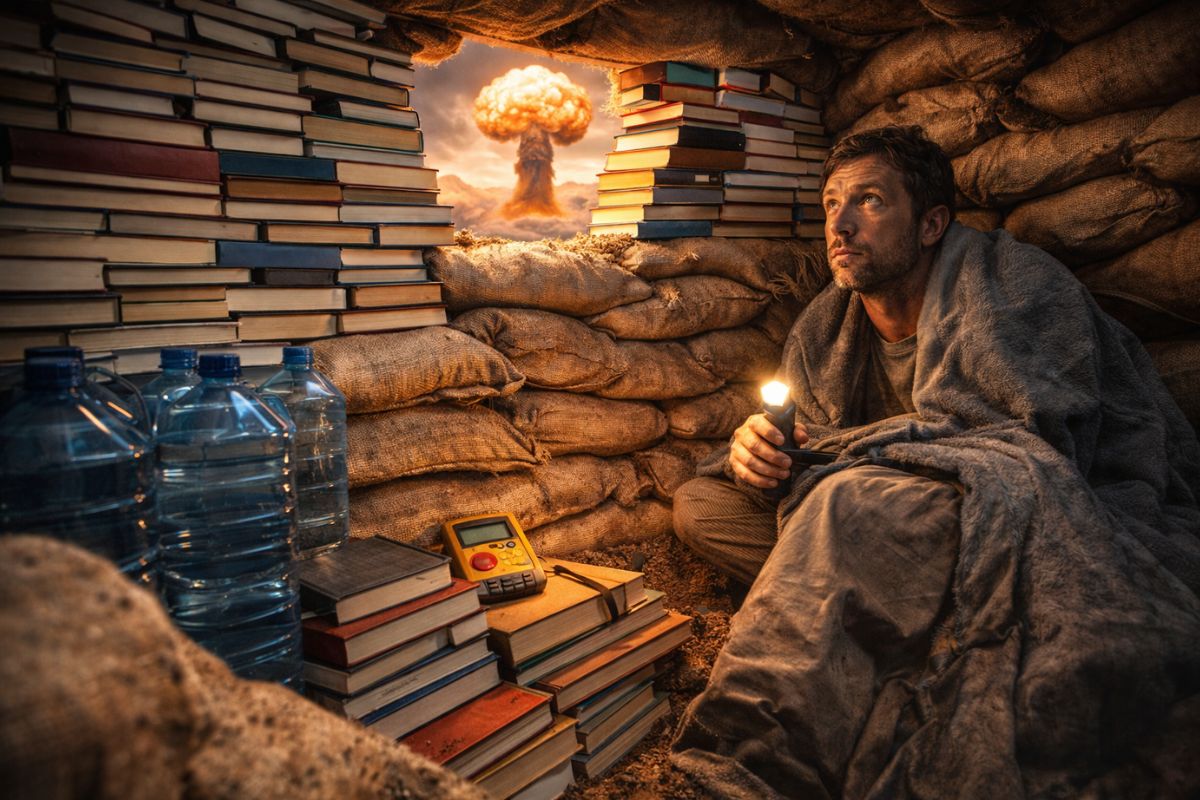
A Home Bunker Can Be Improvised With Mass And Density Using Books, Water, And Bags Of Dirt, Reducing Radiation And Avoiding Contact With Radioactive Dust In The First 48 Hours.
If you search for luxury bunkers, you will find buried steel capsules and very expensive systems that seem to say that only those with money survive. But the logic of protection does not depend on price. A home bunker works when you put enough mass between you and the outside, because gamma radiation decreases when it encounters dense obstacles in its path.
The proposal here is down-to-earth and reflects Brazilian reality. If you live in a brick house or a regular apartment, you already have a base. The home bunker is not about heavy construction, it is about smart improvisation and applied technique, using what already exists on your shelf, in your pantry, and, if you have it, in your backyard.
Why Mass And Density Are Worth More Than Luxury
To understand how an improvised shelter protects, you need to grasp the basics of the problem. Gamma radiation, described as the most dangerous in a nuclear scenario, does not “stop” just because it encounters expensive material. It decreases because it finds enough mass and density to lose strength.
-
The narrowest house in the world is only 63 centimeters wide, but inside it can accommodate a bathroom, kitchen, bedroom, office, and even two staircases.

-
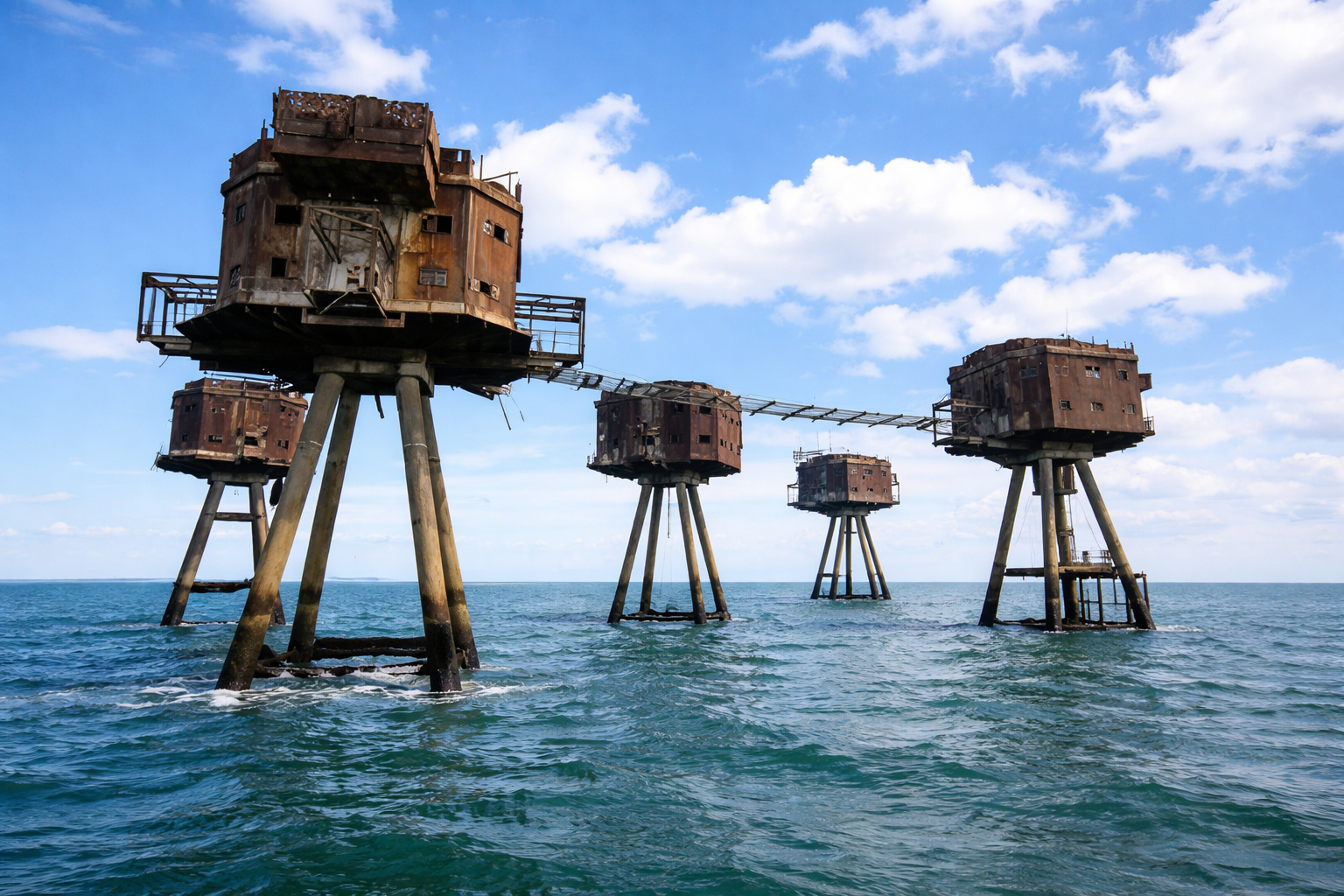
In the middle of the sea, these enormous concrete and steel structures, built by the British Navy to protect strategic maritime routes, look like they came straight out of a Star Wars movie.
-
For years, no one could cross a neighborhood in Tokyo because of the tracks, but an impressive solution changed mobility and completely transformed the local routine.
-
With 15 floors, an unusual building in Curitiba uses concrete, pilasters, and exposed roofs to create the effect of stacked houses.


The idea of a half-value layer helps to visualize. It is the thickness of a material capable of reducing radiation by half.
At the base, a straightforward example appears: about 1 cm of lead does this job, but almost no one has lead at home. However, the same logic can be achieved with other common materials, compensating density with volume.
The reference provided is clear: approximately 6 cm of concrete, 9 cm of compacted dirt, or 12 cm of water counts in this equation.
This is why stacking books to form a 30 or 40 cm barrier and aligning water jugs works as a practical strategy. The home bunker arises from this simple math: if the material is less dense, you increase the thickness.
The Right Place Decides If The Home Bunker Will Work
The choice of location is the most strategic decision. It is useless to gather tons of material and position it in the wrong place. In a house or apartment, the problem does not only come from the sides.
The danger from above also matters, because radioactive dust, referred to as fallout, tends to accumulate on roofs and gutters, creating an emitting layer above your head.
This is why the golden rule is to create distance and barriers between you and the outside. Bathrooms often appear as ideal candidates because they usually have few windows, are surrounded by internal brick walls, and still offer access to water and sewage pipes. Another efficient option is the space beneath a concrete staircase, which already provides superior mass from above.
In buildings, the home bunker can be set up in more central areas, such as internal corridors or elevator halls, as long as they are away from large structural voids.
The logic is always the same: find the core of the residence, where the outside world seems further away. Avoid rooms with large windows and balconies, because glass does not protect against radiation and can shatter with shockwaves.
Books, Water, And Bags Of Dirt Become Improvised Shielding
With the room chosen, the next step is to “bulk up” the walls. In expensive projects, reinforced concrete is discussed. In the home bunker, the base uses three accessible materials, with a simple function: put mass in the path of radiation.
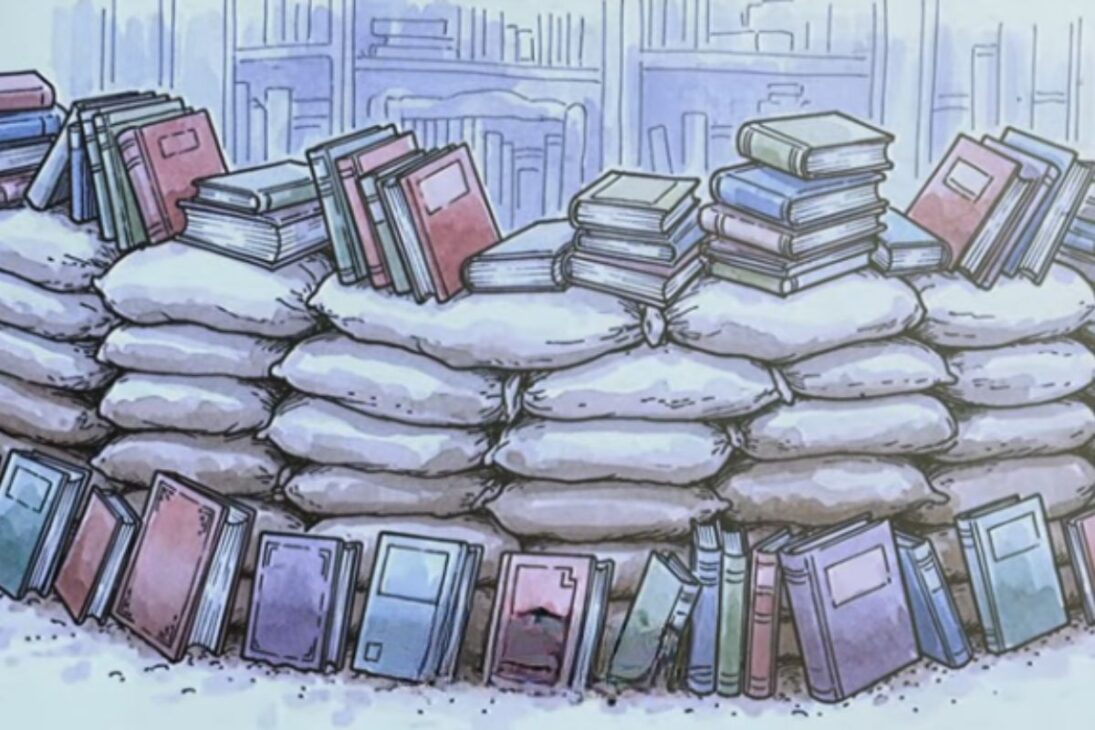
Books and magazines work because paper is processed wood and becomes dense when compacted. A full bookshelf leaned against the wall facing the outside creates a strong improvised barrier. If there is no shelf, the logic is to stack them like bricks to increase thickness.
Water serves a dual purpose. It is vital for consumption and, at the same time, helps as a barrier. 20-liter jugs and full PET bottles can be organized to form a “water wall” around the area where you will stay. Each row adds an extra layer of security.
Bags of dirt come in as a cheap and abundant solution. With sturdy bags filled with dirt from your yard or even from pots, you create an efficient mass block to reinforce doors and windows that are already sealed.
The base makes an essential point: avoiding small “comfort” stones here is not the focus; the goal is mass. The home bunker relies more on the quantity well-placed than on rare materials.
The Secret Is To Create A Low Cocoon, Not To Shield The Entire Room
A common mistake is to think you need to turn the entire bathroom into a fortress from floor to ceiling. The base proposes a more realistic approach: create a “den,” a low cocoon where you can sit or lie down, placing as much mass as possible between you and the ceiling.
In this format, suitcases filled with heavy clothes can be used on countertops or surfaces to reinforce the upper vector. Even items like mattresses can help contain debris, and if they are damp and you can handle it, the retained water increases protection.
The point is simple: less space to protect means more density per protected area, and this makes the home bunker viable without heavy construction.
Sealing Against Radioactive Dust Requires Care With The Air


Shielding does not solve everything. External radiation is dangerous, but inhaling radioactive dust is described as even worse, because it can act inside the body. Therefore, sealing cracks becomes a priority.
The base uses plastic and adhesive tape as the main tools. Windows, door frames, outlets, and ventilation ducts should be sealed with plastic sheeting or open bags, secured with wide tape. However, there is a deadly risk if you seal everything airtight: carbon dioxide accumulation.
To avoid turning the home bunker into a space of asphyxiation, the base brings the solution of improvised passive filtration. The proposal is to leave a small opening at the top of the seal and cover it with several layers of damp cloth or wet towel, to trap particles while the air is renewed through diffusion.
Changing the cloth requires care, preferably with gloves, maintaining the goal of reducing dust entry without blocking breathing.
The First 48 Hours Are The True Test Of Discipline
After assembling the home bunker, the challenge of time begins. The base states that the first 48 hours after a detonation are the most critical because that is when the radioactivity of the fallout decays most rapidly. This means staying in a small space for an extended period, with total focus on routine, hygiene, air, and emotional control.
Waste management becomes a central issue, especially if the chosen location is the bathroom. If the water pressure disappears, the base’s guidance is not to flush to avoid contaminated gases or backflows.
The proposed solution is to use a bucket with a plastic bag and some material to reduce impact, keeping everything sealed.
Lighting also weighs on the psyche. Being in total darkness increases stress and disorganizes the perception of time. LED flashlights and cell phones in power-saving mode appear as alternatives. Candles are mentioned with extreme caution as they consume oxygen and require continuous attention.
Information, Simple Food, And A Steady Mind Increase Your Chances
In a scenario of isolation, information becomes the link to the outside. The base cites battery-operated radios and AM stations as a way to follow emergency bulletins. It is a detail that changes behavior, as it reduces decisions made in the dark.
Regarding food, the base recommends focusing on items that do not require cooking and do not increase thirst, such as bars, chocolate, and cookies.
The idea is to operate in hibernation mode: expend little energy, maintain hydration rationally, and avoid unnecessary improvisations.
In the end, the text concludes with a direct message: survival is not a privilege of luxury bunkers, but the result of technique and an agile mind. The home bunker, as described, relies on books, water, and bags of dirt to create a realistic defense, based on mass, sealing, and discipline.
Had you thought that a home bunker could depend more on books and water than on steel and money, or does that still seem impossible to your reality?






Seja o primeiro a reagir!