





 Portuguese
  English
  Spanish
  7 min of reading
  0 comments


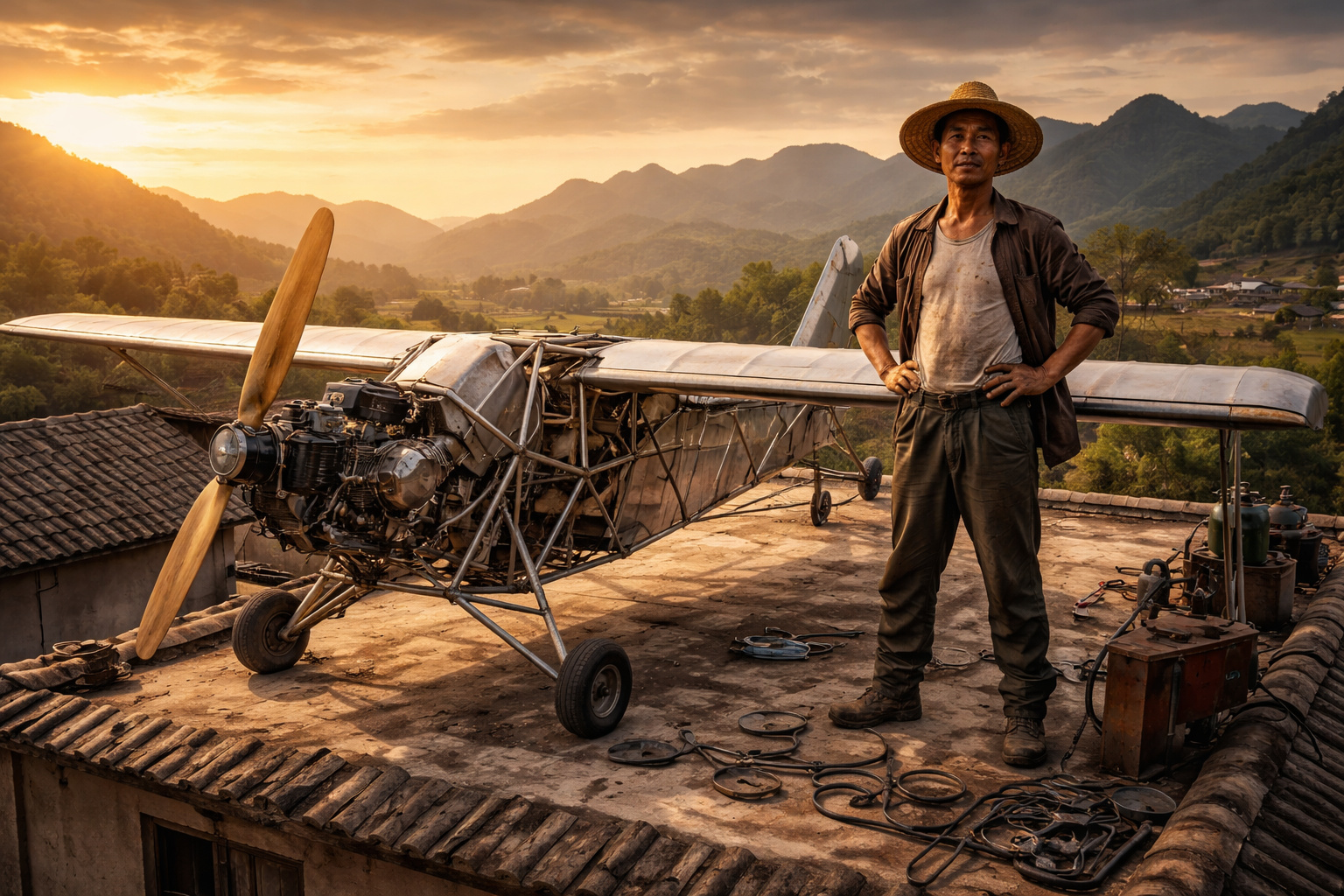
Without a Degree in Aviation, Chinese Welder and Farmer Built a 4.2-Meter Airplane on His Rooftop and Managed to Complete Two Test Flights.
Chen Lianxue was about 50 years old, lived in a village near Pingliang, Gansu Province, in Northwest China, and had spent nearly his entire life working as a welder and lathe operator. He had never attended a formal class on aerodynamics and had never studied at an aviation school. What he had was an old dream that had followed him since childhood: to build an aircraft capable of flying. Without access to specialized courses or financial resources to buy an airplane, Chen decided to take an unusual path. He began to study aerodynamics on his own, analyzing books and technical materials while applying decades of practical experience in metallurgy.
The solution he found was as improbable as the project itself: to build an airplane on the rooftop of his own house.
What Led Chen Lianxue to Study Aerodynamics on His Own
Chen spent much of his life working with welding, turning, and manufacturing metal parts. His professional experience was based on practical skills developed over years of handling steel and aluminum in local workshops.
-
Giant Roman treasure found at the bottom of Lake Neuchâtel in Switzerland reveals an advanced trade system, circulation of goods, and armed escort in the Roman Empire about two thousand years ago.

-
He buried 1,200 old tires in the walls to build his own self-sufficient house in the mountains with glass bottles, rainwater, and an integrated greenhouse.
-
The aircraft carrier HMS Prince of Wales is heading to the Arctic with F-35 fighters, helicopters, and warships in an operation that repositions the United Kingdom at the forefront of NATO in 2026.
-
He found the largest gold shipwreck in the United States with tons of the precious metal at a depth of 2,400 meters in the Atlantic and recovered a treasure that no one thought possible to reach, but 500 gold coins disappeared without explanation.


Despite the intense work routine, a persistent memory from childhood remained: the image of an airplane crossing the sky. That vision morphed into a silent obsession that lasted for decades. When his children grew up and family responsibilities lessened, Chen realized he had a clear choice: try to fulfill the dream or abandon it forever.
There were no resources to buy an airplane, and there were also no accessible aviation schools for a farmer from a rural area in Gansu. What he had were tools, experience with metal, and time to study.
It was then that he began to self-learn aerodynamics and design his own aircraft project.
Why the Rooftop Became the Airplane’s Construction Site
The choice of the rooftop as the construction site was not a whim. Chen simply did not have enough land to set up a structure of this kind. The flat roof of his house ended up being the only available space that allowed him to work without disrupting the family’s routine.
There, exposed to the dry northwest winds of China, the project began to take shape. Over time, the makeshift construction atop the house started to attract the attention of neighbors. Some people stopped in the street to observe the work. Many considered the idea strange or impossible.
Still, Chen continued working. The entire construction process took more than five years.
The Dimensions of the Homemade Airplane Built on a Rooftop
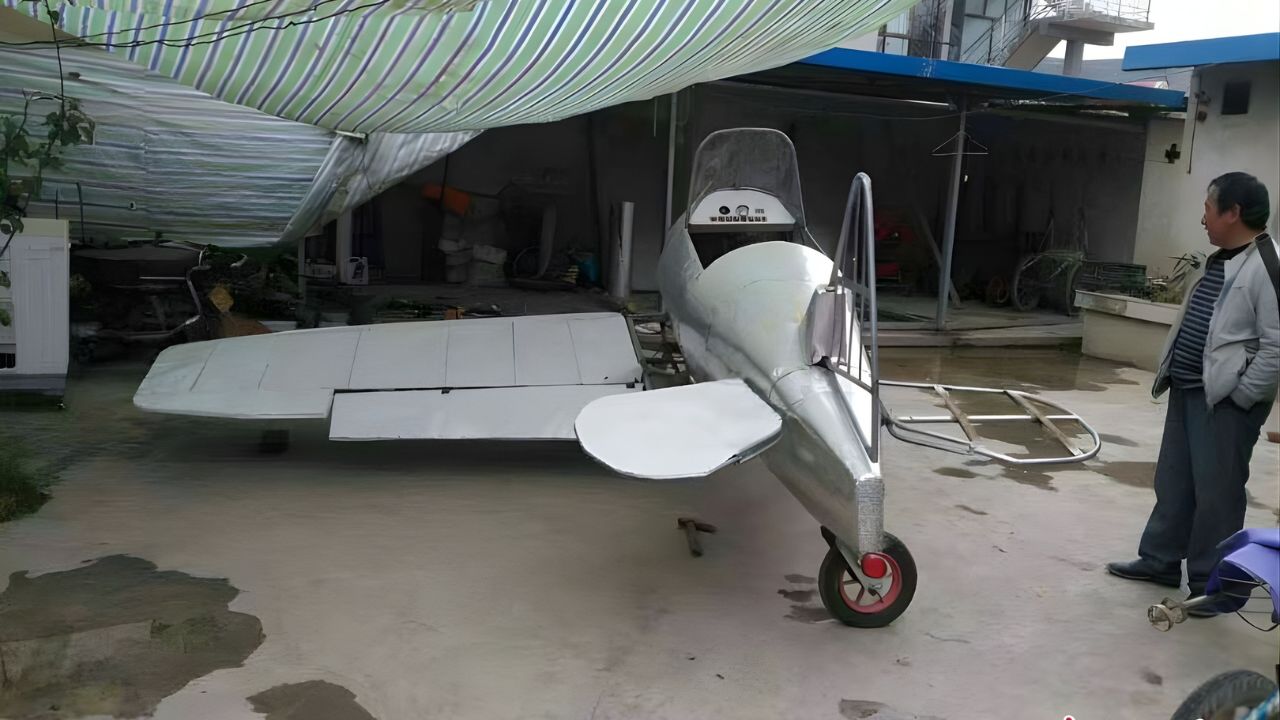
After years of manual labor, the result was a compact yet functional aircraft. The airplane is approximately 4.2 meters long, 5.1 meters wingspan, and 1.6 meters high. The structure was built with reinforced steel and aluminum panels, materials that Chen mastered due to his experience as a welder.
The propulsion came from an improvised solution: two motorcycle engines installed on the wings. This choice was mainly determined by the availability of parts and the affordable cost. Each component of the aircraft — simply named DIY — was manually fabricated by Chen. Many parts were built by him, while others were sourced from local hardware stores.
There were no specialized suppliers or certified aircraft parts. The project was conducted based on technical improvisation combined with self-study.
The Main Technical Challenge: Adapting Motorcycle Engines for Flight
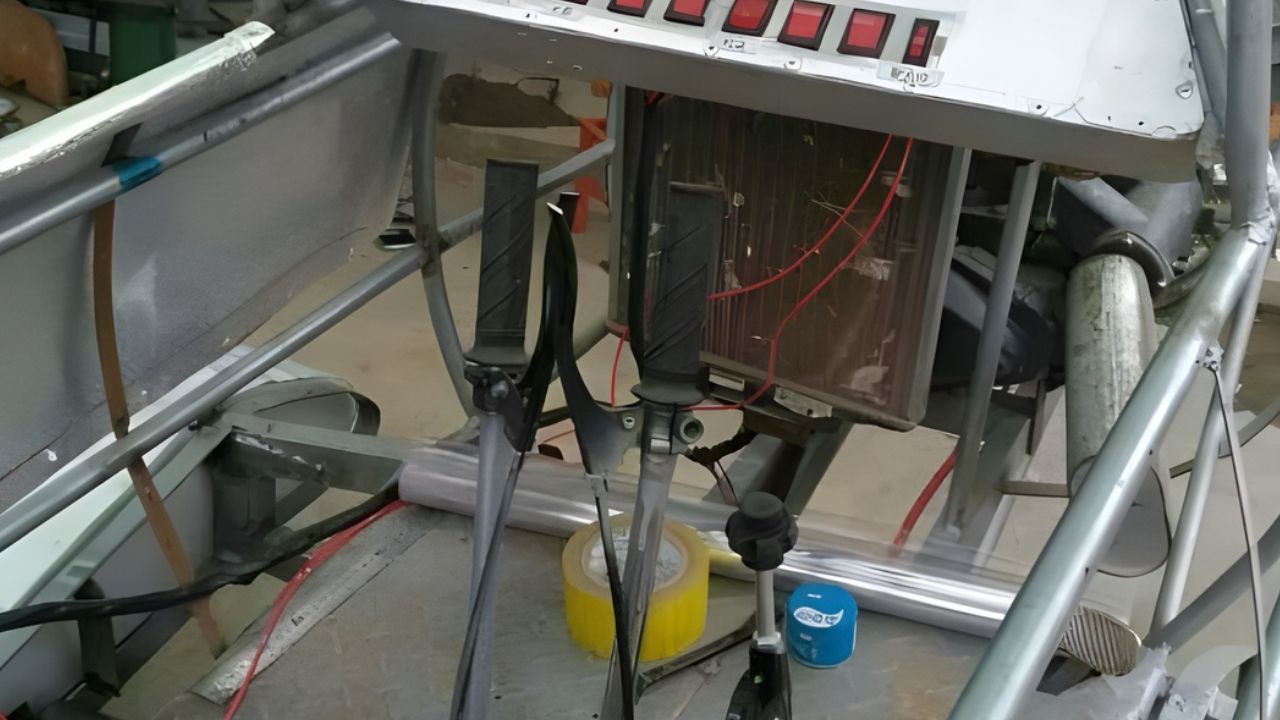
The weakest point of the aircraft built by Chen was precisely the propulsion system. The two motorcycle engines worked but had significant limitations. The combined power was relatively low for an aircraft, and the cooling system was not designed for operation in flight.
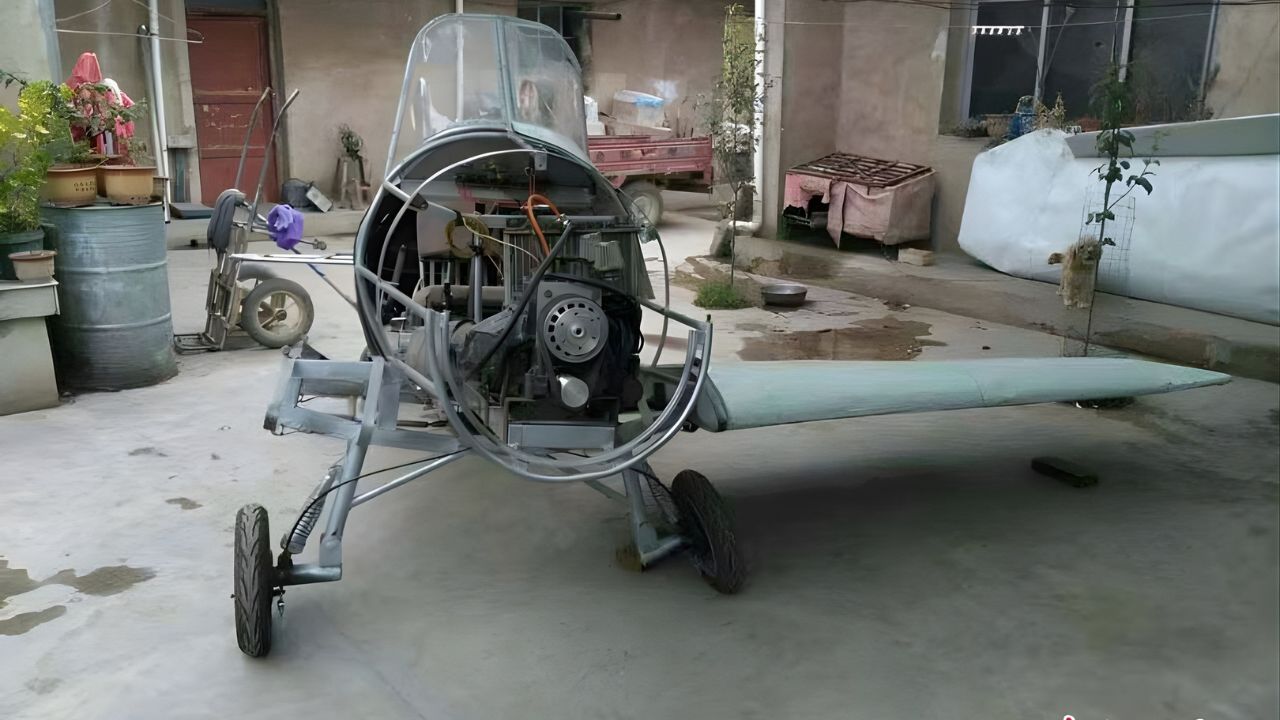
Chen openly acknowledged this problem. According to him, the engine issue needed to be resolved before any attempts at longer flights.
From a technical standpoint, this limitation makes sense. Motorcycle engines have a good power-to-weight ratio for land use, but the thermal demands in flight operation are much more severe. Without a constant airflow and an adequate cooling system, the risk of overheating increases rapidly.
The First Test Flights of the Aircraft Built by Chen
Even with technical limitations, the airplane eventually managed to lift off. Chen completed two test flights, both over relatively short distances. The aircraft traveled a few hundred meters and flew at a few meters altitude.
These tests were not intended to accomplish a full cruise flight. They served as proof of concept to check whether the aircraft could sustain its own weight and respond to commands. In both tests, the airplane managed to take off, maintain basic stability, and land without sustaining structural damage.
Considering that this was a project built by a single person without formal training in aerospace engineering, assembled on the rooftop of a house, the result attracted the attention of experts and curious onlookers.
The Practical Knowledge Behind the Project
Chen Lianxue never studied flight mechanics formally. He also did not possess a pilot’s license or engineering training. Still, his project demonstrates something important: the ability to transform self-taught knowledge into a functional object.
He learned concepts of aerodynamics through reading, understood the limitations of the propulsion system through trial and error, and applied decades of metallurgy experience to create a structure capable of withstanding load and vibration.
This kind of accumulated practical knowledge is often cited by engineers as an important factor in experimental projects.
Rural Inventors and Improvised Projects in China
Chen is not an isolated case. Various rural Chinese inventors have gained media attention over the past decades for building complex vehicles and machines without formal academic training.
One example is Xu Bin, from Zhejiang Province, who built over 40 aircraft in fifteen years. His first project was a gyrocopter made from recycled parts.
At one point, he was fined by the Civil Aviation Administration of China for unauthorized flights. Another well-known case is Zhu Yue, from Liaoning Province. He invested about 2.6 million yuan (approximately R$ 1.9 million) to build a life-size replica of an Airbus A320 in an agricultural field, using a toy model as an initial reference.
These cases share a common element: the combination of personal obsession, practical technical skill, and lack of access to traditional training routes.
Why Building an Airplane on the Rooftop Can Be a Practical Solution
Building on the rooftop may seem like an eccentric idea, but it solves a concrete problem: space. In rural areas, renting a shed or setting up a large workshop can be expensive or unfeasible. The rooftop of one’s own house already provides an elevated and relatively wide platform.
The main difficulty arises when the project is completed. It is necessary to dismantle or transport the structure to the ground before any flight tests.
Chen took this issue into account from the start. The aircraft was designed to be dismantled into parts and reassembled on the ground.
How Aerospace Engineers Would Analyze Chen’s Aircraft
An aerospace engineer would likely point out several limitations in the project. The motorcycle engines are the most vulnerable point of the aircraft. The cooling system was not designed for prolonged flights, and aircraft certification would be impossible within any civil aviation regulations.
Still, experts who analyzed the project noted that the structure is not entirely random. The proportions of the aircraft — 4.2 meters long and 5.1 meters wingspan — are plausible for a small experimental airplane. The combination of steel and aluminum is also compatible with handcrafted constructions.
The main difference between Chen and a trained engineer is not necessarily in the structural logic of the project but in access to tools, laboratories, and formal certifications.
The Importance of the First Flight Meters
The first flight in the history of modern aviation, performed by the Wright Brothers in 1903, covered only 36 meters. Despite the short distance, that experiment represented years of study and failed attempts.
More than a century later, Chen Lianxue managed to fly a few hundred meters with an aircraft he built himself, practically alone, on a rooftop.
The distance covered is not the central element of the story. What is most relevant is the journey necessary to get there.
What Chen Intended to Do After the First Flights
After the initial tests, Chen planned to address the propulsion system issue before attempting longer flights. He hoped to carry out a more extensive test later in 2015, after improving the cooling system of the engines.
Subsequent records about these tests are scarce. What remains documented are the images of the airplane on the rooftop, photos of the dismantled structure, and accounts of the experimental flights.
When the Impossible Becomes a Technical Challenge
Chen Lianxue’s story does not suggest that anyone can build an airplane. What it shows is something more specific: a skilled professional in metallurgy, with decades of practice and a willingness to study, can create a functional aircraft even without formal aviation training.
This is not an encouragement to recklessness but an example of how accumulated technical knowledge and persistence can transform an apparently impossible project into a real technical challenge.
The airplane flew.
Twice.
And it left the rooftop.







Seja o primeiro a reagir!