





 Portuguese
  English
  Spanish
  5 min of reading
  0 comments


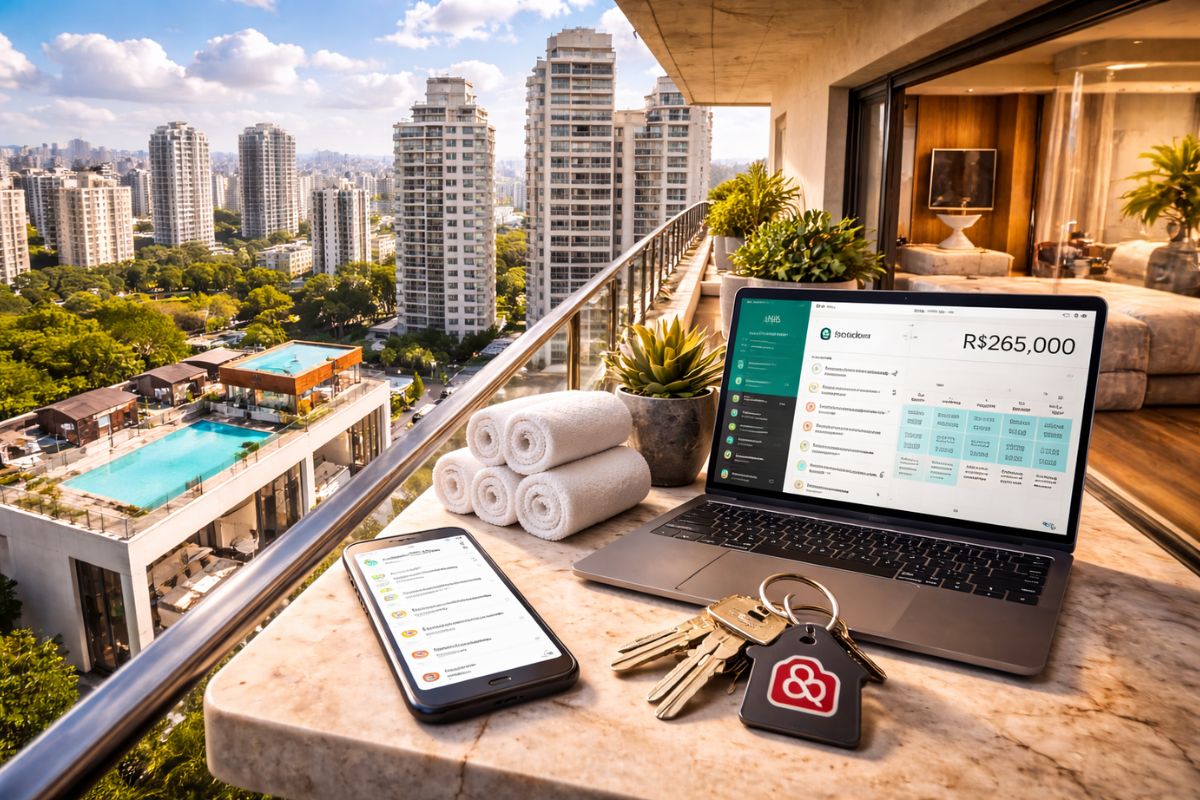
The manager concentrates properties in the south zone of São Paulo, generates around R$ 6 thousand per month on Airbnb, charges a commission on daily rates, and grows with a neighborhood strategy and lean operation
At 30 years old, Laísa became a reference by managing an Airbnb operation with 60 properties for short-term rental, concentrated mainly in Moema and nearby neighborhoods, and a routine that never stops. She says that the total monthly movement of reservations exceeds R$ 200 thousand to R$ 300 thousand, including daily rates and fees, while maintaining direct guest service full-time.
What impresses is not just the volume, but the method: focus on a few neighborhoods, selection of units, standardization of what matters, and an operation that mixes management, check-in, inspection, purchasing, maintenance, and communication under the same command. In the midst of this, she still explains how a studio can generate around R$ 6 thousand per month and why a larger apartment does not always justify the investment.
An operation concentrated in Moema and the south zone
The basis of the business lies in the logic of territory. She explains that the “stronghold” is Moema and that, to facilitate the routine, she focuses on a specific area: Moema, Brooklin, Campo Belo, and Vila Olímpia. The rule is clear: the closer, the more predictable the operation becomes.
-
I entered the most dangerous amusement park in the world to overcome my fear of heights: glass walkway, bike on a cable, swing over the cliff, bungee jump, and the dreaded Plunge of Death.

-
How do frogs and toads manage to cross oceans without swimming and appear on isolated islands? A study involving over 3,800 islands reveals rare events, “invisible journeys,” and the secret role of climate and distance from the continent.

-
The Federal Revenue updates rules for access to digital services and imposes a new standard with a gov account: more security, control of authorizations, and changes in the use of the electronic portal.

-
All mammals on the planet were born from eggs 250 million years ago, and scientists have just found the first evidence of this hidden inside a skull smaller than a coin in South Africa.

Within the same condominium, she cites a practical example: she has five of her own units and manages 15 more from other owners, totaling 20 there. The strategy avoids dispersion, reduces travel, and helps maintain the quality of service on Airbnb.
How it all started and why Airbnb became a turning point
Entering Airbnb came after frustrations with traditional rentals. She reports losses and wear in long-term rentals and shares that she decided to test short-term rental when a studio in Moema was ready.
The test was quick: within about 24 hours, a reservation was made. From there, she did what many do not agree to at the beginning: she cleaned the unit, blocked dates to keep up, and handled everything manually, especially during the pandemic when she started in 2020.
How much does a studio yield and how she explains the numbers
The number that catches attention is clear: when asked about a studio, she mentions an average of R$ 6 thousand per month in gross sales in one example. In the payout to the owner, she states that a good month can yield around R$ 4 thousand to R$ 4.5 thousand, varying according to seasonality and occupancy.
She emphasizes that there are weaker months and better months, and that part of the result depends on routine, turnover, and demand. The logic of Airbnb here is consistency, not a promise of fixed value.
The commission model and what goes into the operation
Regarding compensation, she says she mainly charges 15% on the gross daily rate, deducting the cleaning fee before calculating this commission. In specific cases, when the operation is more challenging due to dispersion, she mentions 17%.
And when she says she does “everything,” she details: finance, purchasing, checklist, inspection, contact with guests and owners. There are no fixed employees directly on her team, but there is outsourced support: cleaning team, a contracted maintenance worker, and legal support.
24-hour service and the cost of being “everything in one person”
The heaviest part of the account is simple: she provides 24-hour service. This includes late-night messages, check-ins outside of hours, and last-minute demands. In one segment, she describes the phone vibrating at night and the need to wake up to resolve issues.
Even so, she claims she can maintain the routine and that the volume is manageable for now. The central point is that, on Airbnb, service is not “extra”: it is part of the product delivery.
Why she prefers studios and does not always buy two-bedroom apartments


She comments that two-bedroom apartments “fly off the shelves” in rentals, but also weighs the acquisition cost. The discussion appears as an investor’s dilemma: a larger property can rent quickly, but costs much more, and the difference in return may not justify the invested amount.
In practice, she says many studios perform solidly in the region and emphasizes that, in some cases, what changes the game is not the size, but the low vacancy and good setup.
What she considers a differentiator in listing and building
The decision to purchase and manage is influenced by building standards and location. She states that she prefers more complete developments, with pool, gym, coworking, and common areas that guests can actually use. She also mentions the importance of having everything nearby, such as subway and services.
In setting up the unit, the choices are pragmatic: items that reduce maintenance and complaints. Refrigerator instead of minibar, cooktop instead of fragile electric stove, air conditioning, and comfort of bed and shower appear as recurring priorities in what she hears from guests.
Beyond Airbnb: why she expanded to other platforms
She shares that she spent about a year and a half only on Airbnb and then moved to Booking, Decolar, and also to Expedia, testing gradually. The logic is always incremental: add a unit, understand the process, adjust, and only then expand.
In the case of Expedia, she describes a direct strategy: raising the price by 40% to 50% due to increased operational work, and says the return is worth it for part of the portfolio.
In some units, she states that a significant portion of sales comes from there, while more luxurious units do not enter because Airbnb and Booking already provide sufficient demand.
Quick question: if you had a well-located studio in Moema, would you list it on Airbnb yourself or would you prefer to hand it over to a manager even if it meant paying a commission?







Seja o primeiro a reagir!