





 Portuguese
  English
  Spanish
  3 min of reading
  0 comments


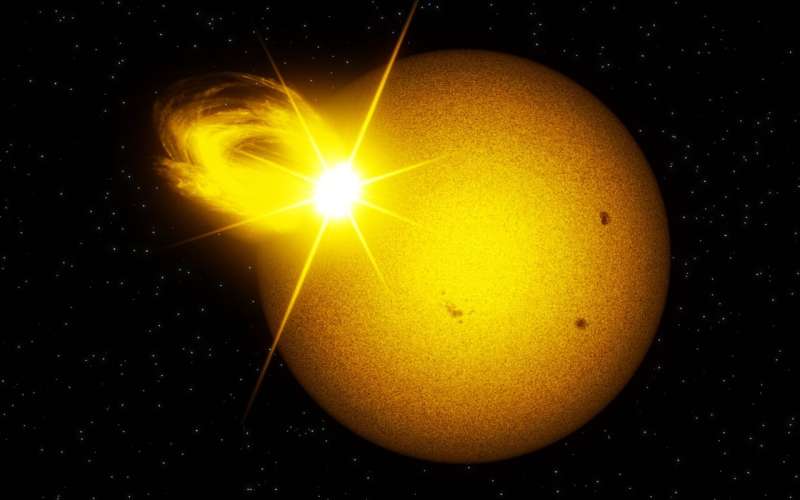
Scientists Predict That The Sun Could Trigger A Solar Explosion Of Unimaginable Proportions In The Next 100 Years, With Energy Comparable To Billions Of Nuclear Bombs, Causing Global Impacts.
In the next hundred years, our Sun could produce a solar explosion as devastating as the combined forces of billions of nuclear bombs.
While the sun often emits smaller eruptions, there is evidence that extraordinarily energetic events, known as superflares, are more frequent than scientists initially thought.
New Discoveries About Supereruptions On The Sun
A recent study, based on observations of stars similar to the Sun, revealed that these extreme explosions occur, on average, once every 100 years.
-
INMET danger alert: heavy rains between the 3rd and 4th may drop up to 100 mm/day and winds of 60 to 100 km/h in several regions of Brazil require extra caution.

-
The parts crisis may bring back the drop notch and microSD in 2026; while Windows 11 promises to become lighter, leaks mention batteries of up to 10,000 mAh and 200 MP cameras.

-
In Kenya, engineer Nzambi Matee created “bricks 2.0” using packaging plastic: a mixture with sand, heated and pressed; they are 5 times more resistant, already have official licensing, and are being used in streets and construction projects.

-
More than 20,000 positions could be opened, and thousands of technicians are starting to be trained in Brazil, as the expansion of data centers creates an urgent race for professionals to keep the internet, cloud, and artificial intelligence running 24 hours a day.


This discovery surprised scientists, who previously believed that superflares occurred at much longer intervals.
“We were very surprised that stars similar to the Sun are prone to such frequent superflares,” said Valeriy Vasilyev, the lead author of the study conducted by the Max Planck Society (MPS).
Superflares are incredibly powerful solar storms, with the potential to wreak havoc on Earth. They could disable electronics, destroy data, knock out satellites, and even put astronauts at risk.
How Scientists Study Superflares
To understand these events, researchers observed stars similar to our Sun.
Using data from NASA’s Kepler Space Telescope, they monitored the brightness of thousands of stars between 2009 and 2013. Sudden changes in brightness indicate the occurrence of superflares.
The team analyzed data from 56,450 stars and found evidence of 2,889 superflares across 2,527 of them. Based on this analysis, scientists concluded that stars like the Sun produce a supereruption every century, on average.
Sami Solanki, director of the MPS and co-author of the study, explained: “We cannot observe the Sun for thousands of years. Instead, we monitor stars similar to the Sun for short periods, which helps us estimate the frequency of superflares.
These explosions release more than one octillion joules of energy in a very short span, which would be devastating for our planet.
The Carrington Event
While scientists cannot predict when the next superflare will occur, history provides a glimpse of its potential impact.
In 1859, the Carrington Event triggered a solar storm that affected telegraph systems worldwide.
The energy released was so massive that its impact is compared to “10 billion 1-megaton nuclear bombs.”
Studies of Earth’s past have revealed other extreme solar activity events, which left marks in natural records such as tree rings and ice layers.
Through carbon-14 analysis, scientists identified five major events in the last 12,000 years. This suggests that extreme solar explosions occur, on average, once every 1,500 years.
However, the new study points to a higher frequency, indicating that events like Carrington could happen every 100 years.
Implications
If a supereruption were to hit Earth, its consequences could be devastating.
Electrical systems and communication networks would be at risk, causing widespread damage in an increasingly technology-dependent world.
To mitigate these risks, it is crucial to continue monitoring the Sun and studying ways to protect our critical systems.
Alexander Shapiro from the University of Graz emphasized the importance of the collected data: “Overall, Kepler data provides us with evidence of 220,000 years of stellar activity.” This information is vital for predicting the Sun’s behavior.
Finally, Natalie Krivova, co-author of the study, stressed: “The new data are a clear reminder that even the most extreme solar events are part of the Sun’s natural repertoire.”
As research advances, scientists hope to better understand these phenomena and prepare humanity for the impact of an extreme solar event.
After all, it is only a matter of time before the next superflare occurs.










-

-

3 pessoas reagiram a isso.