





 Portuguese
  English
  Spanish
  5 min of reading
  0 comments


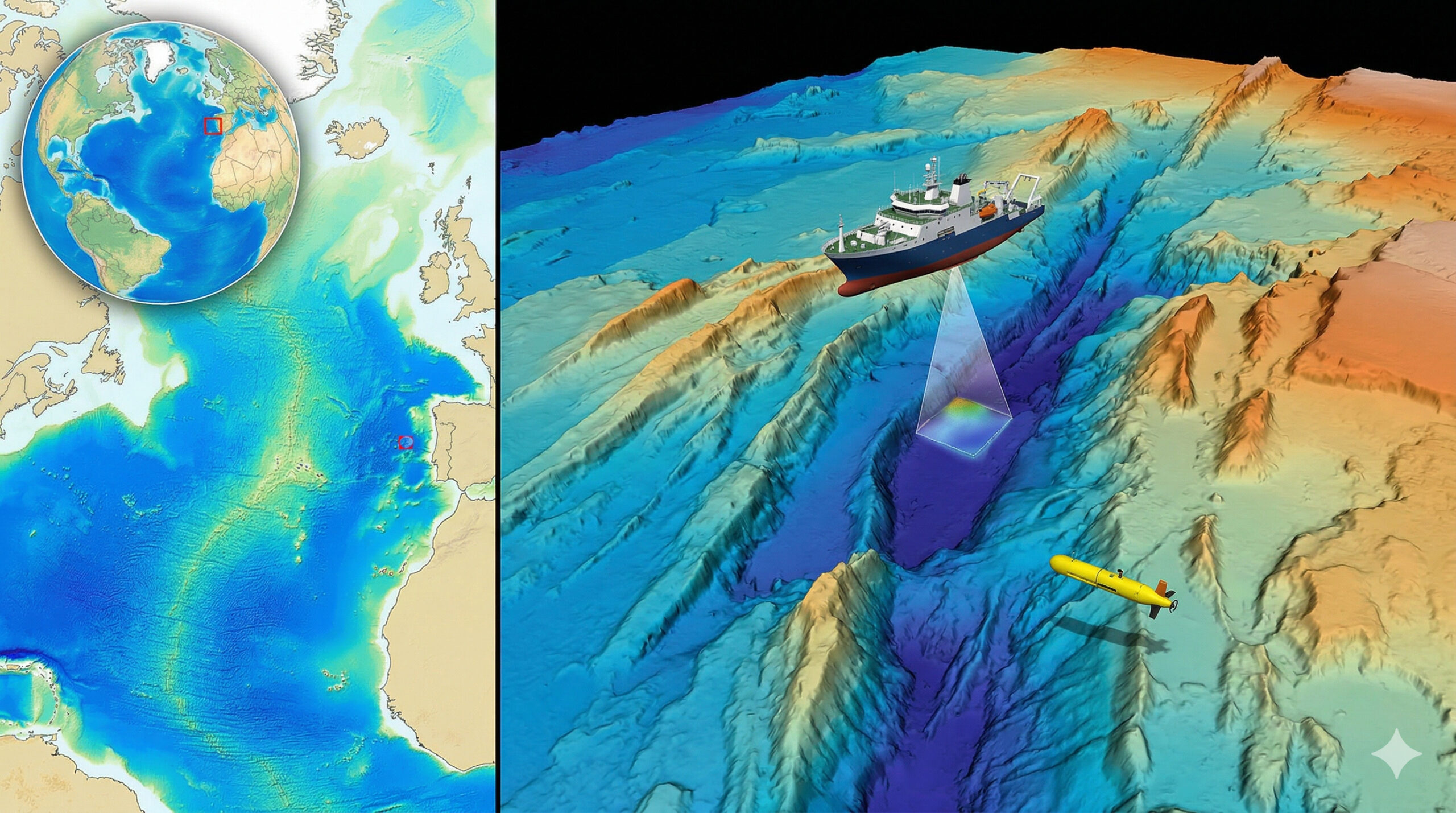
500 km Submarine System in the Atlantic Reveals How Tectonic Plates Tore the Ocean Millions of Years Ago and Formed Giant Structures.
In 2026, international researchers released new findings about one of the most intriguing geological structures on the floor of the Atlantic Ocean: the King’s Trough Complex, located about 1,000 kilometers off the coast of Portugal. According to a study led by the GEOMAR Helmholtz Centre for Ocean Research Kiel and published in the scientific journal Geochemistry, Geophysics, Geosystems, analyses based on high-resolution sonar, additional bathymetric data, and geochemical investigations clarified the origin of this submarine system, which extends about 500 kilometers.
The most striking data from the research is that this immense structure began to form between approximately 37 and 24 million years ago, when a temporary tectonic boundary between the European and African plates passed through this region of the North Atlantic. According to the authors, the ocean floor was progressively stretched and fractured from east to west, in a process compared to the functioning of a “zipper”.
This revelation positions the King’s Trough Complex as one of the most impressive examples of tectonic dynamics in the Atlantic, expanding the understanding of how the interaction between plate movements and deep mantle activity can reshape the ocean floor on a gigantic scale over geological time.
-
Under the island of Mauritius, in the middle of the Indian Ocean, scientists found fragments of continental crust that are up to 3 billion years old, remnants of a sunken microcontinent that was once connected to Madagascar and India.
-
Solution for plastics: understand how the cockroach emerges as an ally against pollution and drives innovative sustainability pathways with real benefits for the environment.

-
The United States Navy revealed a sixth-generation fighter concept with a bat-like shape that promises to fly at four times the speed of sound and operate from aircraft carriers with stealth technology never seen before.

-
China is sending 600 state-of-the-art buses to transform Nicaragua into a benchmark for public transportation in Latin America, and the first giant batch of 180 units has already arrived in the country, surprising everyone.


Submarine System Rivals Large Terrestrial Formations in Scale
The King’s Trough Complex is not just another irregularity in the oceanic relief. It is a system composed of deep valleys, cliffs, and linear structures that extend for hundreds of kilometers.
With about 500 km in length, the structure is often compared to large terrestrial formations such as the Grand Canyon in the United States. Although the geological features are different, the longitudinal scale is impressive.
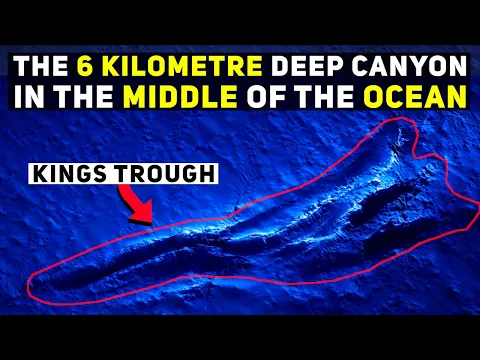

This extent places the system among the largest linear features ever identified on the floor of the Atlantic, highlighting the capacity of tectonic forces to shape the planet in dimensions that often go unnoticed from the surface.
Most of these formations remain invisible to the direct human eye, being revealed only by modern ocean mapping technologies.
Formation is Linked to a Rare Tectonic Event Between Europe and Africa
The origin of the King’s Trough Complex is directly associated with a tectonic event considered unusual in the geological history of the Atlantic.
During the period between 37 and 24 million years ago, a zone of weakness developed between the tectonic plates of Europe and Africa. This region began to function as a temporary boundary, allowing internal forces of the Earth to create a progressive opening in the ocean floor.
This process did not occur abruptly, but rather gradually, with the ocean floor being deformed and extended over millions of years, creating a linear structure comparable to a continuous tear.
This type of phenomenon helps explain how the planet evolves structurally over time, revealing that tectonic plates are not static systems, but dynamic and subject to complex changes.
Volcanism of the Azores Played a Fundamental Role in the Formation
Another determining factor for the formation of the system was the volcanic activity associated with the Azores region.
The area where the King’s Trough Complex is located is close to a zone known for intense geological activity, influenced by a mantle plume — a current of hot material rising from the Earth’s interior.

Studies indicate that a primitive arm of this volcanic system contributed to weakening the oceanic crust, facilitating the tectonic rupture process that gave rise to the complex.
This type of interaction between volcanism and tectonics is fundamental to understanding how large submarine structures are formed.
High-Resolution Sonar Technology Was Essential for the Discovery
Although the King’s Trough had been known for decades, a detailed understanding of its origin was only made possible thanks to technological advancement.
The use of high-resolution multibeam sonar, combined with seismic data and geological sample analysis, allowed for precise mapping of the ocean floor’s topography.
These technologies revealed previously invisible details, such as the continuity of structures, exact depths, and deformation patterns that clearly indicate tectonic action.
The advancement in ocean mapping has allowed scientists to discover and reinterpret structures that were hidden beneath kilometers of water.
Peake Deep Stands Out as One of the Deepest Points in the Region
Within the system, one of the most striking points is the so-called Peake Deep, considered one of the deepest areas of the complex.
Although it is not the deepest point in the entire Atlantic, it stands out within the structure for its significant depth and how it integrates into the submarine valley system.
This region helps illustrate the intensity of the forces that acted during the formation of the complex, creating deep depressions on an oceanic scale. These environments are also of great scientific interest due to their extreme conditions and possible unique ecosystems.
Submarine Structures Reveal Invisible Dynamics of the Planet
The study of the King’s Trough Complex reinforces a central idea in modern geology: much of the planet’s transformations occur far from the visible surface.
The ocean floor, which covers more than 70% of the Earth, is still less known than many terrestrial environments. Structures like this demonstrate that there are ongoing processes — or recorded in the past — that shape the planet on gigantic scales.
The analysis of these formations allows for the reconstruction of ancient geological events, understanding tectonic movements, and predicting future behaviors of the plates.
Comparison with Other Formations Expands Geological Understanding
Although the King’s Trough Complex is often compared to the Grand Canyon, the differences are important. While the Grand Canyon was formed by river erosion over millions of years, the Atlantic system is the result of internal tectonic forces.
This distinction shows that similarly appearing structures can have completely different origins, reinforcing the complexity of geological processes. Still, the comparison in terms of scale helps to dimension the magnitude of the structure.
The results released in 2026 directly contribute to the understanding of the evolution of the Atlantic Ocean. The study indicates that the ocean was not formed merely by simple plate separation processes, but by more complex events, including intermediate phases and temporary boundaries.
This type of discovery helps refine geological models and improves understanding of how continents and oceans evolve over time.








Seja o primeiro a reagir!