





 Portuguese
  English
  Spanish
  5 min of reading
  0 comments


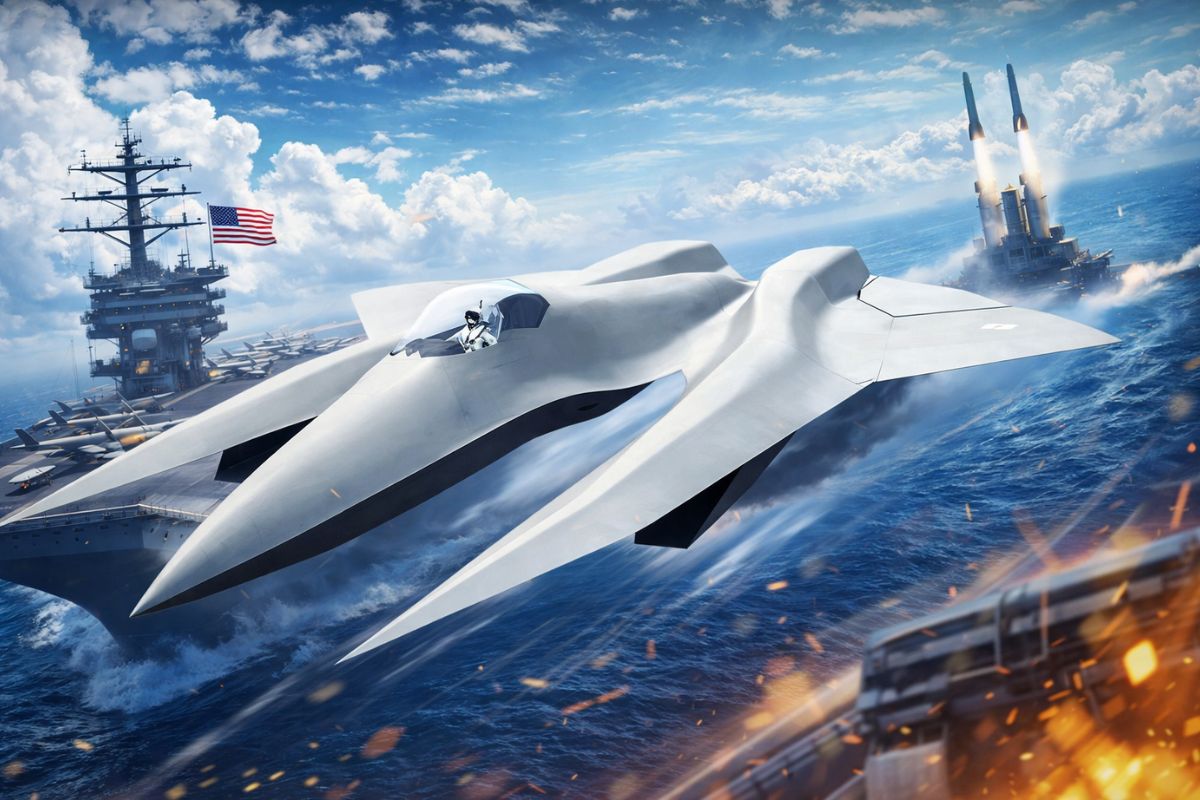
The new fighter called SM-39 Razor has a bat wing silhouette and was proposed for the program that will replace the F/A-18 Super Hornet on American aircraft carriers, promising hypersonic speeds of Mach 4 and stealth capabilities that surpass everything currently existing in naval aviation.
According to information from the portal Cronista, the United States Navy is defining what will be the next generation of naval air power, and one of the concepts that emerged in this process has an appearance that seems straight out of science fiction. The SM-39 Razor is a bat-shaped fighter proposed by Stavatti Aerospace for the F/A-XX program, which aims to replace the current F/A-18 Super Hornet as the main carrier-based aircraft of the American fleet. The promises are bold: Mach 4 speeds four times the speed of sound, advanced stealth technology, and the ability to operate from aircraft carriers.
The project is part of a technological race that will define aerial combat in the coming decades. The sixth generation fighter is not just an evolution of what exists today; it is an attempt to leap an entire generation in terms of performance, stealth, and peculiarities. And the SM-39 Razor, with its radical silhouette and numbers that challenge the limits of current engineering, represents the boldest side of this debate. But boldness and solutions are different things, and that’s where the story gets interesting.
What is the F/A-XX program and why does the Navy need a new fighter
The F/A-18 Super Hornet has been the main carrier-based fighter of the American Navy for decades. It does everything: air superiority, ground attack, escort, and electronic warfare. But it is aging.
-
While lunar missions are deploying increasingly larger robots, Japan has bet on a small SORA-Q the size of a palm, which transformed on the Moon and photographed the SLIM landing.

-
Genetic study shows that Europe after Rome was not born from a lightning invasion, but from families, migrations, and a lot of mixing.

-
China wants to install a giant power bank in space to harvest solar energy continuously, day and night, and has already tested on the ground, in a 75-meter tower, the wireless transmission of energy over a distance of 100 meters to various moving targets.
-
The brute force of the waves turns into clean energy with almost no waste, as promised by a gyroscopic converter created in Japan that, in simulations, couples with the sea’s sway and reaches the maximum limit of 50% efficiency, leaving old marine generators behind.


The F/A-XX program exists precisely to develop the fighter that will take the place of the Super Hornet on aircraft carriers, with capabilities designed for the combat scenarios of the next three or four decades.
The difference between what the Navy needs and what the Air Force is pursuing is fundamental. The naval fighter needs to take off from short distances with a catapult, board a moving aircraft, resist the corrosion of the maritime environment, and withstand the structural impact of thousands of forced landings.
This description opens the door for unconventional designs, and it is precisely in this space that the SM-39 Razor positions itself as a radically different fighter from anything naval aviation has ever operated.
What is the SM-39 Razor like and why does it look like a bat

The SM-39 Razor was proposed by Stavatti Aerospace with an architecture that engineers call an integrated wing and fuselage design.
In practice, this means that the fighter has no clear separation between body and wings; everything is a continuous surface, with multiple angular edges that give the whole a bat silhouette. This shape is not aesthetic; it is functional. Each angle is calculated to deflect radar signals and reduce the aircraft’s detectable signature.
The design envisions a twin-engine, stealthy fighter with internal payload capacity, meaning weapons are housed within the fuselage, without external pylons that would increase the radar signature.
According to Stavatti’s forecasts, the SM-39 would be capable of supercruise at speeds far exceeding those of current fighters, with predictions reaching Mach 4. To put it in context: the F/A-18 Super Hornet reaches Mach 1.8.
The F-22 Raptor, considered the most advanced fighter in operation today, supercruises at Mach 1.82. A fighter at Mach 4 would be unprecedented in the history of carrier-based military aviation.
Why Mach 4 is a promise that raises serious doubts about the fighter
Four times the speed of sound is the kind of number that makes any aviation enthusiast pay attention and any aerospace engineer raise an eyebrow. Military aviation experts warn that reaching Mach 4 with turbofan engines presents extreme challenges in terms of thermal management.
These speeds, the friction with the air heating the fuselage to temperatures that require special materials and coatings – and cooling the engines becomes a monumental engineering problem.
There is another paradox in the design of the fighter. Hypersonic speed generates a huge infrared signature; basically, the aircraft becomes an incandescent point for heat sensors.
For a fighter that aims to be stealthy, flying at Mach 4 and remaining invisible at the same time is a contradiction that current physics does not easily resolve. This does not mean it is impossible, but it means that possible technological solutions do not yet exist in operational form.
What Stavatti Aerospace really delivers beyond fighter concepts
This is the point where skepticism from the specialized community becomes more concrete. Stavatti Aerospace has a long history of impressive conceptual designs but has never designed an operational prototype. None of its previous proposals reached the flight test stage, let alone mass production.
In the context of the F/A-XX program, where giants like Boeing and Northrop Grumman compete—companies with decades of experience in building fighters that actually fly and operate from aircraft carriers—Stavatti’s position is delicate.
The U.S. Navy has not officially confirmed that the SM-39 Razor has been presented as a formal proposal within the program, which reinforces the perception that the project is, for now, more of a conceptual demonstration than a real candidate. This does not diminish the value of the proposal as an engineering exercise, but it places the fighter in a different category from an actively developing project.
What the SM-39 Razor reveals about the future of sixth generation fighters
Regardless of whether the SM-39 Razor becomes a reality or not, the concept sheds light on where military aviation is heading.
The sixth generation fighter, whatever it may be, will need to combine advanced stealth, long range, high payload capacity, integrated electronic warfare, and possibly coordinated operation with independent drones.
The Razor attempts to put all of this into a single package and still adds hypersonic speed.
The debate between what is undesirable and what is feasible is precisely what defines a conceptual phase of any military program.
The SM-39 Razor is the most speculative and imaginative side of this debate about the future of naval fighters—a demonstration of how far engineering can dream before comparing itself with the limits of physics, budgets, and industrial reality.
Boeing and Northrop Grumman will likely present more conservative proposals. But it is in bold projects like the Razor that ideas are found that eventually end up being incorporated, even if partially, into the aircraft that actually take off from aircraft carriers.
What do you think: a bat-shaped fighter flying at Mach 4 is the future of naval aviation or pure science fiction? Leave your opinion in the comments.







Be the first to react!