






 Portuguese
  Spanish


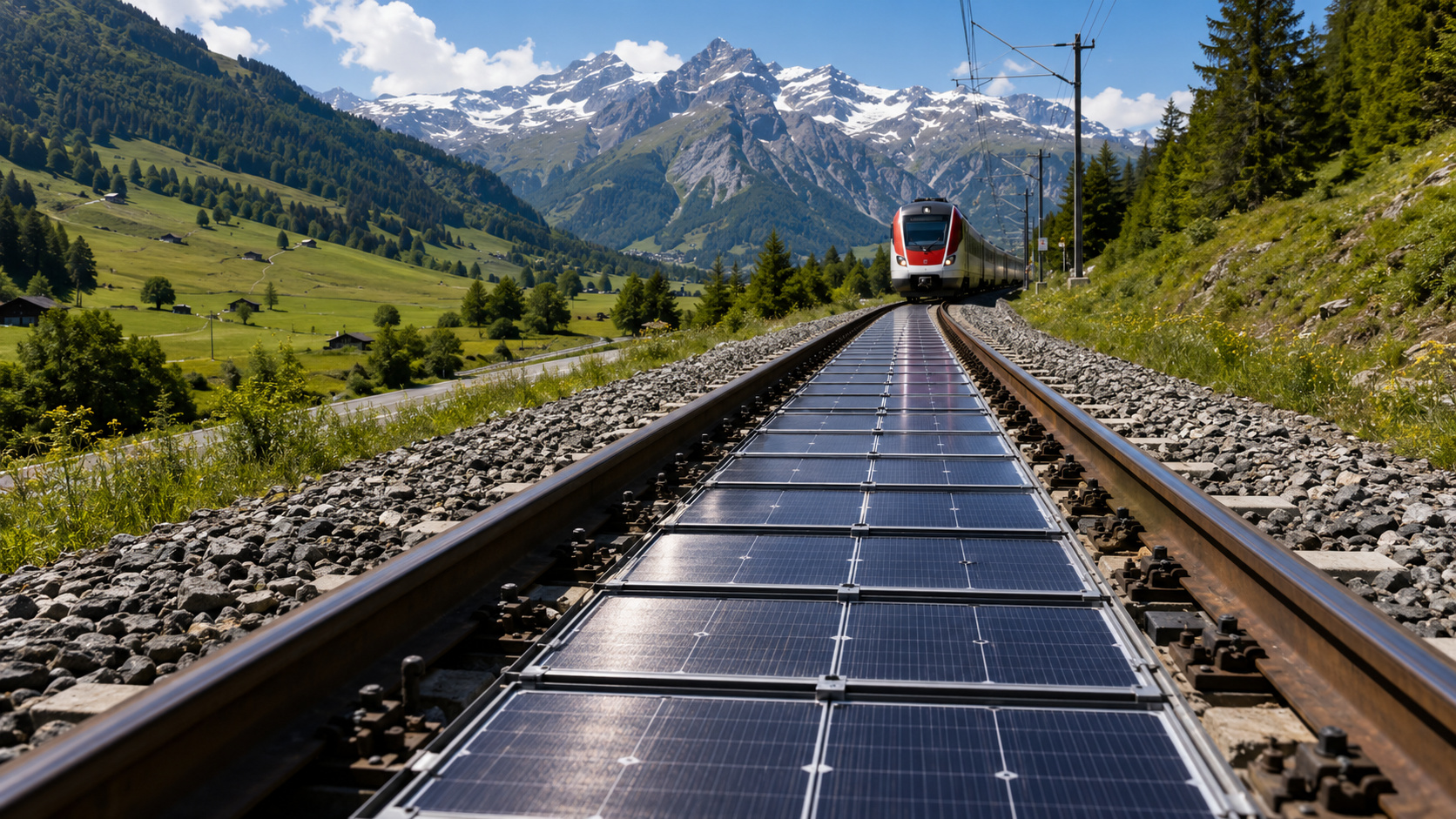

Sun-Ways installed removable solar panels between active tracks in Switzerland and paved the way for railways to generate clean energy without occupying new areas.
Sun-Ways inaugurated on April 24, 2025, in Buttes, in the Swiss canton of Neuchâtel, what is being considered the world’s first operational project with removable solar panels installed on an active railway line. The proposal takes advantage of the space between the tracks to produce renewable electricity without competing for area with agriculture, forests, or urban expansion.
The pilot occupies about 100 meters of track, uses 48 photovoltaic modules of 380 W, totals 18 kWp of installed power, and was designed to generate about 16,000 kWh per year, a volume deemed sufficient to meet the annual consumption of four to six Swiss households.
Removable solar panels between active tracks place the Swiss railway at the center of the new generation of solar energy
The innovation of Sun-Ways is not only in the use of photovoltaic modules on a railway, but in the fact that the system was designed to operate on a line open to passenger traffic. This differentiates the project from other solar energy experiences in railway infrastructure and makes Buttes a real test, not just a laboratory concept.
-
500 MW Solar Plant in China Reproduces Dangerous Oscillation, Allowing Sungrow Inverters to Identify Grid Strength in 40 ms Before Stabilizing Voltage and Frequency

-
Researchers Bring Solar Energy to Indigenous Villages in Amapá and Pará, Transforming Electricity into a Tool for Community Workshops and Income Generation in Remote Regions

-
Brazil Depends on China for 99% of Imported Solar Panels, Highlighting Unique Reliance in the Photovoltaic Market and Igniting Debates on Domestic Industry, Prices, Supply Chain, and Energy Security
-
This Unique Renewable Energy Plant Survived Years Without Oil and Will Continue With More Wind, Solar, and Batteries


The system was implemented between the tracks, on the sleepers, with the proposal to occupy a strip that normally remains underutilized along the railway network.
The idea was born precisely from the understanding that the railway can serve not only for transportation but also as a continuous surface for electricity generation.
This logic expands the reach of solar energy without requiring the opening of new territorial occupation fronts. Instead of seeking only rooftops, parking lots, or free areas, the Swiss project attempts to incorporate renewable generation directly into an already established infrastructure.
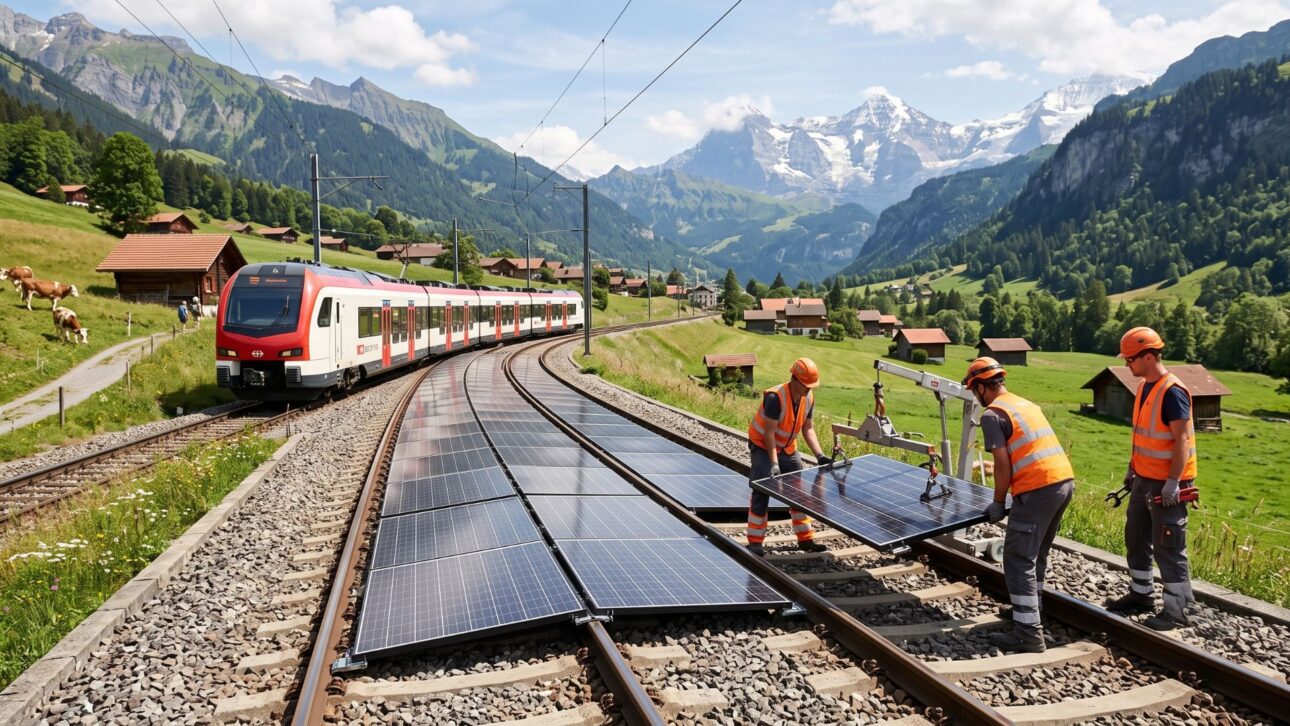
Railway system with removable solar modules designed to allow quick maintenance and continuous line operation
One of the central points of the technology is removability. The modules can be removed to allow inspections, repairs, component replacement, and maintenance interventions on the track, without turning solar electrification into a permanent obstacle for railway operation.


In the testing phase, the ease of removal became one of the project’s key aspects. In 2026, the founder of Sun-Ways told Swissinfo that a module with three panels, measuring six meters, can be removed from the tracks and disconnected from the network in about ten minutes with dedicated tools.
This feature gives the system an important operational advantage. Instead of requiring heavy construction for each intervention on the line, the model was designed to coexist with the railway routine and preserve access to the infrastructure whenever there is a technical need.
Specialized railway machine installs up to 1,000 square meters per day and accelerates the expansion of solar energy on the tracks
The installation of the modules can be done manually, but the project gained real scale with the use of a machine from the Swiss company Scheuchzer, adapted to place and remove the panels directly on the track. The goal is to transform the assembly into an industrial railway process, not a low-productivity artisanal work.
According to Swissinfo, this equipment can install or remove almost 1,000 square meters of panels in a few hours. This data is strategic because it tackles one of the main challenges of any new infrastructure technology: the cost and time of large-scale implementation.
With this, the space between the tracks ceases to be just a technical strip and becomes treated as an energy corridor. Sun-Ways’ proposal is precisely to transform an area already integrated into the railway network into a platform for distributed electricity generation throughout the territory.
Swiss railway network of 5,320 kilometers could generate 1 billion kWh and supply 300,000 homes
The ambition of the project goes far beyond the Buttes section. The estimate released by Sun-Ways and reproduced by Swissinfo indicates that the approximately 5,320 kilometers of the Swiss railway network, excluding tunnels and less sunny areas, could generate up to 1 billion kWh per year.
This volume would be equivalent to the annual consumption of about 300,000 households and around 2% of the electricity used in Switzerland. In a country seeking to expand renewable generation, this data helps explain why the experiment attracted attention even before leaving the pilot phase.
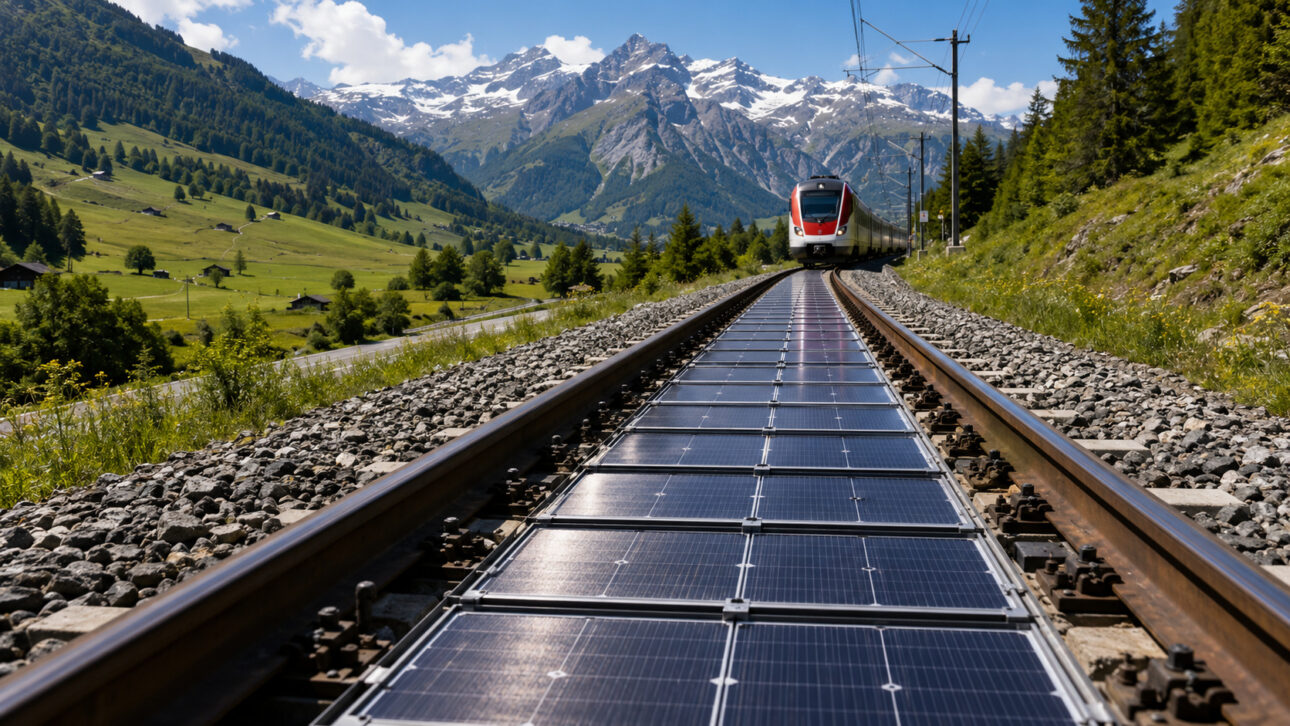
The project also fits into a broader logic of intensive use of existing infrastructure. Instead of opening new areas for plants, the proposal tries to convert an already implemented railway corridor into an additional source of clean electricity, with the potential for large-scale repetition.
Sun-Ways project received approval from the Swiss regulator and will be monitored until 2028 under real operating conditions
The authorization for the test came from the Swiss Federal Office of Transport, which adopted a cautious stance towards the novelty. Swissinfo reported that the agency approved the pilot in Buttes because the trains on the section run at a moderate speed of up to 70 km/h, and determined that the testing phase should last a minimum of three years.
The purpose of the monitoring is to measure track behavior, wear, maintenance, inspection, reflections, dirt accumulation, and compatibility with the railway routine in all seasons. In practice, the technology will only be able to advance to new levels of adoption if it proves consistent technical performance in continuous operation.

So far, the reported signs are positive. In June 2026, Swissinfo reported that more than 11,000 trains had already passed over the panels and that the installation had proven stable and safe, with no conflicts reported with traffic, maintenance, or line infrastructure.
Partnership with SNCF and international interest show that the Swiss solar railway has already begun to influence other networks
The project stopped being a local curiosity when it began to attract external interest. The SNCF, a French railway group, formalized cooperation with Sun-Ways to study the impacts of the technology on maintenance, inspection, electricity generation, and railway operation, using Buttes as a learning field until April 2028.
This movement has strategic weight because SNCF is one of the largest electricity consumers in France and seeks to expand its photovoltaic production. By following the Swiss pilot, the company begins to evaluate whether the space between tracks can become another front of generation within the European railway sector.
If the technology confirms technical and economic viability, the consequence could be significant: railways cease to be just mobility corridors and also function as clean energy corridors, integrating transport and electricity generation in the same infrastructure.


