





 Portuguese
  English
  Spanish
  6 min of reading
  0 comments


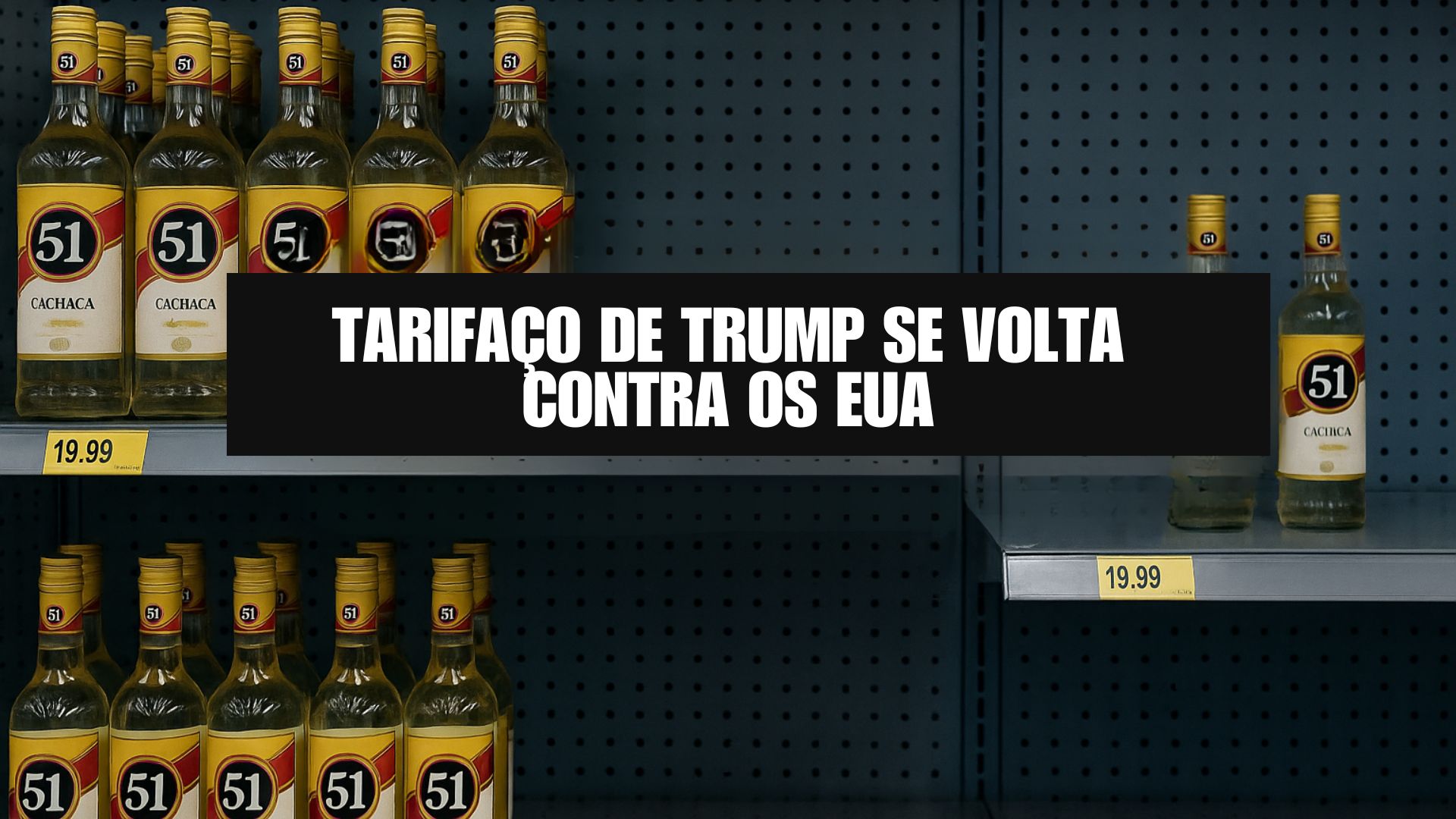
50% Surcharge Imposed by Trump Government Threatens to Make Cachaça Exports to the United States Infeasible, Main Market for Brazilian Premium Spirits, and Is Already Causing Order Cancellations and Declines in Revenue for Small Producers.
Brazilian cachaça is facing an unprecedented barrier in the United States. With the additional 50% tariff decreed by President Donald Trump, producers report paralysis in sales, order cancellations, and suspension of negotiations.
According to the newspaper Folha de S. Paulo, the impact is already showing in the sector’s accounts: exporters estimate a 12% decline in revenue from the American market and a retraction in the volume sold.
Although the country is only the third in purchase volume — behind Paraguay and Germany — the U.S. ranks highest in price per liter, paying, on average, 96% above the global average for higher value-added labels.
-
Inflation in March reaches 0.88% according to IBGE and pressures the Brazilian economy, impacting family budgets and requiring more strategic decisions to maintain financial control.
-
In Paraná, distributor Pacto connects 100% of the load in Coronel Vivida to batteries: a BES of 10 MW and 20 MWh costs just over R$ 30 million and lowers the local tariff now.

-
With a dependence of up to 80% on gas imported from the United States, Mexico is responding with a robust energy strategy, betting on shale gas, creating a scientific committee, and preparing to expand natural gas production to reduce vulnerability and strengthen its energy security in the coming years.
-
The United States proposes to Brazil a critical minerals agreement with a minimum price to combat Chinese dumping and priority for investment, but the Planalto is blocking the signing out of fear of upsetting China and due to electoral calculations in a year of competition.
Therefore, the destination is considered the most profitable for Brazilian cachaça and, at the same time, the most sensitive to cost changes.
Immediate Impact on Business
In family-owned properties and artisanal distilleries, the change in access to the American market has stalled operations.
One of the voices describing the scenario is Katia Alves Espírito Santo, owner of Cachaça da Quinta, a century-old company founded in 1923 in the municipality of Carmo (RJ).
According to her, half of the production went to the United States through an importer that markets the drink under the brand Avuá.
“We are a small business focused on a premium product. It has been a violent impact because it completely affects the operation,” says the entrepreneur.
The distillery reduced production after order freezes.
“My fear is losing work that began over ten years ago. We had to reduce production because many orders stopped. I still don’t know how it will turn out,” she says.
Strategic Weight of the U.S. for Cachaça
The North American market has been sustaining the internationalization strategy of several Brazilian brands.
In 2024, the U.S. imported 824 thousand liters, with business worth US$ 3.6 million.
Although the figure represents a small fraction of national production, the profitability of this destination kept lines operating and provided breathing room for micro and small businesses.
The logic is known to exporters: premium and aged labels achieve better prices in the U.S. than in other countries.
Consequently, any abrupt tariff variation alters cost structures and forces importers to reconsider contracts, extend deadlines, or cancel orders.
Sector Reaction and Alert to Competitive Imbalance
The Brazilian Institute of Cachaça (Ibrac) gathered reports from associates and communicated the situation to the Ministry of Agriculture and Livestock (Mapa), which is monitoring the case through the Sector Chamber of the Cachaça Production Chain.
According to Ibrac’s executive director, Carlos Eduardo Cabral de Lima, the consequences are immediate:
“The announcement of the surcharge has already caused immediate and severe consequences for exporting companies, because any change in access conditions puts cachaça in a position of unequal competition with other alcoholic beverages that are already consolidated in the American market.”
The institute’s projections indicate a 12% reduction in external revenue and a decline of at least 6% in the volume shipped to the U.S.
For Lima, the trend is concerning: “The low competitiveness against other spirits means that, in the medium term, cachaça could be excluded from the American market. What is at stake is the sustainability of thousands of small producers.”
Size and Capillarity of the Production Chain
In Brazil, the cachaça chain is extensive and fragmented. More than 1,200 producers are registered with Mapa, responsible for 7,223 brands.
The annual production reported by companies in the sector reaches about 800 million liters, generating more than 600 thousand direct and indirect jobs.
The base of this workforce is in rural areas, in small enterprises that depend on a regular cash flow and higher-margin markets to sustain their structure.
Emergency Credit to Secure Cash Flow
To mitigate financial losses, producers turned to an emergency line from the Brazil Sovereign Program, announced on August 13, aimed at exporters affected by tariffs imposed by the U.S.
The program design allocates R$ 30 billion from the Export Guarantee Fund combined with R$ 10 billion from BNDES, totaling R$ 40 billion for working capital and operational adaptations, with a fixed rate of up to 0.66% per month.
“It’s government support that provides some relief while this situation is not resolved definitively,” says Katia, indicating that the line helps to maintain commitments while negotiations do not progress.
Difficulty in Redirecting Production
Unlike sectors with wide substitution of destinations, cachaça faces cultural barriers.
Consumption is associated with local habits and cocktail culture, which requires demand building over the years, involving investment in consumer education, bartender training, and constant presence at points of sale.
In this context, Paraguay leads in imports due to logistical and cultural proximity, while Germany maintains a tradition of spirits consumption that favors the entry of new labels.
The global interest in the drink caipirinha serves as a gateway but does not replace, in the short term, the scale and margin obtained in the U.S.
Political Negotiations and Horizon of Uncertainty
Entrepreneurs and entities see in the conversations between President Luiz Inácio Lula da Silva and Donald Trump a possibility to reopen paths.
Meanwhile, importers await concrete signals to resume purchases.
The sector evaluates that any diplomatic advance that reduces costs at the border may prevent the exclusion of cachaça from American shelves and preserve jobs in municipalities dependent on the activity.
Without tariff relief, the tendency is to postpone investments, cut inventories, and renegotiate debts.
Depending on the duration of the impasse, small brands may lose space built over a decade, especially those that have bet on the premium niche and gained distribution in bars and restaurants in the U.S.
What Is at Stake for the American Consumer
For Brazilian families living in the United States and for the audience that discovered cachaça through cocktails, the price increase and the loss of availability have already turned the spirit into a sporadic product, more present in memories than on shelves.
Importers report declines in orders and retailers reduce assortment, prioritizing competing drinks with better cost-benefit ratios after the tariff.
The maintenance of the scenario tends to raise caipirinha prices in bars, restrict promotions, and limit the variety of brands.
Even established labels, which can absorb part of the shock due to scale or old contracts, find it difficult to plan new shipments with compressed margins.
If the tariffs remain at current levels, producers are evaluating suspending shipments and focusing on regional markets, which slows down the internationalization of cachaça and reduces the spirit’s presence in the largest global showcase of beverages.
In light of this situation, which path should prevail: an agreement that alleviates the tariff or a definitive reconfiguration of Brazilian brands’ strategy outside the U.S.?






Seja o primeiro a reagir!