





 Portuguese
  English
  Spanish
  3 min of reading
  0 comments


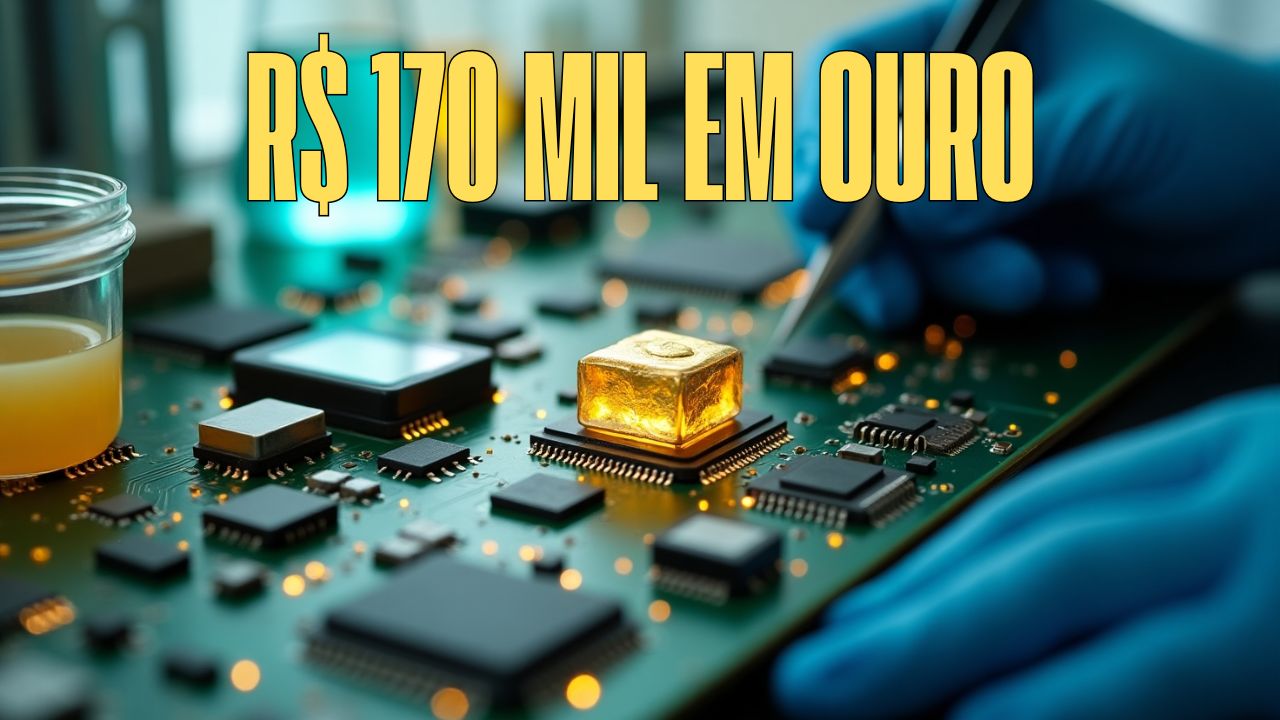
Swiss Researchers Develop Sustainable Method That Transforms Electronic Waste Into Gold Nuggets. Brazil Can Benefit From The Technology, As It Generates More Than 2 Million Tons Of E-Waste Per Year.
A team of scientists from ETH Zurich in Switzerland has developed a revolutionary technique to extract gold from electronic waste, using a substance derived from whey. The method allows for the recovery of up to R$ 170,000 per ton of electronic waste, in an economical and environmentally safe manner. The discovery was published by the university’s scientific journal and covered by outlets such as Época Negócios, the Sustentix portal, and the Escola Educação website.
The new approach offers a viable alternative to traditional mining and the use of toxic products like cyanide, bringing great possibilities for both industry and the environment.
A Hidden Gold Mine in Electronic Waste
Electronic waste — made up of discarded computers, cell phones, circuit boards, and appliances — contains valuable metals such as gold, silver, copper, and palladium. It is estimated that a ton of e-waste can contain up to 10 times more gold than a ton of raw ore, according to the “Urban Mining” study from CETEM/Mineralis.
-
IPTU exemption for seniors in 2026: see how to secure the benefit.

-
The institute that trained the greatest aerospace engineers in Brazil has just opened its first campus outside São Paulo after 75 years: ITA Ceará will have R$ 445 million, new courses in energy and systems, and classes are expected to start in 2027.
-
Luciano Hang, owner of Havan, goes to Juiz de Fora after the tragedy in February, brings R$ 1 million, hands out R$ 2,000 cards, and donates up to R$ 15,000 to victims in the region.

-
The Brazilian passport allows legal residence in dozens of countries without the need for a prior visa, and most Brazilians are unaware that they can apply for residency directly upon arriving in nations in South America, Africa, and even Europe.


According to the United Nations (UN), the world generated over 53.6 million tons of electronic waste in 2020, and less than 20% was properly recycled. Brazil alone produced about 2.1 million tons, making it the fifth-largest generator of e-waste in the world.
How The Extraction Works With Whey
The innovation by ETH Zurich researchers lies in the creation of a sponge made from protein nanofibrils, extracted from whey — a common by-product of the dairy industry.
According to Época Negócios, this sponge is used to selectively capture gold ions dissolved in liquids extracted from electronic boards. The ions are then converted into solid gold nuggets with a purity greater than 90%.
The method eliminates the need for toxic and complex substances, reducing the environmental impact of urban mining. Operational costs are lower, making the technique feasible for industrial-scale implementation.
Economic Potential: Up To R$ 170,000 Per Ton
Based on calculations made by specialists and cited by the Escola Educação portal, a ton of electronic waste can yield up to R$ 170,000 in gold — a value significantly higher than the returns of traditional mining operations in natural deposits.
The value of the technique arises not only from the gold extracted but also from the potential to recover other precious metals and reusable components. The ETH Zurich project envisions that the technology could be adapted to also extract silver and copper in future versions.
Brazil Can Benefit From The Technology
With one of the largest productions of electronic waste in Latin America, Brazil can directly benefit from this innovation. Implementation in recycling cooperatives and electronics processing hubs could generate income, jobs, and reduce environmental impacts.
According to Instituto GEA, over 90% of Brazilian e-waste is still improperly disposed of or underutilized, with only 3% being recycled by specialized companies. The adoption of methods like the one from ETH could transform this scenario.








-

Uma pessoa reagiu a isso.