





 Portuguese
  English
  Spanish
  5 min of reading
  0 comments


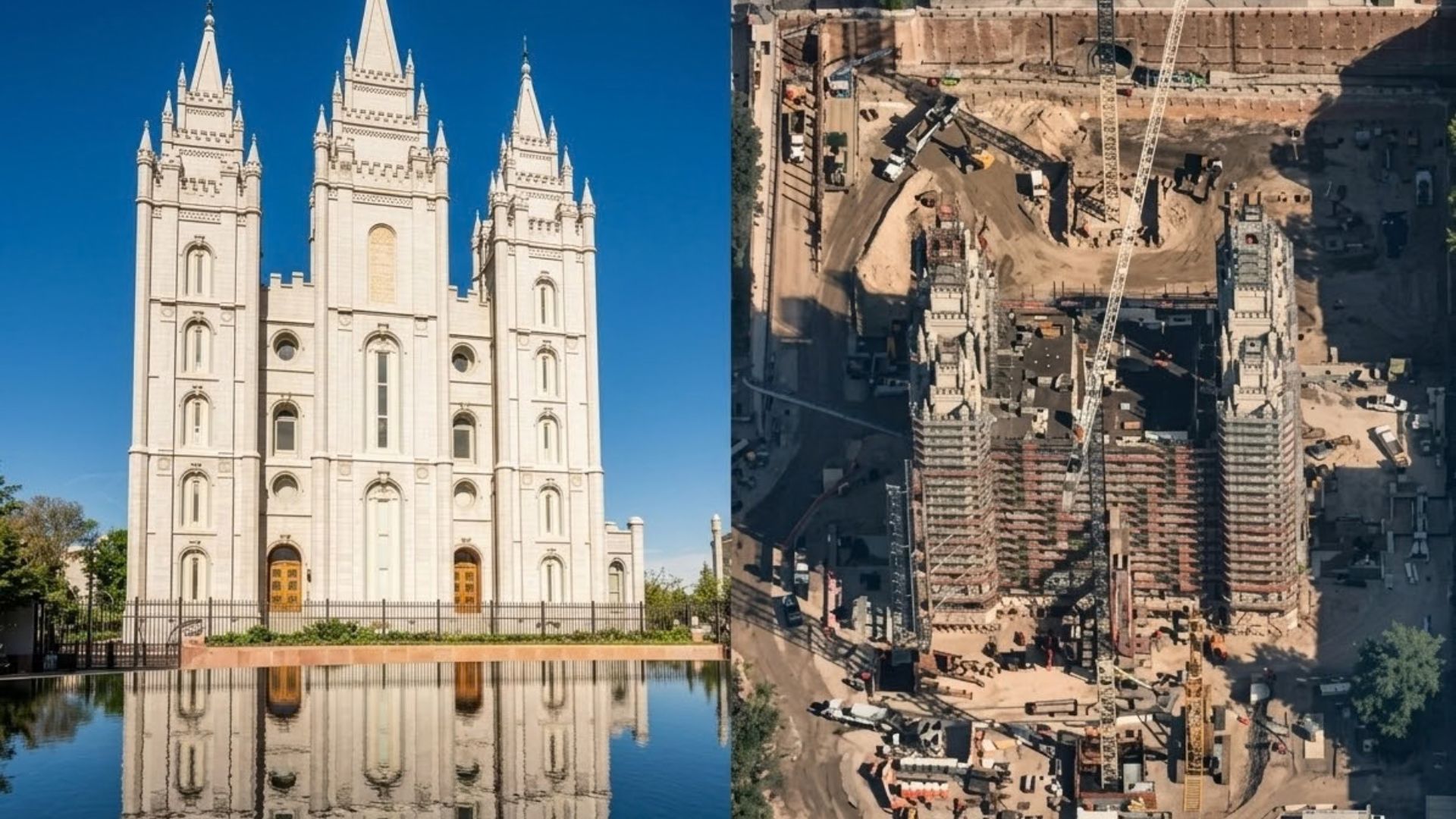
Deep Excavation, Seismic Engineering, and Historical Preservation Combine in One of the Largest Retrofit Projects in the United States, Taken Place Under a 130-Year-Old Temple Without Altering Its Most Recognizable Image and With Structural Solutions That Are Nearly Invisible to Those Who View the Building from the Outside.
The Salt Lake Temple, the main religious landmark of Temple Square in Utah, is undergoing one of the most complex structural interventions ever made on a historic building in the United States.
The project combines deep excavation, foundation replacement, internal reinforcement, and the installation of 98 seismic isolators to reduce the impact of major earthquakes on a structure completed in 1893, with granite walls that are up to nine feet thick at the base, equivalent to about 2.7 meters.
The completion of the renovation is scheduled for the end of 2026, with a public reopening planned for 2027.
-
Congonhas receives the monorail promised for the 2014 World Cup after more than a decade of delays and becomes the first airport in Brazil with integrated subway.
-
Goodbye, concrete: a new trend in civil construction reduces the weight of the structure by up to 30%, accelerates projects by up to 40%, cuts costs on steel and labor, and improves thermal insulation with EPS.
-
Russian engineers create an innovative propeller blade for aircraft that could completely change the way airplanes and helicopters operate.

-
Couple finishes building PVC chalet on the beach on the last day, with air conditioning and curtains, but discovers the bathroom drain is inverted: water escapes from the drain, risking breaking the floor, and the rush continues before the trip.


The scale of the intervention can be explained by the fact that the temple was built at a time when modern seismic engineering standards did not exist.
The building was designed to bear enormous vertical loads but not to efficiently dissipate lateral movements from a strong earthquake.
In 2019, when announcing the temple’s closure for renovations, The Church of Jesus Christ of Latter-day Saints stated that the project’s main focus would be a deep seismic modernization.
Studies cited by local media indicated that, without this adaptation, the structure would face severe risk during a major quake in the region.
The urgency stems from the geological context of northern Utah.
The Salt Lake City metropolitan area lies within the influence of the Wasatch Fault, a tectonic system considered the main seismic threat to the state.
In a report published when the modernization was announced, experts associated with the preservation history of the Utah Capitol stated that the Salt Lake Valley could experience an earthquake of magnitude 7.3, a scenario used as a reference for the temple’s new protection system.
Seismic Retrofit Under Historic Granite Walls
To install the new structural base, engineers needed to create a bottom-up solution, literally under a monumental construction that could not lose its historical form.
The official project update explains that retaining walls were constructed, and the soil could be excavated about 17 feet, or 5.2 meters, below the original foundation, both on the inside and outside of the temple, to the level where the new lower foundations rest.
At the same time, project communications noted the creation of an operational slab 35 feet, or approximately 10.6 meters, below the former sidewalk level around the building.
This process required temporary shoring and gradual load transfer to prevent the weight of the historic walls from compromising the intervention.
The temple’s outer walls are not decorative cladding but solid structural granite.
Therefore, each stage of excavation and consolidation of the new foundations needed to be synchronized with beams, reinforced concrete, and tension cables, so that the construction remained stable while the original ground ceased to be the main support of the structure.
Only later, when the new base began to bear the weight of the building, could the retaining walls and remaining soil beneath part of the structure be removed.
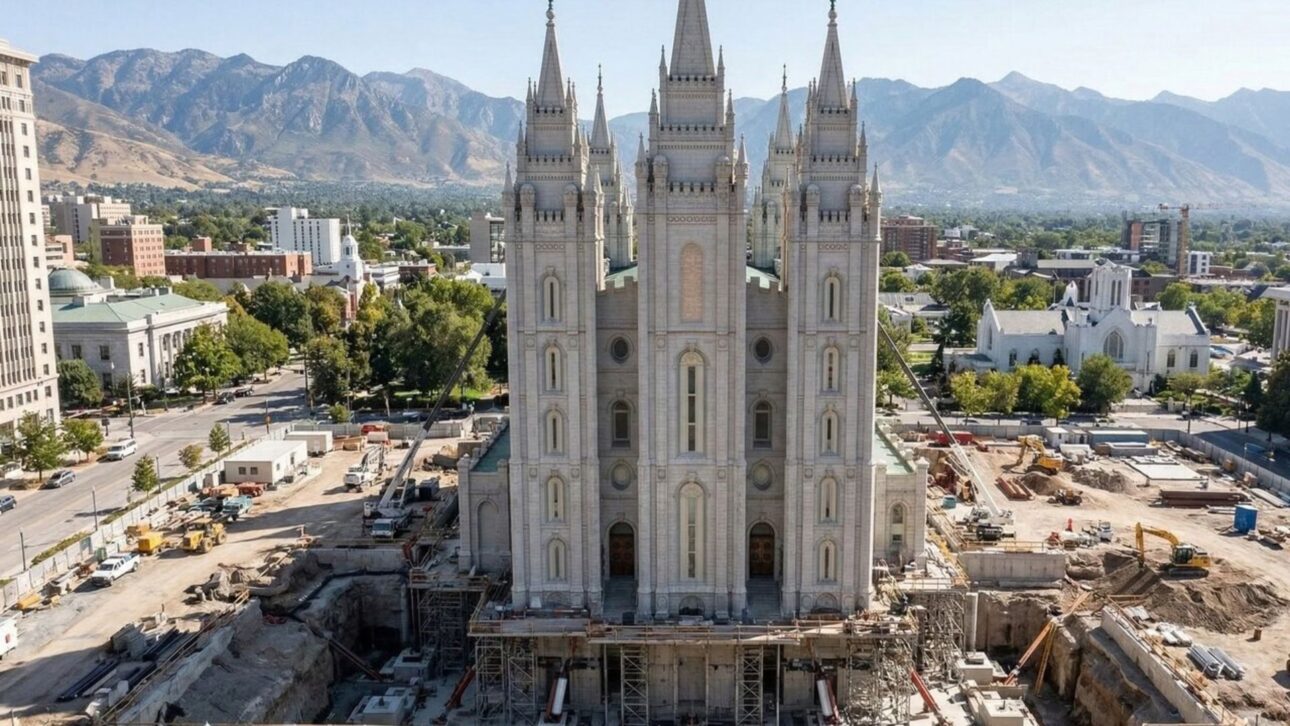
Only then did the isolators become free to perform their function: allowing the temple to shift horizontally during an earthquake instead of absorbing all seismic force rigidly, as would occur with a conventional foundation.
How the 98 Seismic Isolators of the Temple Work
The system chosen for the temple is base isolation, a technology already used in public buildings and historic landmarks subject to seismic activity.
In the case of Salt Lake, the Church states that 98 isolators were installed on the new lower foundations.
Each unit has a diameter of about 2 meters, weighs 18,000 pounds, or 8,165 kilograms, and allows for up to 5 feet of horizontal displacement in any direction, equivalent to about 1.5 meters.
In practice, this mechanism decouples the building’s behavior from the ground.
When the earth moves, the energy is not transferred directly and completely to the stone walls.
A significant portion of the effort is absorbed and controlled by the combination of rubber, steel, and internal components of the isolators, reducing the stresses that could open severe cracks, compromise towers, or cause partial collapse.
Still, the project is not limited to the movable supports.
Documentation and local coverage show that the temple also received steel reinforcements in walls, floors, ceilings, and towers, because isolation alone would not resolve all vulnerabilities of such heavy historic masonry.
Work in Salt Lake City and Comparison with Other Seismic Reinforcements
Comparison with other seismic works helps to measure the choice.
Utah has already applied base isolation in historic buildings like the Salt Lake City-County Building and the state Capitol.
In the case of the Capitol, 265 isolators were installed during the major renovation conducted between 2004 and 2008.
The difference is that the temple combines a rare mix of symbolic value, structural mass, architectural delicacy, and need for almost complete aesthetic preservation, which increases the complexity and cost of each stage of the work.
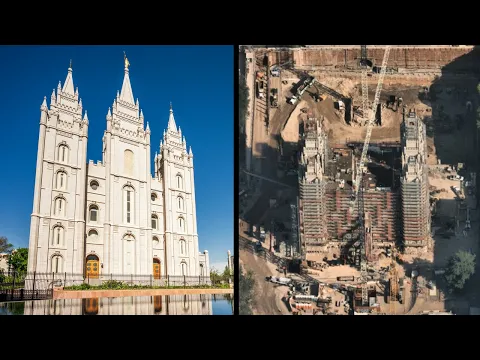

Historical Preservation and Underground Expansion of the Temple
The renovation is not just about seismic resistance.
According to the Church, the renovation aims to recover visual characteristics closer to the Victorian period of the late 19th century, as well as to reorganize the internal spaces to accommodate more people safely and comfortably.
The project adds 100,000 square feet of area, about 9,300 square meters, and expands the building’s functional capacity with new underground environments and redesigned internal circulation.
This combination of restoration and modernization explains why the work extends over the years and mobilizes simultaneous fronts of engineering, architecture, and conservation.
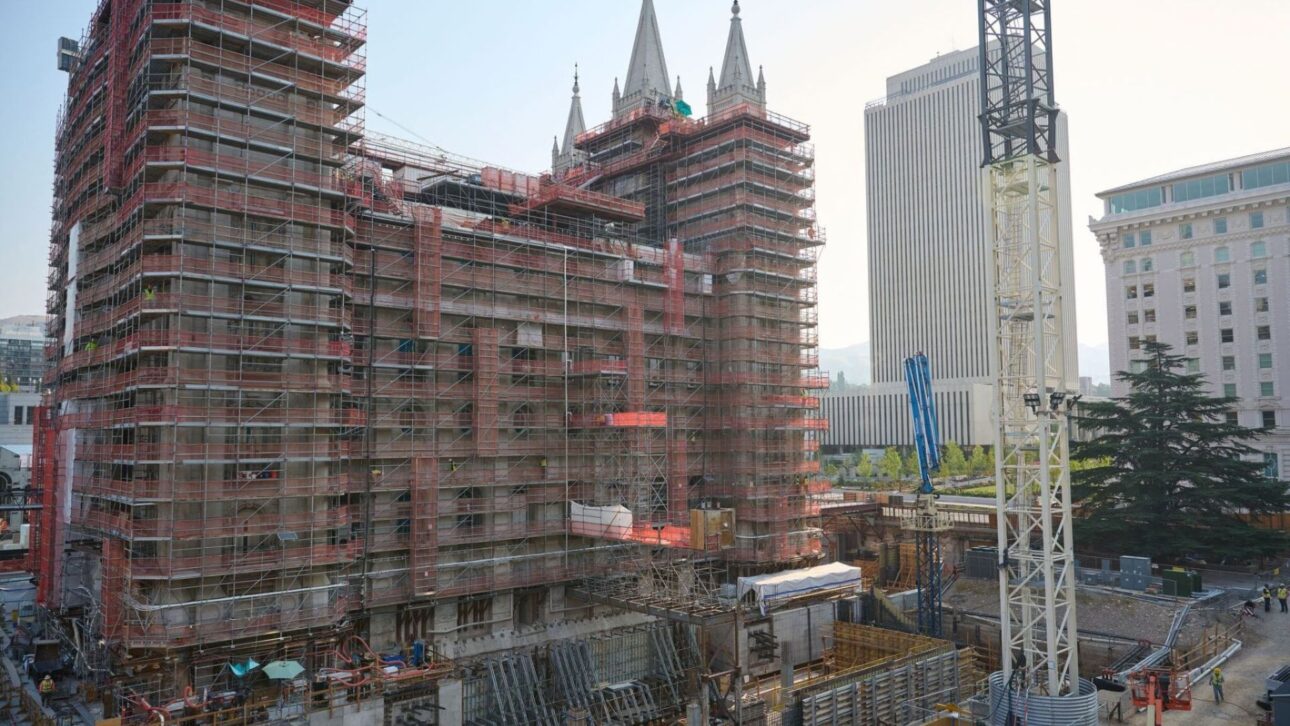
In January 2026, the Church reported that the removal of external scaffolding had already begun, signaling a transition between the heavy construction phase and the final finishes.
Even so, the institution maintains the forecast to complete the entire renovation complex by the end of 2026, ahead of a public celebration scheduled for 2027.
The Salt Lake Temple case has become a reference because it demonstrates how a structure built in the 19th century can be adapted to contemporary standards without losing its most recognizable visual identity.
Instead of demolition or apparent shielding, the solution adopted transfers the protection inside and below the building, in an intervention that almost disappears from the visitor’s view but redefines the monument’s ability to survive against the primary geological threat of the region.








-

Uma pessoa reagiu a isso.