





 Portuguese
  English
  Spanish
  4 min of reading
  1 comment


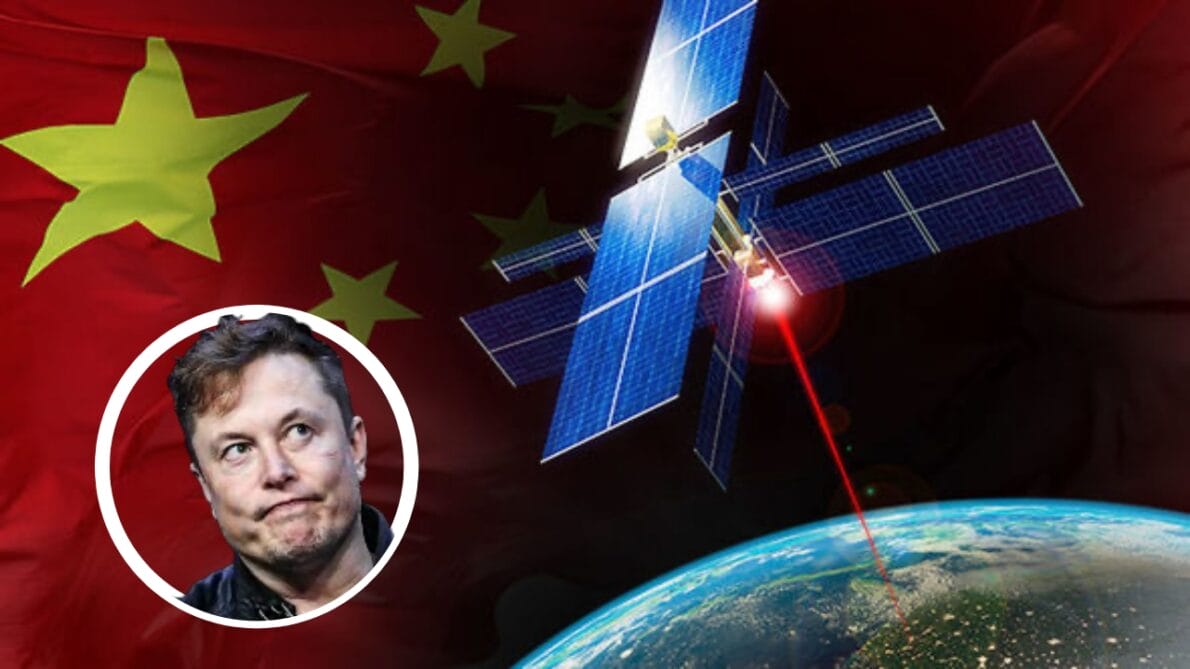

Chinese Military Reveals Surprising Technology to Destroy Parts of Starlink Constellation, Billionaire Elon Musk’s, Which Has Over 2,300 Satellites in Orbit
Imagine a scenario where futuristic technology comes out of the pages of science fiction and into the reality of geopolitical disputes: submerged submarines, invisible to radar, equipped with laser weapons capable of taking down orbiting satellites. This is the warning that China has just issued to Elon Musk, further intensifying tensions with the U.S.
In a revealing study, Chinese scientists from the People’s Liberation Army (PLA) detail how this cutting-edge technology could transform the balance of power in space and threaten the security of networks like SpaceX’s Starlink. Discover how this innovation could change the future of technological warfare and its implications for global security.
Scientists from China’s People’s Liberation Army (PLA) Reveal That Submarines with Laser Weapons Could Destroy SpaceX Satellites, Elon Musk’s
Scientists from the People’s Liberation Army of China (PLA) conducted studies that indicate Chinese submarines, equipped with laser weapons, could destroy SpaceX satellites if China’s security is at risk. This finding was published in a peer-reviewed article in the Chinese journal Command Control & Simulation, detailing how submarines equipped with megawatt lasers can target satellites while remaining submerged.
-
Global summit with over 40 countries pressures Iran for a blockade in the Strait of Hormuz and warns of direct impact on oil, food, and the global economy.

-
Russia has broken the U.S. maritime blockade to send oil to Cuba and is now loading a second ship while Trump says that “Cuba is next” in a possible military action against the island.

-
Spain challenges the USA and closes its airspace for operations against Iran, raising global tension and provoking the threat of a trade rupture.

-
While no other country manufactures tanks in Latin America, Argentina activates the TAM 2C-A2 and raises a curiosity about the technological lag in the region.


The study, led by Professor Wang Dan from the Submarine Academy, describes a submarine armed with a megawatt-class solid-state laser that can fire at satellites and then hide again at the seabed. The research emphasizes that the greatest challenge in anti-satellite operations is concealing the attack, normally carried out by ground-to-air missiles, which leave visible traces and are easily detected.
The researchers explain that surface operations are risky due to the high visibility of missile launches, which leave smoke trails and reveal the attackers’ location. Wang and her team note that the satellites of SpaceX’s Starlink program are small, numerous, and densely clustered, making the network resilient and difficult to dismantle by missiles.
Not Only China but Also the U.S. Consider Submarines for Anti-Satellite Attacks
Directed energy weapons, such as lasers and microwave systems, are viewed as the only effective way to target a large number of objects in low Earth orbit (LEO). Recently, China claimed to have developed a compact power source that could significantly reduce the size of a microwave weapon capable of taking down satellites. Elon Musk
Not only China but also researchers from the United States are considering the use of submarines for anti-satellite attacks. An article from the U.S. Naval Institute, published earlier this year, highlighted the stealth of submarines in such operations. Directed energy technologies on nuclear submarines could enable offensive space attacks while remaining hidden beneath the ocean’s surface.
China Fears That SpaceX, Elon Musk’s, Is Building a Spy Satellite Network for the United States
The PLA study includes a step-by-step guide for attacking satellites like those from Starlink from the sea. The process involves sending submarines equipped with lasers to specific maritime areas, waiting for the satellites to enter strike range. The laser weapon is raised and fires at the right moment, with positional guidance provided by other forces. After the attack, the submarine submerges again, waiting for new missions or returning to base.
While the study specifically mentions Starlink satellites, it does not detail why they would pose a threat to Chinese security. Previous reports suggest that China fears that SpaceX, owned by billionaire Elon Musk, is building a spy satellite network for the United States. This concern has escalated with the launch of the Starshield program, a collaboration between SpaceX and the Pentagon to track Chinese hypersonic weapons.
Ukraine Uses the Starlink System for Military Communications During the Russian Invasion, Worrying China with Possible Use by Taiwan
Ukraine has been using the Starlink system, owned by billionaire Elon Musk, to maintain military communications during the Russian invasion, an example that worries China, fearing similar use by Taiwan in the event of conflict. Chinese military experts warn that future Starlink satellites could carry additional payloads for military operations, such as electronic interference and reconnaissance.
With over 2,300 satellites in orbit, the Starlink network is considered resilient, typically functioning normally even with the loss of some satellites. Chinese researchers suggest a combination of destruction methods to disable parts of the constellation and compromise its operational system in potential future conflicts.










stoupid holewood take of china satklight clouse cable gamin bargge star light denny ice day ugly flaorda from nothers eat dinner call home now jinnahkhan ring satrin call hate miami1959