





 Portuguese
  English
  Spanish
  6 min of reading
  0 comments


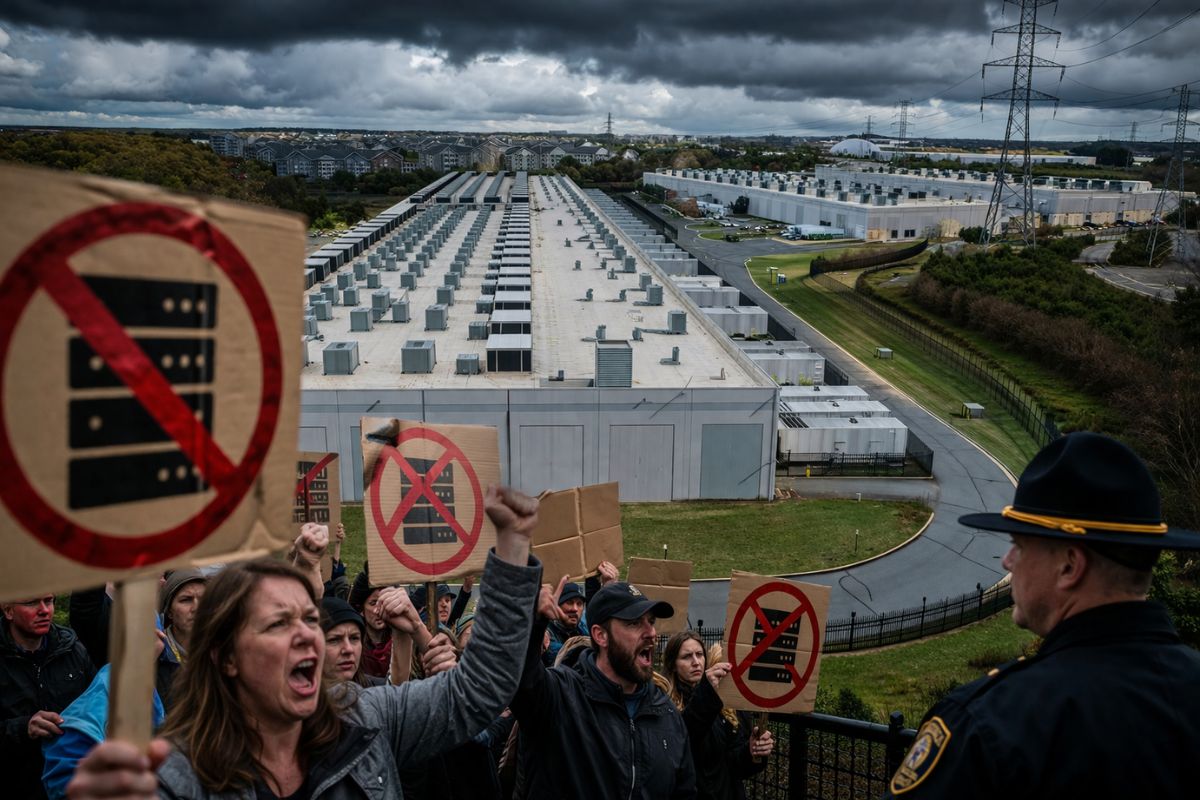
At least a dozen US states are discussing prohibiting or suspending the construction of new artificial intelligence data centers, and Maine is about to become the first to approve a state law freezing these projects until 2027, all to avoid higher energy costs for residents.
The US states have begun to react to what many lawmakers consider a concrete threat to citizens’ wallets: the voracious energy consumption of data centers built to fuel the artificial intelligence race. Maine has passed a bill in both legislative chambers that prohibits the construction of new data centers with a capacity of 20 megawatts or more, enough to power over 15,000 homes. Governor Janet Mills has already signaled support for the measure, which, if signed, will make the state the first in the United States to freeze this type of project at the state level.
The case of Maine is not isolated. Similar proposals have emerged in at least ten other US states, including Virginia, Georgia, New York, Maryland, and Oklahoma. The concern is the same across all of them: large data centers consume enormous amounts of electricity and water, and the cost of this infrastructure may ultimately be passed on to residential consumers. In Maine, energy rates have already risen nearly 60% between 2021 and 2026, according to data compiled by Heatmap News, and the prospect of new gigantic projects has left lawmakers and residents on alert.
Why US states want to prohibit artificial intelligence data centers
According to the portal of G1, the logic behind the reaction of US states against data centers is straightforward: these facilities consume energy on a scale that rivals entire cities. A single 20-megawatt data center can consume electricity equivalent to that of more than 15,000 homes, according to the Wall Street Journal.
-
A SR-71 Blackbird lost both engines at 25,000 meters altitude over the Soviet Union in 1984 while spying on Russian nuclear submarines, and the crew had to choose between ejecting in enemy territory or trying to restart the engines while in free fall towards the Barents Sea.

-
A Syrian immigrant arrived in São Paulo with nothing, sold fabric door to door until he saved enough money to open a store on the corner of 25 de Março in 1905, which still operates at the same address today, 120 years later, in the same yellow mansion, with 60,000 items on the shelves and the fourth generation of the Abdalla family in charge of Doural.

-
Plato said 2,400 years ago that poverty does not come from a lack of money but from an excess of desires, and modern neuroscience has proven he was right by showing that the human brain releases dopamine not when it achieves something but when it is still desiring, which turns each purchase into fuel for the next.

-
“No one hires you based on your school record”: a drama in Brazil shows the difficulty of finding a job even with a deficit of 530,000 vacancies in IT, salaries of up to R$ 35,000, and 50% of hires without a diploma.

When dozens of these projects are proposed simultaneously in the same region, the impact on the electrical grid becomes a public issue, not just a business concern. Utility companies need to invest in infrastructure to meet this demand and, as analysts told CNBC, tend to pass these costs on to consumers.
Water consumption is another factor fueling opposition. A study from the University of California in Riverside estimated that answering 50 questions on ChatGPT could consume half a liter of water, and the data centers that train these AI models require cooling systems that use significant volumes of this resource.
The combination of higher electricity bills and intensive water use has created a political backlash that transcends party lines in US states. In Maine, the bill received votes from Republicans, although the majority of the Democratic caucus led the proposal. Republican Representative William Tuell summed up the growing sentiment by stating that the more one learns about the issue, the more a pause seems necessary.
The case of Maine and the first statewide ban in history
Maine is at the forefront of this dispute between US states and the technology industry. The bill LD 307, introduced by Democratic Representative Melanie Sachs, passed the House by a vote of 82 to 62 and the Senate by 19 to 13.
The measure freezes the construction of data centers with more than 20 megawatts until November 2027 and creates the Maine Data Center Coordination Council, a council tasked with studying the impacts of these facilities on the electrical grid, the environment, and the rates charged to residents.
Representative Sachs defended the proposal by stating that it is not a rejection of innovation, but rather a way to ensure the responsible management of the state’s natural and energy resources. Opponents, such as Republican Representative Steven Foster, argue that Maine already has robust regulatory processes and that the ban fuels an disproportionate fear regarding an industry that does not even have a significant presence in the state—only nine data centers currently operate in Maine.
But supporters of the measure point out that the goal is precisely to get ahead: with energy rates already among the highest in the country, allowing the arrival of large data centers without prior planning could be devastating for low- and middle-income families.
Other US states following the same path
Maine may be the first, but it will hardly be the last. At least ten other US states have already proposed measures to restrict or temporarily suspend the construction of data centers, according to a survey by the National Conference of State Legislatures (NCSL).
Virginia, which leads the United States with 579 data centers in operation, is facing growing resistance from local communities concerned about the impact on water and energy supply. In Botetourt County, residents are actively fighting against a data center planned by Google.
In Georgia, another hub for data centers for companies like Meta and Microsoft, the state legislature ended the session before voting on a moratorium proposal. In New York, Maryland, Oklahoma, and South Carolina, similar projects have been proposed, although none have become law so far.
The pressure has also reached the federal level: Senator Bernie Sanders and Representative Alexandria Ocasio-Cortez introduced a bill to impose a national moratorium on AI data centers until a more restrictive regulatory framework is implemented. Economist Anirban Basu, from the Associated Builders and Contractors, summarized the trend to the Wall Street Journal: Maine will be the first of many US states to adopt similar moratoriums.
The economic side that US states cannot ignore
Prohibiting data centers is not a decision without economic consequences, and the technology industry has been emphatic in pointing out the risks. Glenn Adams, business development director at Maine-based construction company Sargent Corp., stated that any state that halts the construction of data centers, even temporarily, will fall behind in a global race. The company is already building data centers in Virginia and North Carolina, and Adams warned that investors and developers will simply migrate to more receptive jurisdictions.
The debate in US states also involves a less intuitive argument: that data centers can actually help reduce energy costs in the long run. Neil Chilson, head of AI policy at the Abundance Institute, argues that these facilities are stable, long-term customers that provide utilities with the revenue needed to invest in more energy generation and grid modernization, benefiting all consumers.
However, this argument faces skepticism in US states where rates are already high and grid capacity is limited. In Maine, organizations like Our Power warn that even if companies commit to building their own energy generation, it is unlikely to be sufficient to offset the overall increase in costs.
What Brazil can learn from the reaction of US states
While US states are trying to curb the expansion of data centers, Brazil is moving in the opposite direction. The first major artificial intelligence data center projects announced in the country in Rio de Janeiro, Eldorado do Sul (RS), Maringá (PR), Uberlândia (MG), and Caucaia (CE) could have consumption equivalent to that of more than 16 million homes, according to estimates published by G1. Only the ByteDance project in Caucaia anticipates an initial capacity of 200 megawatts and an investment exceeding R$ 580 billion.
The contrast is revealing. In US states, concern about the impact on energy rates and water resources has already generated restrictive legislation even before large projects materialize. In Brazil, where 204 data centers are already operating and new unprecedented scale enterprises are on the way, the regulatory debate is still in its infancy.
The American experience suggests that ignoring energy and environmental planning at the early stage can lead to a much more costly public and political backlash in the future. The question that US states are asking—who pays the bill for the AI revolution?—is the same that Brazil will need to answer soon.
US states are halting the construction of data centers to protect residents from higher energy bills. Do you think Brazil should do the same, or should the priority be to attract investments in technology?







Seja o primeiro a reagir!