





 Portuguese
  English
  Spanish
  5 min of reading
  0 comments


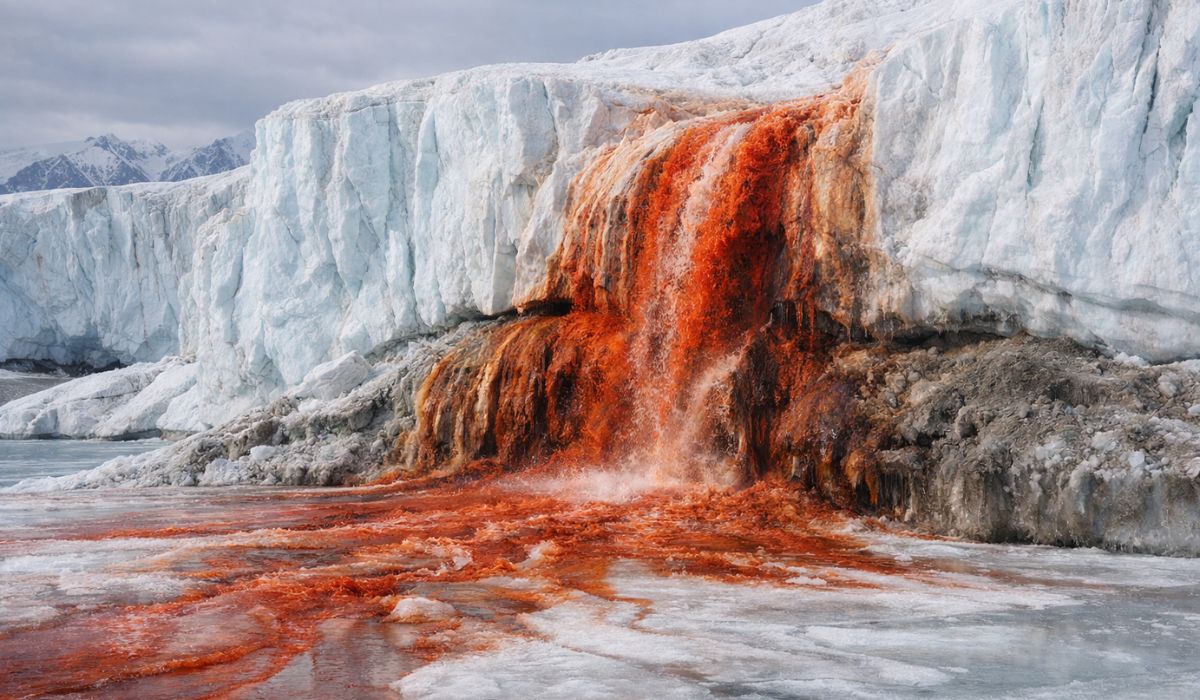
A reddish flow escaping from the Antarctic ice has led scientists to investigate a rare subterranean system, where chemistry, extreme climate, and ancient microorganisms have transformed Taylor Glacier into one of the most studied points on the continent.
The so-called Blood Falls, on Taylor Glacier in Antarctica, are the subject of research for bringing together an unusual geological phenomenon and an extreme microbial system.
The red coloration is not related to blood or algae, but to a brine rich in iron that flows from within the ice and oxidizes upon contact with atmospheric oxygen.
This intermittent flow comes from a system of saline water trapped beneath the glacier and is associated with microorganisms that survive without sunlight and do not depend on free oxygen as the basis of their metabolism.
-
While the U.S. still faces limitations in deep space, China is developing unprecedented technology with strategic satellites that maintain communication with the far side of the Moon and aims for dominance by 2030.

-
China surprises the world by developing an engine that operates from takeoff to over Mach 6 using a counter-rotating compressor and shock waves to reduce weight and revolutionize hypersonic aircraft.

-
Avatar was right: scientists from the European Space Agency have proven that a laser beam can move objects in space without using a drop of fuel, and the discovery paves the way for ships that never need to refuel, satellites that never become junk, and interstellar travel that previously existed only in science fiction.

-
A student spent years dragging friends to see a solitary 1.8-meter stone in a forest in England until archaeologists decided to investigate and discovered a 3,700-year-old ritual site hidden beneath the ground, featuring five fallen stones, a ceremonial platform, and a spring that fed Bronze Age rituals.
Red color of the Blood Falls in Antarctica
The reddish appearance that flows over the edge of Taylor Glacier results from a chemical reaction.
When the iron-laden brine emerges from within the ice, the dissolved iron comes into contact with the air and forms iron oxides, producing the rust-like appearance that stains the white ice.
Recent research has replaced old interpretations, raised in the early 20th century, that associated the color with the presence of algae.
The flow does not occur as a permanent waterfall.
In practice, it is an episodic overflow of hypersaline brine, rich in iron, that reaches the surface at specific moments and leaves frozen deposits of reddish-orange hue in front of the glacier.
It was this contrast, observed since the discovery of the site by Griffith Taylor in 1911, that led to the phenomenon being continuously studied in the McMurdo Dry Valleys.
Brine beneath Taylor Glacier
Studies conducted by researchers from the University of Alaska Fairbanks and other institutions indicate that the source of this material is a brine system trapped beneath and within Taylor Glacier.
The mapping was done using echo radar, a technique used to detect the path taken by the fluid within the ice.
The data indicate a route of hundreds of feet from a saline reservoir connected to a broader network of brackish groundwater in the region.
The water remains liquid despite the intense cold due to two combined factors.
On one hand, the high concentration of salts lowers the freezing point.
On the other hand, the release of heat associated with the freezing process itself helps maintain the flow in an environment where the average annual air temperature is around -17 °C.
Based on these studies, researchers describe Taylor Glacier as the coldest glacier known to maintain a persistent flow of water.
According to explanations released by NASA, the most remote origin of this brine dates back to a phase when the area now occupied by the Dry Valleys was connected to the sea.
The region is thought to have functioned as a fjord millions of years ago.
Later, with climate change, the retreat of the sea, and the subsequent advance of the glacier, portions of saline water and iron-rich salts became trapped and concentrated in the frozen underground.
Microorganisms live without sunlight
Analyses of the fluid expelled by the glacier show that the system harbors microorganisms capable of surviving in permanent darkness, without photosynthesis, in very salty water and with limited nutrient availability.
Instead of using light to produce energy, these organisms rely on chemical reactions involving iron and sulfur compounds.
Scientific works describe this metabolism as a cycle linked to the reduction of iron and sulfate.
In practical terms, this means that the microbes exploit inorganic compounds present in the brine and in the rocks beneath the ice to maintain cellular activity.
For this reason, the site has come to be used as an example of life in extreme conditions, far from the environments where most terrestrial organisms develop.
The scale of isolation is also treated as one of the central points of research.
Scientific and institutional sources converge in pointing out that this ecosystem has remained separated from the external environment for a very long interval, measured at least 1.5 million years.
Other descriptions place it, more broadly, on a scale of over 1 million years or millions of years.
The confirmed point in research is that it is an ancient microbial community, preserved under the ice and adapted to unusual conditions even for Antarctica.
Astrobiology and the search for life beyond Earth
The Blood Falls have also begun to be studied in the field of astrobiology for functioning as a planetary analog.
NASA uses this concept to refer to extreme environments on Earth that help guide the search for signs of habitability on other bodies in the Solar System.
In the case of Taylor Glacier, scientific interest lies in the combination of liquid saline water, physical isolation, intense cold, limited available energy, and microbial life sustained by chemical reactions, rather than by light.
This set of characteristics supports comparisons with frozen areas on Mars and with ice-covered moons, such as Jupiter’s Europa and Saturn’s Enceladus.
However, the research does not treat this similarity as proof of life beyond Earth.
According to agencies and research centers related to the topic, terrestrial environments like Blood Falls help define which instruments, chemical signals, and types of samples may be most useful in investigating potentially habitable niches on other worlds.
Scientific research and preservation of the site
The scientific relevance of the site is also linked to preservation.
As the discharge occurs episodically and the system is difficult to access, each sampling is treated by researchers as a restricted opportunity to study the chemistry of the brine, the behavior of microorganisms, and the dynamics of ice in an extreme polar environment.
Furthermore, the phenomenon provides data on water circulation in cold glaciers, iron transport, and the interaction between rock, salt, and microbial life beneath the Antarctic surface.
At the same time, the Blood Falls remain at the center of studies that bring together geology, microbiology, and astrobiology in the same natural setting.
Under an apparently static ice front, there is an active, pressurized, and biologically inhabited saline system, revealed when the brine reaches the exterior and oxidizes upon contact with the atmosphere.




Seja o primeiro a reagir!