





 Portuguese
  English
  Spanish
  4 min of reading
  0 comments


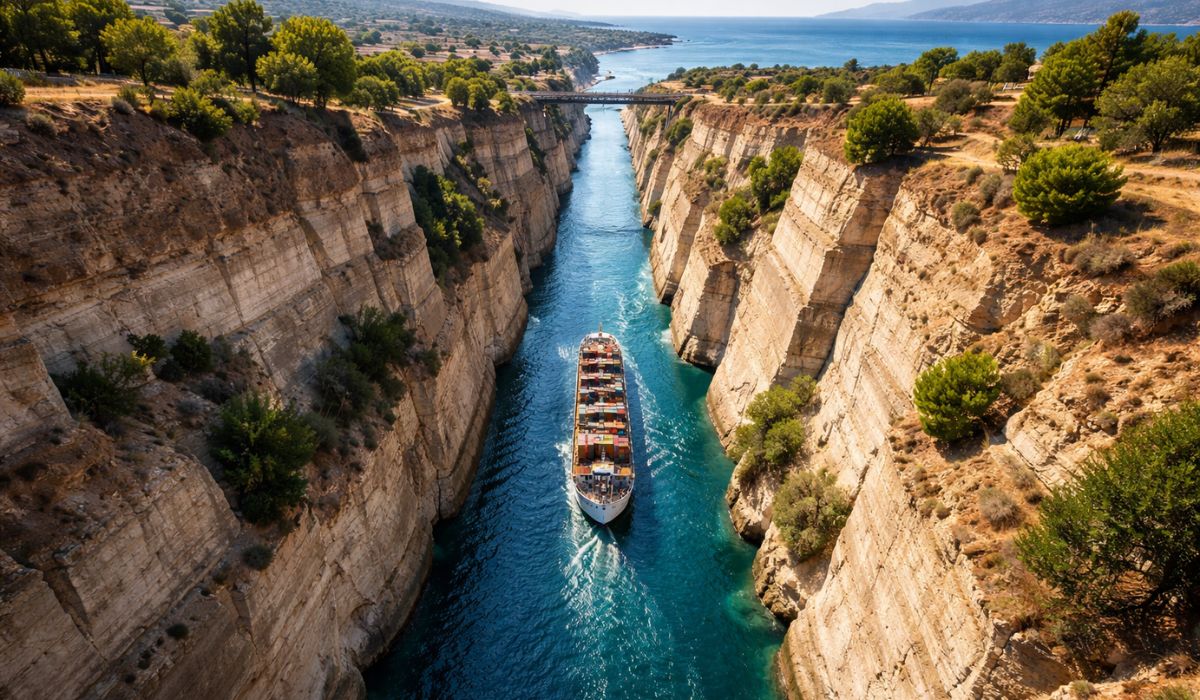
A project conceived in ancient times, interrupted for centuries and completed only at the end of the 19th century transformed the Corinth Canal into one of the most unusual stories in engineering and global infrastructure.
The Corinth Canal, in Greece, is often cited as a rare example of a project conceived in ancient times and completed only many centuries later.
The initial idea is usually placed in the 7th century BC, while the official inauguration took place on July 25, 1893.
Throughout this interval, the goal remained the same: to open a passage between the Gulf of Corinth, facing the Ionian Sea, and the Saronic Gulf, connected to the Aegean Sea, to shorten navigation around the Peloponnese.
-
The USA invaded Brazil to create a city: founded after the war, the municipality of 250,000 inhabitants is the safest in São Paulo.

-
With a length of 399.9 meters and a capacity for over 24,346 containers, the MSC Irina becomes the largest ship in the world and revolutionizes global maritime transport.

-
With nearly 6,000 square meters and an investment of $100 million, the building that seems to move in Las Vegas has a reflective stainless steel façade, creates optical illusions, and has become a symbol of creativity worldwide.

-
From Florianópolis to Antarctica non-stop at 60 years old: 1st Brazilian woman to sail solo makes history by facing one of the most dangerous routes on the planet.


The proposal is attributed to Periander, ruler of ancient Corinth.
At that moment, however, the opening of the canal did not progress.
Historical sources indicate that technical difficulties, high costs, and the engineering limits of the time prevented the execution of the work.
Instead, the region came to rely on a land solution for the transport of smaller vessels over the isthmus.
In the following centuries, the idea reappeared at different times.
Historical records indicate that names like Julius Caesar and Caligula considered resuming the project, but without effective execution.
Later, Emperor Nero even began excavations in the year 67 AD, mobilizing thousands of workers.
The initiative, however, was interrupted after his death, and the plan was abandoned again.
This long interval helps to explain why the Corinth Canal is associated with a work of exceptional duration.
However, it was not a continuous construction over 2,500 years.
What occurred was a succession of attempts, interruptions, and resumptions in different historical contexts, until the technical advancements of the 19th century allowed for definitive execution.

Corinth Canal and the Resumption of the Work in the 19th Century
The decisive resumption only gained momentum after the independence of Greece, formalized in 1830.
The new state began to discuss the project, but execution still faced financial limitations.
Decades later, in a context of expansion of major infrastructure works, the plan advanced again, also driven by the international impact of the opening of the Suez Canal in 1869.
In this context, the modern construction of the Corinth Canal began in 1882.
The work faced financial difficulties and changes in control until its completion in 1893.
Thus, a project conceived in ancient times finally became a permanent maritime link between the two gulfs.
The canal is about 6.3 kilometers long, 8 meters deep, and approximately 21 meters wide at the bottom and 25 meters at the surface.
The rocky walls reach about 90 meters high in some sections.
These numbers help explain why the structure became known not only for its history but also for the physical characteristics of the cut opened in the isthmus.
Limitations of the Corinth Canal in Commercial Navigation
From a logistical point of view, the canal allowed for a shortening of about 700 kilometers in the route of vessels that previously needed to navigate around the Peloponnese.
Still, the economic utility of the work fell short of expectations.
The main reason pointed out by historical records and specialized reports is the width limitation, which restricted the passage of larger vessels.
With the advancement of commercial navigation between the end of the 19th century and the 20th century, ships began to operate with increasingly larger dimensions.

In this scenario, the Corinth Canal ceased to serve a significant portion of the international maritime traffic.
The passage remained useful for smaller vessels but lost its place as a strategic axis on a large scale.
In addition to the reduced width, the canal has always faced operational problems.
The geological characteristics of the region favor slope instability, while the narrow shape of the passage contributes to intense currents and more delicate maneuvers.
Therefore, navigation in the area has been subject to restrictions, technical interventions, and temporary closures over time.
Tourism, Maintenance, and Current Use of the Corinth Canal
In recent decades, the Corinth Canal has become more associated with tourism and historical interest than with large-scale commercial navigation.
The site continues to attract small vessels and visitors interested in the engineering of the work and its unusual trajectory, marked by centuries of interruptions before the definitive completion.
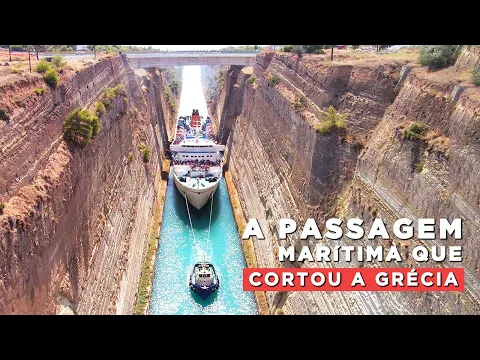
In 2019, the cruise ship Braemar crossed the canal and was noted as the largest vessel to pass through the site.
The episode drew international attention to the reduced dimensions of the passage and the type of operation that can still be performed there.
More than recovering commercial centrality, the crossing served as a demonstration of the limitations and singularities of the structure.

The operation of the canal is also still conditioned by safety and maintenance issues.
After recent landslide episodes, Greek authorities announced on March 20, 2026 that the route should be reopened for light navigation in July, after months of stabilization work that began in November 2025.
The update shows that, even more than a century after the inauguration, the structure still relies on constant monitoring.
The trajectory of the Corinth Canal brings together, at the same time, ancient history, engineering ambition, and limited contemporary use.
Conceived in a remote period and completed only at the end of the 19th century, the project remained associated with the same purpose throughout different eras.
It is this permanence of the idea, crossing empires, governments, and technological changes, that sustains the curiosity surrounding the work to this day.







Seja o primeiro a reagir!