





 Portuguese
  English
  Spanish
  6 min of reading
  0 comments


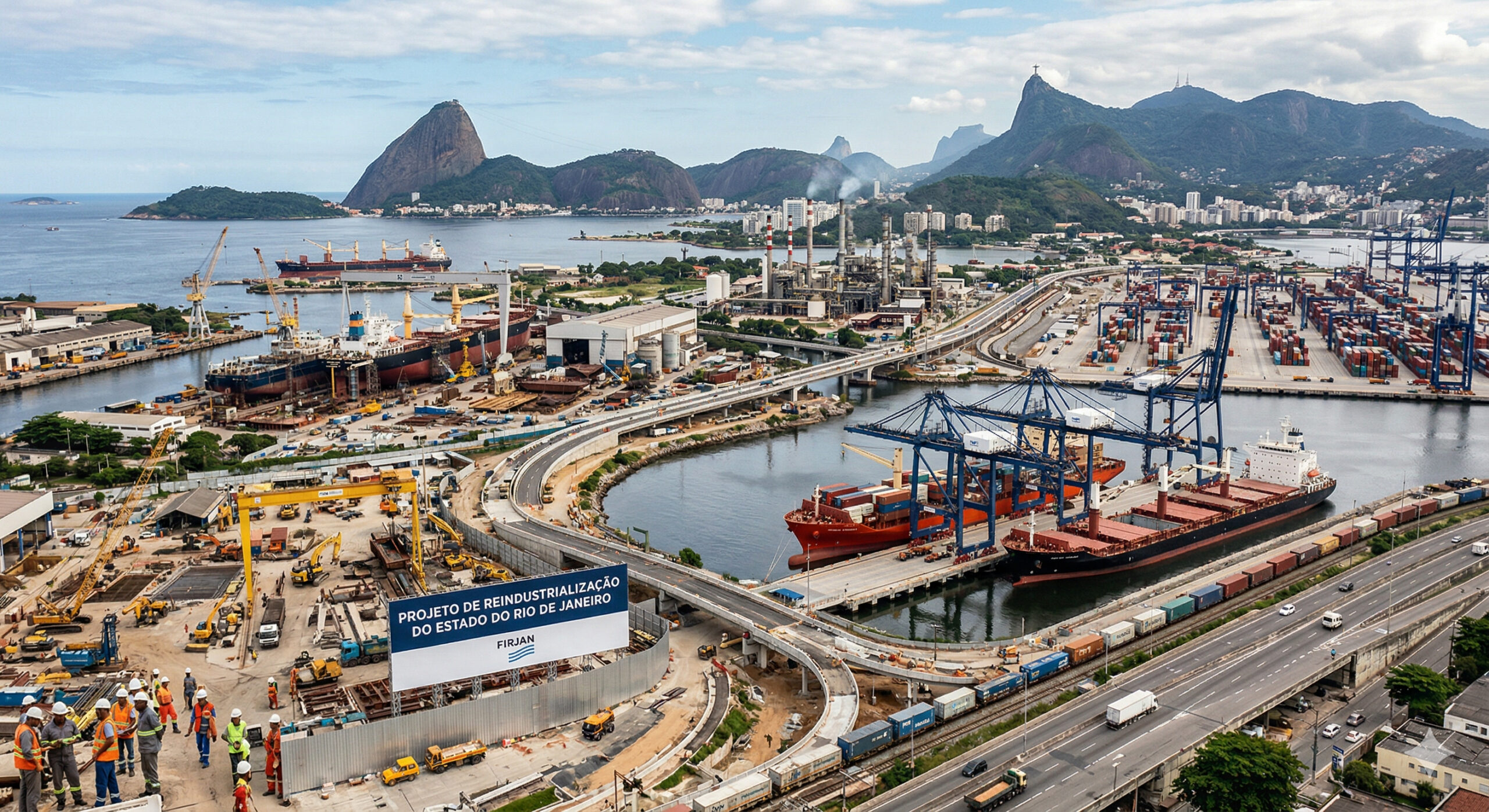
Firjan study points to R$ 526.3 billion in investments in Rio by 2028, with nearly 2,000 projects, focusing on energy, industry, and logistics.
In 2026, the Federation of Industries of the State of Rio de Janeiro (Firjan) revealed, through the study Investment Panorama 2026-2028, a data that repositions Rio de Janeiro at the center of the national economy: R$ 526.3 billion in investments expected by 2028, distributed across approximately 2,000 mapped projects. The survey, based on ongoing ventures and potential projects identified by the entity, indicates that the state may experience one of the largest concentrations of productive capital ever recorded in a single federation unit.
The number draws attention not only for its absolute volume but also for its composition: R$ 327.6 billion are already underway, while another R$ 198.7 billion remain as potential investments, dependent on factors such as environmental licensing, financing, and corporate decisions. This breakdown, detailed in Firjan’s own survey, shows a hybrid package between already mobilized capital and projects in the maturation phase, forming a scenario capable of redefining the productive base of Rio over the decade.
Firjan’s investment panorama shows how Rio has returned to the center of the Brazilian economy
A detailed reading of the study reveals that the state is not just receiving sporadic investments but is structuring a new economic cycle based on strategic sectors. Firjan identified 1,882 ongoing projects and an additional 79 potential initiatives, indicating that Rio has become a relevant destination for national and foreign capital.
-
The shot backfired: the United States sanctions intended to curb China ended up creating a record revenue boom for Chinese chip manufacturers, with growth of up to 247% in a single year.
-
With a dependency of up to 80% on gas imported from the United States, Mexico responds with a robust energy strategy, betting on shale gas, creating a scientific committee, and preparing to expand natural gas production to reduce vulnerability and strengthen its energy security in the coming years.
-
Goodbye to the classic stamp in the passport and welcome to total digital control: the new border system of the European Union is already in operation with mandatory biometrics, and those who download the Travel to Europe app before their trip can save time.

-
How much does a minimum wage employee really cost in 2026? The amount can reach close to R$ 3,000 and surprises business owners.

Another relevant data point is international presence: R$ 104.5 billion are linked to projects with foreign participation, reinforcing the state’s role as an energy and logistics platform. This movement signals a recovery of confidence from the external market, something that had been shaken after years of fiscal crisis and institutional instability.
The federation itself projects direct impacts on the labor market, with 607,000 workers employed per year during construction and 638,000 permanent jobs in the operational phase, numbers that indicate a structural transformation and not just a cyclical one.
Oil and gas dominate the plan with over R$ 215 billion and sustain the base of reindustrialization
The engine of this new phase has a clear name: energy, especially oil and gas. The sector concentrates R$ 215.7 billion, equivalent to almost two-thirds of all confirmed investments in the state.
This weight is not random. Rio de Janeiro hosts a significant portion of Brazilian pre-salt production and concentrates critical infrastructure such as offshore bases, refineries, terminals, and logistics centers. What changes now is the level of integration of this chain.

Instead of merely acting as an extractive hub, the state is beginning to reconnect exploration, processing, refining, and distribution, creating conditions for greater value aggregation. This productive chain is what sustains the implicit reindustrialization thesis in the plan.
Boaventura Energy Complex transforms former Comperj into a high-complexity industrial axis
One of the strongest symbols of this transformation is the Boaventura Energy Complex, in Itaboraí, which occupies the space of the former Comperj, long associated with paralysis, corruption, and waste.
The project has gained a new configuration and has begun operating based on pre-salt gas. The processing unit is already in operation, with a capacity of 21 million cubic meters per day, connected to the drainage system known as Route 3.

The new phase includes integration with the Duque de Caxias Refinery (Reduc), forming a high-complexity industrial corridor between municipalities in the metropolitan area. The estimated investment in this integration is around R$ 26 billion, making it one of the largest industrial projects in the state.
When completed, the complex is expected to increase the production of S-10 diesel by 76,000 barrels per day, aviation kerosene by 20,000 barrels per day, and low-sulfur lubricants by 12,000 barrels per day, in addition to incorporating renewable fuel production.
The construction phase also has a direct impact on employment, with an estimate of up to 30,000 direct and indirect jobs, reinforcing the project’s role as the industrial anchor of the new phase in Rio.
Offshore projects like Raia and Búzios explain why the sea concentrates nearly R$ 200 billion
The majority of resources continue to come from the sea. According to Firjan, offshore investments total around R$ 197.6 billion, being the heaviest block of the entire survey.
Among the most relevant projects is the Raia Project, operated by Equinor, with an approximate investment of US$ 9 billion. The initiative involves exploration in water depths of about 2,900 meters and reserves exceeding 1 billion barrels of oil equivalent.
When it comes into operation, expected in 2028, the field will have the capacity to drain 16 million cubic meters of gas per day, a volume equivalent to about 15% of Brazilian demand.
Another giant is the Búzios field, which has already surpassed the mark of 1 million barrels of oil per day, establishing itself as one of Petrobras’s largest assets. Expansion continues with new platforms planned, each functioning as a true floating factory connected to the ocean floor.
These projects help explain why Rio maintains a leading role in the global energy industry, even after years of crisis.
Transport infrastructure receives R$ 41 billion and tries to eliminate historical bottlenecks
If oil generates wealth, infrastructure defines whether it can circulate. The study points to R$ 41 billion in transport investments, focusing on highways, railways, and ports.
The most emblematic highlight is the Serra das Araras, a critical section of the Via Dutra that connects Rio and São Paulo. The project foresees a new layout with four lanes in each direction, 24 viaducts, advanced safety systems, and a significant increase in average speed.
Today, about 390,000 vehicles pass through the section monthly, many of them trucks. With modernization, the ascent time is expected to decrease by about 25%, and the descent time could be halved, directly impacting national logistics.
In addition, the plan includes improvements to highways such as BR-101 and BR-040, railway modernization by MRS Logística, and expansion of port terminals, especially in Itaguaí and the Port of Rio.
Regional distribution shows how investments spread across the state
Although offshore concentrates the largest share, investments are distributed across different regions. The East Fluminense leads among land projects, with about R$ 28.4 billion, driven by the Boaventura Complex.
The capital appears with R$ 19.7 billion, including urban projects, infrastructure, and services. Meanwhile, the South Fluminense, with R$ 12.9 billion, maintains industrial relevance, especially in the automotive and logistics chains.
This distribution indicates that the economic impact could reach different regional hubs, reducing the historical concentration of investments.
Structural bottlenecks still threaten to turn billions into unfulfilled promises
Despite the significant volume, the study itself points to clear risks. Infrastructure still presents deficiencies, public safety increases logistics costs, and the regulatory environment remains a factor of uncertainty.
Projects classified as potential, totaling nearly R$ 200 billion, depend on environmental licensing, financial structuring, and strategic decisions that have yet to be made.
Among the most sensitive examples are the resumption of Angra 3, the Port of Jaconé, and the Southeast Railway Ring, all with a history of delays and uncertainties.
These factors show that the path between planning and execution remains one of the state’s greatest challenges.
With R$ 526 billion at stake, is Rio facing real reindustrialization or yet another billion-dollar promise?
The volume of investments mapped by Firjan places Rio de Janeiro before a rare opportunity to reorganize its economy around a more robust and integrated productive base. At the same time, the execution of this plan depends on factors that go beyond money: logistical efficiency, regulatory stability, security, and management capacity.
What is underway is not just a cycle of construction but a possible redefinition of the state’s role in the Brazilian economy.
And you, do you believe that this package of over R$ 526 billion can really reindustrialize Rio de Janeiro by 2028, or are we facing yet another grand promise that may fall by the wayside?




Seja o primeiro a reagir!