Portuguese
  Spanish


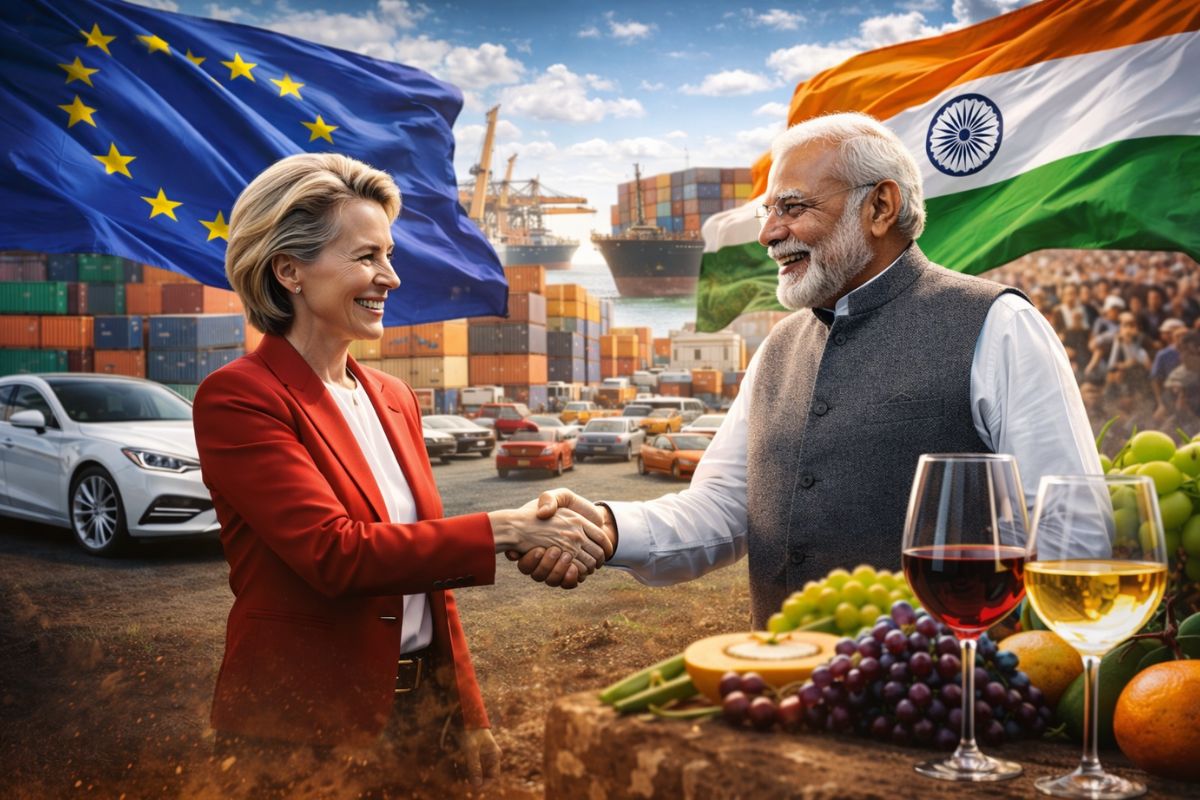

Historical Free Trade Agreement Reduces Tariffs on Cars, Wines and Industrial Products, Creates Market of 2 Billion People and Promises to Double European Exports by 2032
The EU and India have just concluded a historical free trade agreement that could reshape the global trade map in the coming decades. The pact aggressively reduces tariffs on European products, opens the Indian market to cars, wines, and industrial goods, and creates a trading zone with 2 billion consumers, viewed in Brussels as “the mother of all agreements.”
More than a simple tariff treaty, this historical free trade agreement is a direct response to the pressure from Donald Trump’s tariffs, uncertainties in the North American market, and China’s economic rise. At the same time, it meets New Delhi’s interests in attracting investment, increasing exports of textiles, precious stones, and pharmaceuticals, and asserting itself as one of the fastest-growing economies in the world.
What Is at Stake in the Historical Agreement of Free Trade
The historical free trade agreement between the EU and India was finalized after nearly two decades of ups and downs, with negotiations relaunched in 2022 and accelerated in the last six months.
-
From a 12-square-meter room to leading a $4.8 billion fuel empire with over a thousand stations

-
El Niño Threatens Brazilian Food Production, Economists Predict Rising Prices for Coffee, Corn, and Rice
-
Brazil’s First Freight Railway Built from Scratch, EF-118 Connecting Espírito Santo to Rio de Janeiro, Goes to Auction in October Attracting Chinese Giant in Multi-Billion Dollar Bid for Southeast Rail Network

-
Audit in Rio de Janeiro’s State Government Uncovers Ghost Employees Across All 77 Departments, Leading to Over 4,000 Dismissals and Significant Cost Savings




The political message is clear: Europe and India want to diversify partners and reduce dependence on the United States and China.
By the announced terms, the agreement aims to double EU merchandise exports to India by 2032, reducing or eliminating tariffs on about 96% of European exports to the Indian market.
In practice, the EU estimates an annual savings of 4 billion euros in customs duties for its companies, while India gains expanded access to the vast European market for its manufacturing and services industry.
By creating a free trade area covering 2 billion people, the historical free trade agreement becomes central to the European strategy of “rules-based cooperation,” at a time when the multilateral system is being tested by trade wars, punitive tariffs, and geopolitical conflicts.
Who Wins With Lower Tariffs: Cars, Wines, And Industrial Goods
One of the most visible effects of the historical free trade agreement is in the automotive sector. Today, European cars entering India face tariffs of 110%.
With the agreement, this rate will be gradually reduced to 10% over five years, directly benefiting manufacturers like Volkswagen, Renault, Mercedes-Benz, and BMW.
Up to 250,000 vehicles manufactured in Europe will be able to enter annually with a preferential tariff, a volume much larger than the limit negotiated by the United Kingdom in its own agreement.
In addition to cars, tariffs on a wide range of industrial products will be reduced to zero or close to it. This list includes iron and steel, plastics, chemicals, machinery, and pharmaceuticals.
For countries like France, Italy, and Spain, the highlight is the wine and spirits sector, with tariffs dropping from 150% to somewhere between 20% and 40%. Meanwhile, olive oil and various processed foods, such as pasta and chocolates, are working towards zero tariff in the Indian market.
From India’s side, the package facilitates exports of textiles, precious stones, and medicines, while preserving red lines in agriculture, dairy, and sensitive products for both the government and local public opinion.
What Was Left Out to Calm Farmers and Indian Authorities
To politically enable this historical free trade agreement, both Brussels and New Delhi had to backtrack on sensitive points. Agricultural products considered “sensitive” in the EU were kept out of the pact, such as beef, chicken, rice, and sugar.
The maintenance of tariffs on these items is viewed in Brussels as essential to reducing resistance from farmers and increasing the chances of approval in the European Parliament.
In India, the government required that areas like dairy products and cereals not undergo changes in trade conditions, following priorities for protecting its own rural sector.
At the same time, the agreement does not yet include geographical indications, a delicate issue for the EU, which wants to officially protect names associated with products such as cheeses, wines, and other typical foods in the Indian market.
This block of geographical indications will be addressed in a separate agreement, showing that, although comprehensive, the historical free trade agreement was calibrated to avoid political collisions that could hinder its ratification.
Trump, Punitive Tariffs, and the Race for New Partners
The timing of the historical free trade agreement is not accidental. The EU and India operate under the shadow of Donald Trump’s tariffs, which turned trade into a political weapon.
India currently faces tariffs of 50% on its exports to the US, and has experienced an additional 25% penalty for purchasing Russian oil, citing the need for cheap energy to support 1.4 billion inhabitants.
The EU, in turn, saw tariffs on its products triple to 15% in disputes with Washington. At the same time, Brussels is concerned about China’s economic power and the Chinese monopoly on critical supply chains, as well as restrictions on the export of strategic inputs.
In this context, deepening relations with India, a rapidly growing economy moving towards becoming the fourth largest in the world, is seen as a strategic step.
Thus, the package is not limited to trade: it also includes a security pact, cooperation in maritime security, hybrid threats, and counter-terrorism, as well as agreements on labor mobility and the prospect of including India in the Horizon Europe research program.
Ratification, Implementation by 2027, and Next Moves
Despite the euphoria surrounding the historical free trade agreement, the pact still has a long institutional path ahead.
On the European side, EU member states and the European Parliament will need to ratify the text, in a process that may be politically arduous, mainly due to agricultural sensitivity. In India, the text also needs to pass the scrutiny of the government and the cabinet in New Delhi.
The European Commission speaks of implementation starting in January 2027, if all steps are fulfilled.
Until then, technical teams on both sides will need to detail timelines for tariff reductions, safeguards, dispute resolution mechanisms, and instruments to monitor environmental and climate commitments, envisioned in a sustainable development chapter.
Meanwhile, both the EU and India continue closing other free trade agreements. Brussels is advancing with Mercosur, Indonesia, and Switzerland, while New Delhi has concluded pacts with the United Kingdom and Oman.
All of this reinforces the reading that the historical free trade agreement EU-India is part of a larger chessboard, where large economies are trying to reshape trade routes in the face of punitive tariffs, competition with China, and geopolitical shocks like the war in Ukraine.
In the end, Ursula von der Leyen called the pact the “largest free trade agreement in history,” and Narendra Modi classified the deal as a “huge” opportunity for 1.4 billion Indians and millions of Europeans.
Now it remains to be seen whether domestic politics on both sides will follow the enthusiasm of the negotiators.
For you, is this historical free trade agreement between the EU and India more of a geopolitical move or a real opportunity for jobs, investments, and cheaper products in everyday life?