





 Portuguese
  English
  Spanish
  4 min of reading
  0 comments


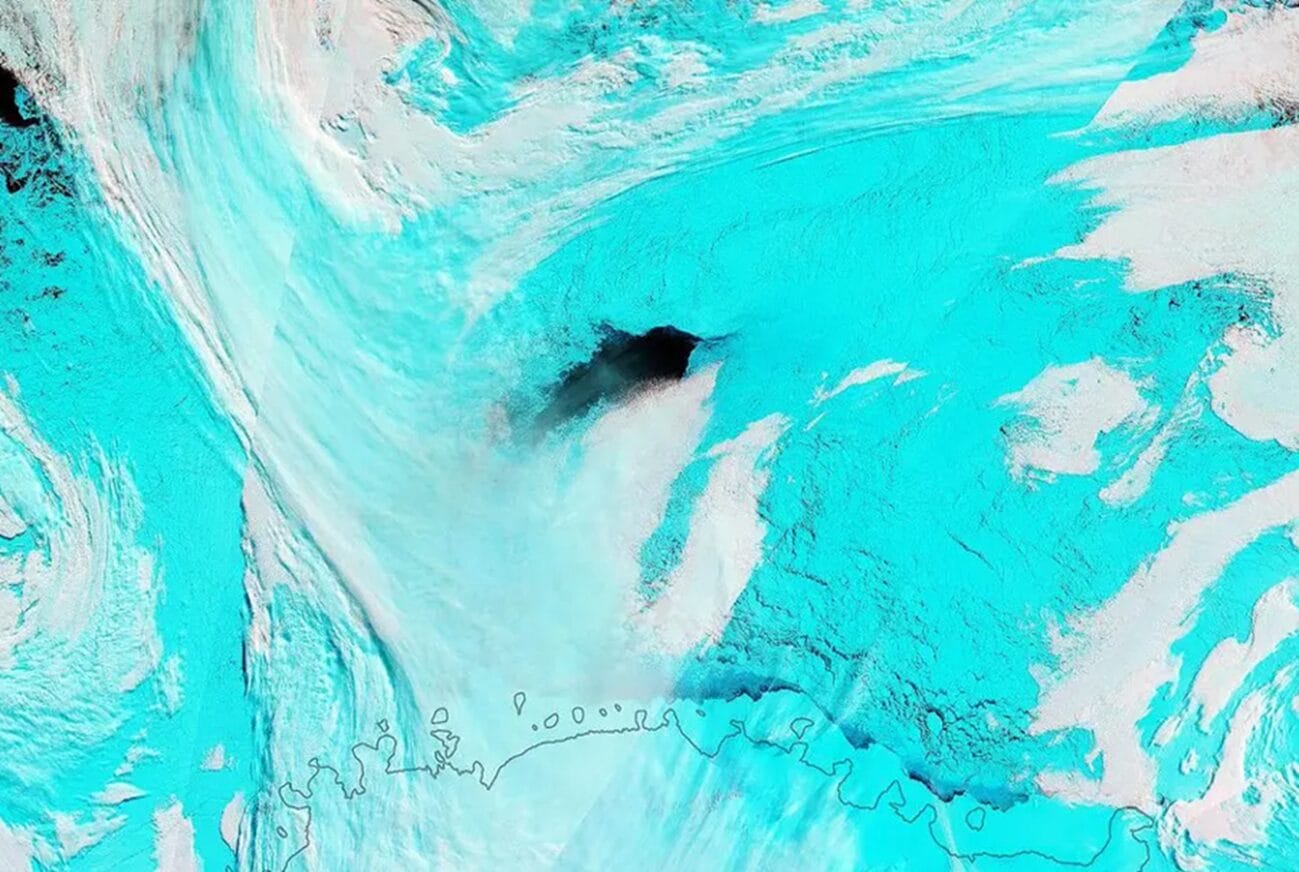
Study Shows That Combination of Wind, Temperature, and Salinity Patterns Caused the Opening of the Rare Antarctic Polynya
What seemed like just another winter in Antarctica turned into an impressive scientific discovery. In the midst of the frozen expanse of the continent, scientists from NASA observed something completely out of the ordinary: a huge dark patch in the sea ice.
This phenomenon, called a polynya, surprised experts with its size and location.
A Hole the Size of Switzerland
The polynya drew attention from its first appearance. It grew to the size of Switzerland and remained visible for weeks, in an area completely surrounded by ice.
-
Supercomputer calculates when humanity may disappear from Earth, predicts a scorching supercontinent, temperatures of up to 70 degrees, and a planet moving towards becoming uninhabitable.

-
INMET danger alert: heavy rains between the 3rd and 4th may drop up to 100 mm/day and winds of 60 to 100 km/h in several regions of Brazil require extra caution.
-
The parts crisis may bring back the drop notch and microSD in 2026; while Windows 11 promises to become lighter, leaks mention batteries of up to 10,000 mAh and 200 MP cameras.

-
In Kenya, engineer Nzambi Matee created “bricks 2.0” using packaging plastic: a mixture with sand, heated and pressed; they are 5 times more resistant, already have official licensing, and are being used in streets and construction projects.


What was most intriguing was its distance from the coast and its position over an underwater plateau known as Maud Rise. After the ice reformed, scientists began to investigate how something like this could occur so far from solid ground.
What Are Polynyas?
Polynyas are temporary openings in sea ice. In the Southern Ocean, the sea acts like a “layer cake”: a layer of cold and less salty water on top, resting over warmer and saltier waters. These differences in density keep the system relatively stable.
For a polynya to form, this stability must be broken. Salt needs to rise, making the upper layer denser, which initiates a convection process. When this happens, the ice breaks, heat escapes, and the ocean releases gases.
Polynyas that appear near the coast are more common, caused by winds pushing the ice away. In contrast, those that occur offshore, like the one at Maud Rise, are rarer and require a precise combination of factors.
The Maud Rise Enigma
Maud Rise is an underwater elevation of 1,402 meters. In the 1970s, satellites detected a gigantic polynya in the same region during three consecutive winters. At the time, scientists assumed the phenomenon would be recurring. However, since then, it has only appeared sporadically and for short periods.
In 2017, the polynya returned on a large scale, reigniting scientific interest. A group of researchers led by Aditya Narayanan from the University of Southampton decided to investigate. They used floating robots, seals marked with sensors, and ocean models to understand the phenomenon.
Factors Explaining the Phenomenon
During the analyzed winters, the Weddell Gyre — an ocean current that spins clockwise — intensified. This brought warmer and saltier water to the surface, which weakened the ice below.
However, this melting should have caused cooling in the upper layer, interrupting the process. But something prevented that.
According to Professor Fabien Roquet from the University of Gothenburg, more salt needed to reach the surface to keep convection active.
Extratropical storms helped by pushing sea ice away and bringing salty water to Maud Rise. There was also a contribution from the so-called “atmospheric rivers,” humid clouds that warm the surface.
The Role of Ekman Transport
Another decisive factor was identified in an old physical concept: Ekman transport. When the wind blows over the ocean, the rotation of the Earth causes the surface water to move at an angle. This movement pushed salty water directly to the northern region of Maud Rise, precisely where the polynya formed.
According to researcher Alberto Naveira Garabato, also from the University of Southampton, this transport was the final necessary element. The storms helped not only to move the ice but also to position the right water in the right place.
With convection underway, the hole in the ice released more than twenty times the heat that would normally escape through an intact layer. By the end of September, the polynya froze again.
Global Impact of the Phenomenon
Although located in Antarctica, the phenomenon can have effects across the planet. Professor Sarah Gille from the University of California San Diego explained that the effects of a polynya remain in the water for years.
It can influence the path of ocean currents, modify how heat is distributed, and even alter global circulation. During the process, carbon-rich water rises to the surface and releases CO₂. Meanwhile, brine, rich in oxygen, sinks and reinforces deep currents.
This process feeds the so-called “conveyor belt” of global currents, which plays a fundamental role in regulating the world’s climate.
What to Expect from Upcoming Winters
The future of polynyas depends on climate changes. The mechanism observed at Maud Rise requires a stronger gyre and intense storms, conditions that may become more frequent with global warming.
Since 2016, scientists have noticed a trend of declining sea ice volume in Antarctica. Until then, it had remained stable. The same warm and salty water that formed the polynya in 2017 now seems to be thinning the ice at the edges of the continent.
Researchers will continue to monitor the region over the coming winters. Even if the polynya does not form again, its recent presence has shown that Antarctica still holds secrets.
And more than that: what happens in the ice at the southern extreme can have effects far beyond, influencing oceans, climates, and ecosystems across the planet.
The complete study on the Maud Rise polynya was published in the journal Science Advances.








Seja o primeiro a reagir!