





 Portuguese
  English
  Spanish
  11 min of reading
  0 comments


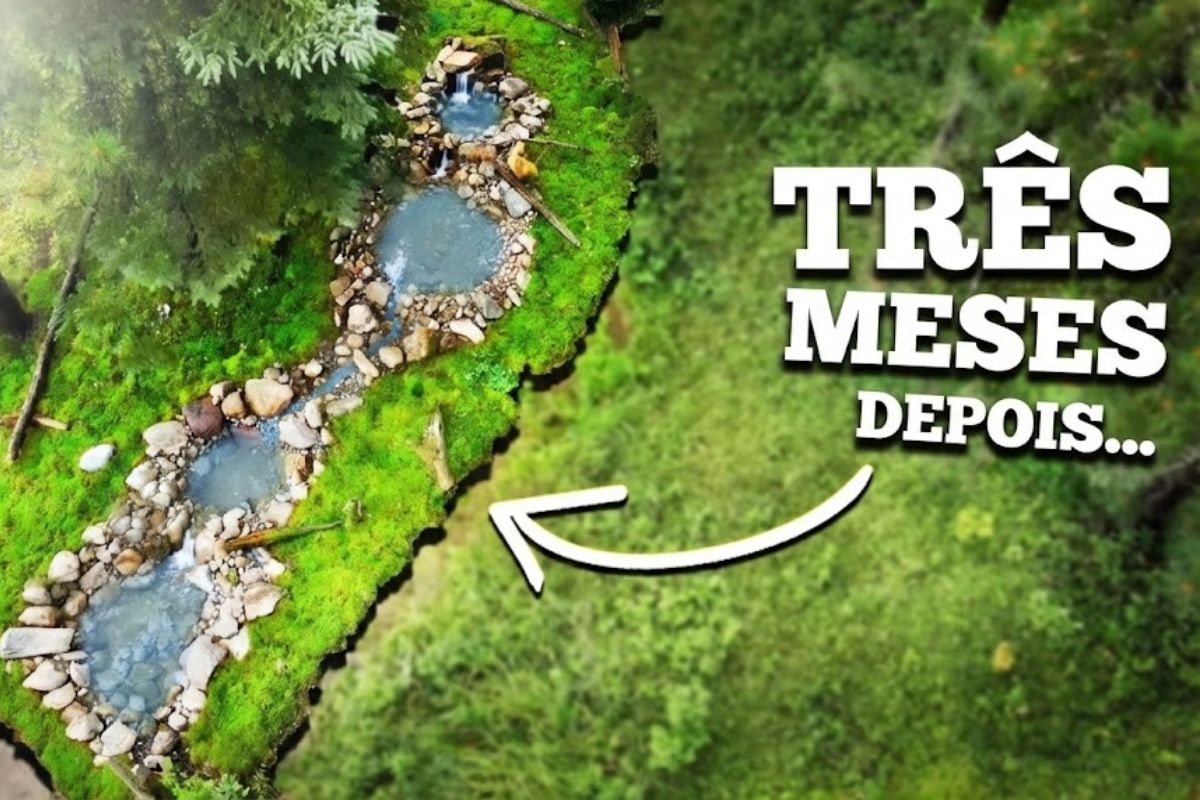
Bird Bath Lake Was Constructed Three Months Ago With Waterfall and Pump, Monitored by Cameras. Storms and Blackouts Shut Down the System, Concentrating Water in the Well and Forcing Overflow to the Drain. Even So, Foxes, Raccoons, Skunks, and Turkeys Began to Use the Area and Dig Through the Moss Frequently
The bird bath lake was built three months ago to provide the property’s wildlife with a water point to drink and bathe in the hot, dry summer. Trail cameras have been monitoring the bird bath lake since it was set up and recording the dynamics between the waterfall, pump, and pools, as well as the arrival of visitors.
The schedule became the first test. Upon starting the work, the person in charge reported a dry period and the drying up of small natural pools. Three days after completing most of the bird bath lake, temperatures dropped from the “low 20s” to the “low 10s” and two of the wettest weeks of the year came, with storms, strong winds, and thunder. This sequence exposed a specific risk: blackouts shut off the pump, interrupt the waterfall, cause the pools to empty into the lower well, and increase the chance of water overflowing to the drain, reducing the total volume of the system.
Timeline of the Bird Bath Lake in Three Months

The bird bath lake was installed to face hot, dry months, but the start coincided with a sudden change in the weather.
-
Giant Roman treasure found at the bottom of Lake Neuchâtel in Switzerland reveals an advanced trade system, circulation of goods, and armed escort in the Roman Empire about two thousand years ago.

-
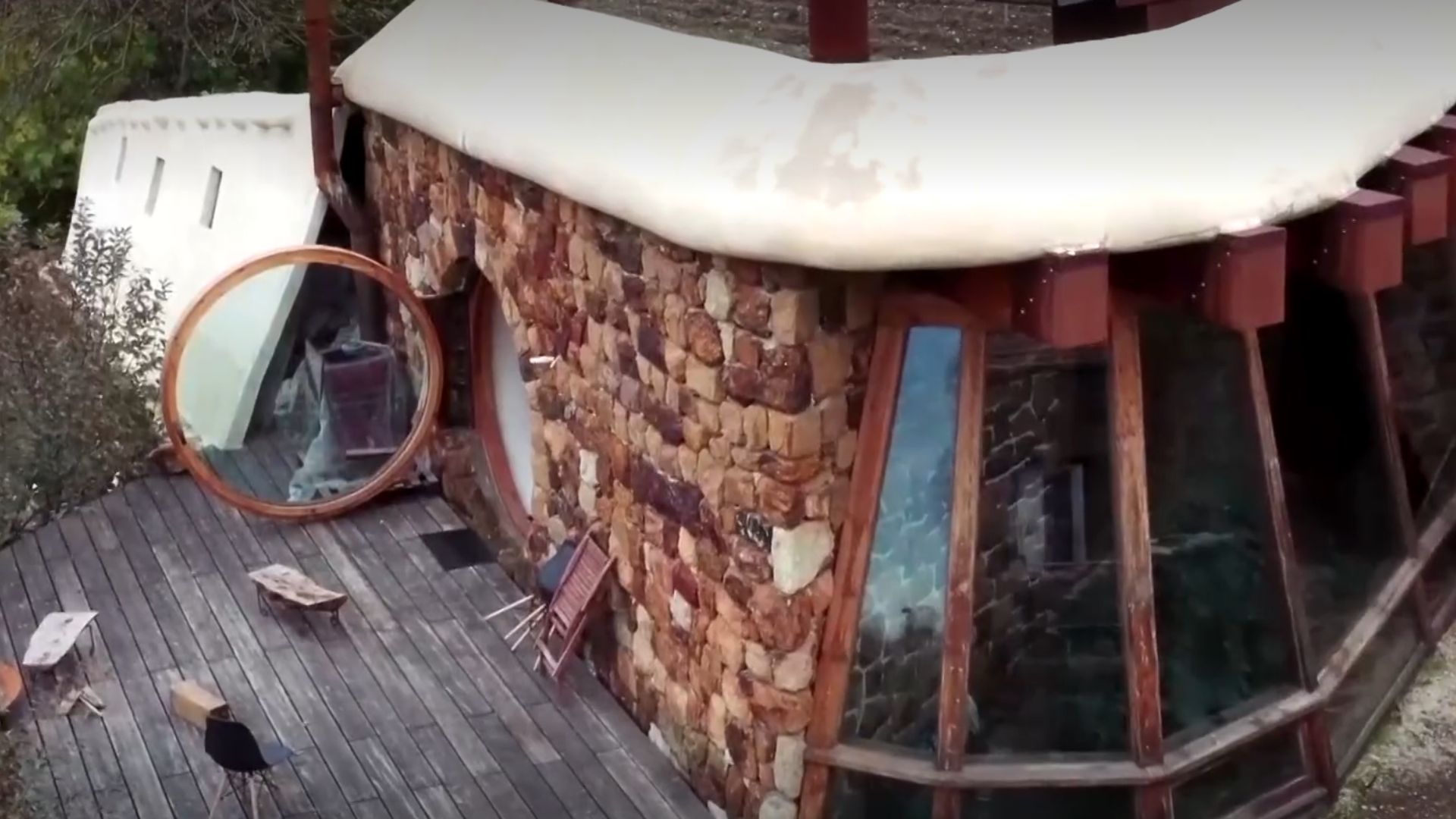
He buried 1,200 old tires in the walls to build his own self-sufficient house in the mountains with glass bottles, rainwater, and an integrated greenhouse.
-
The aircraft carrier HMS Prince of Wales is heading to the Arctic with F-35 fighters, helicopters, and warships in an operation that repositions the United Kingdom at the forefront of NATO in 2026.

-
He found the largest gold shipwreck in the United States with tons of the precious metal at a depth of 2,400 meters in the Atlantic and recovered a treasure that no one thought possible to reach, but 500 gold coins disappeared without explanation.


The person in charge described the contrast as “bad timing”: ditches that had been dry for weeks began to flow with rainwater right at the beginning, while the pump was still in the adjustment phase and being monitored by cameras.
The monitored period includes four factual milestones.
First, the construction during the drought, prompted by small pools drying up.
Second, the turn a few days later, with a decrease in temperature and two very rainy weeks.
Third, the passage through successive storms and blackouts, which caused water loss due to overflow.
Fourth, the approach of winter, with the decision to remove the pump and the waterfall and let the bird bath lake freeze, replacing the offering with a smaller heated bath.
Why the Bird Bath Lake Was Constructed and What Was Drying Up

The decision to build a bird bath lake was made during a dry spell.
The initial observation was straightforward: several small puddles and smaller pools on the property were drying up, reducing the wildlife’s access to shallow water for drinking and bathing.
The purpose of the bird bath lake was, therefore, to create an alternative with multiple pools, able to keep water available even when other points fail.
The rainy scenario that followed does not negate the original logic.
It changes the nature of the problem: the momentary scarcity gives way to instability of volume and energy, where storms and blackouts become the main operational variable for the pump and the waterfall.
How the Waterfall Works and Why the Pump Defines the System Balance

The bird bath lake was designed as a sequence of tiered pools.
The pump is located in the well, in the lower pool, and sends water through a tube to the top, where the waterfall is formed.
The tube was placed to be hidden under the rocks, reducing visual interference and protecting the water line.
When the pump is on, the waterfall replenishes the volume at the highest point.
As the upper pool fills, it overflows into the pool immediately below. The process repeats until the water reaches the lower well again, reactivating the cycle.
In practical terms, the bird bath lake behaves like a circuit of planned overflow.
When the pump shuts off, the system goes into passive mode.
The waterfall stops, the cycle ceases to redistribute water and the extra accumulated water in the upper pools drains into the lower well.
If this repeats frequently, the lower well may overflow at a lower point and water will exit to the drain, reducing the total volume of the bird bath lake without any physical leak.
Storms and Blackouts: The Operational Failure That Looks Like Leakage, But Is Energy
The storms triggered the first operational deviation.
With strong winds and thunder, blackouts and intermittent power cuts occurred. Each blackout interrupted the pump and, without the pump, the waterfall ceased.
The chain effect is measurable by the behavior of the pools: the excess drains into the well, the well overflows and the system loses water to the drain.
The cited risk is not just losing water.
It is losing water with sufficient repetition for the lower well to have insufficient volume at some point.
This can make the bird bath lake “run low,” depending on how many times storms and blackouts interrupt the pump throughout the period.
Turning Off the Pump as Precaution: What Changes and What Does Not Change
The person’s response was preventive: anticipating storms, he turned off the pump for a few days.
The motivation was to avoid intermittent shutdowns during blackouts, which could increase overflow to the drain.
He described this as a minor inconvenience, but with low operational cost.
The technical point is that turning off the pump does not eliminate the function of the bird bath lake.
The pools continue to hold water, like a regular bird bath, allowing wildlife to drink and bathe.
What changes is the presence of flowing water in the waterfall, which may also alter the visitor profile, as suggested by records of raccoons.
What Worked Well: Absence of Blockages and Physical Leaks
Aside from the impact of storms and blackouts, the three-month period was described as stable in terms of maintenance.
There was no mention of blockages in the tube or physical leaks in the pools. No cracks or escape points outside of the overflow to the drain were reported.
The main uncertainty was structural: would rocks and moss support continuous wildlife use, with running, foraging, and digging.
This doubt was answered by direct observation, without the need for immediate intervention.
Foxes, Raccoons, and Skunks: The First Visitors and the Test of Rock Stability
During the first two cold and rainy weeks, the bird bath lake was relatively quiet for birds, but intense for mammals.
The cameras recorded fox pups, a female raccoon with three pups, and skunk visits, among other movements around the pools.
Foxes were treated as the highest expected user of the bird bath lake.
Seeing pups running over the rocks, going up and down edges, and circling without knocking over the arrangement was interpreted as a sign of stability.
The raccoons, for their habit of foraging in water, served as a test for accessing the pools and entrance and exit without getting stuck.
Pump On and Waterfall Active: The Pattern Observed With Raccoons
Upon reviewing the footage, the person in charge noticed a specific pattern: raccoons entered the water only on days when the pump was off.
This happened even with the animals appearing on-site on other days, reinforcing the repetition of the finding during the period.
He did not assert that the waterfall scares off raccoons, but noted the hypothesis of a preference for still water.
As an indirect reference, he mentioned having heard that deer prefer points of stagnant water because they are quieter and make it easier to detect predators.
In the bird bath lake, this type of difference turns a technical decision, to turn the pump on or off, into an ecological variable that may alter the type of use.
A Second Bird Bath Smaller: Variety of Mammals and Planned Adjustment
A smaller bird bath with a constant flow was noted, and the comparison was explicit: raccoons did not use it, although they had circulated and inspected it.
In contrast, this smaller bath attracted chipmunks, red squirrels, skunks, groundhogs, and foxes, expanding the visitor inventory.
The identified problem was reach. Groundhogs and skunks seemed to have difficulty reaching the water level.
The planned adjustment for the following year is to lower this smaller bath by about a foot into the ground, digging a hole, to bring the water closer to the ground level.
The goal is to maintain a simple and portable design that “works,” without requiring heavy construction.
Vegetation in the Pools: Point Reinforcement Before Winter and Nursery Plan
In the main bird bath lake, the short-term strategy was moderate.
The person in charge remarked that it was already September and that snow was less than two months away, which would require removing the pump and waterfall around November.
Therefore, he avoided major upgrades and preferred light interventions.
Among these interventions, he collected rocks with moss and added branches and perches for birds, creating more options for access.
He also took plants and mats of vegetation from a larger lake and temporarily spread them in the pools.
The idea is to combine cover, microhabitat, and nutrient absorption.
For the next year, the plan is to use the top and lower well pools as a nursery for native aquatic plants.
These pools are less used and were considered less safe for birds, while the central stretch is seen as more favorable due to having less steep edges and better visibility.
Moss Dug Up: Foxes, Skunks, and Turkeys Reconfigure the Environment
The moss was a sensitive point of the bird bath lake. It was collected near the edges of an explored forest and, according to the person in charge, was already in poor condition at the beginning.
The expectation of recovery was compressed by the pace of wildlife use.
The fox pups ran and “fought” over the moss, compacting and displacing part of the coverage.
Skunks began to turn over the moss, described as tearing the surface in search of larvae or possibly slugs, which were numerous in the area.
Later, a pair of turkeys appeared and began scratching and digging through the moss while foraging.
The forecast is that the moss will become irregular and sparse in areas, a direct effect of the intense use of the bird bath lake.
Logs and Unexpected Uses: Lookout, Foraging, and Feeding Scene
Logs were positioned with the idea of serving as refuge for small amphibians, but the cameras showed another path.
A red squirrel used the log to watch over its territory. Flickers were seen probing the wood to find insects. A blue jay appeared aggressively removing the bristles from a woolly bear caterpillar.
This sequence reinforces the observational nature: the bird bath lake, by attracting wildlife, also exposes how surrounding elements, logs, rocks, and perches, gain unforeseen functions.
The project ceases to be just a water point and becomes a platform for behavior.
An Unintentional Maintenance: Fertilization, Grazing, and Control of Tall Plants
Even with the moss dug up, the person in charge described collateral gains. Foxes “fertilize” the soil, he said, as an effect of using the space.
Turkeys graze and remove plants trying to sprout in the moss, helping to keep the surroundings lower. Raccoons, in turn, appear frequently in the cameras, as if checking the equipment.
The result is a bird bath lake with maintenance partially outsourced to the wildlife, with mixed effects.
There is physical disturbance of the moss, but there is also cleaning of vegetation and movement that keeps areas open.
Trail Cameras: When Red Squirrels Become the Trigger to Record Small Birds
The trail cameras have been monitoring the bird bath lake since the beginning.
The person in charge acknowledged that red squirrels trigger many recordings and can be bothersome in other situations.
Here, it worked as a solution: the cameras sometimes have difficulty capturing small birds, but when a red squirrel activates the sensor, songbirds may appear in the background using the pools.
This helped track smaller visitors, like goldfinches, mentioned as abundant for being among the last to breed in the summer.
He also reported seeing the last fledglings of the year, perched in pines above the bird bath lake and calling the adults until they received food.
A Sharp-Shinned Hawk and the Framing Issue: Partial Record, High Impact
In mid-September, as the weather warmed again, the first raptor appeared at the bird bath lake: a sharp-shinned hawk perched on the rocks.
However, the camera was displaced by a few centimeters and captured only a quick glimpse of the tail.
The person in charge did not assert whether the bird attempted to bathe or hunt.
Still, he treated the record as relevant because it indicates that the bird bath lake has entered the territory map of predators, even if the event was not fully documented.
Turkeys on the Rise: 11 Juveniles, Two Fixed Males, and 10 to 15 Clips Per Day
The turkeys were the most constant group in the images. A set of 11 juveniles appeared and, according to the person in charge, tends to visit about once every two weeks.
More frequently were two male turkeys, described as gobblers, who circulate daily in front of the property.
They make a circuit: they feed on fallen fruit under apple trees, go to the garage entrance to pick up grit, and then head to the bird bath to drink.
The recorded volume was 10 to 15 clips per day, sometimes more, which describes intense use of the bird bath lake during a period when the presence of other birds was low.
Weak Fall Migration: When the Lake Became More “Mammal-Oriented” and Regulars
The person in charge reported that he tried to film birds sitting next to the bird bath lake for about a day a week, but visits were rare.
He contextualized that in the north, after the nesting season, it is common to have a quiet stretch and that fall migration typically increases activity. During the observed period, this did not happen on the expected scale.
The comparison was with spring, when there were days with some hundreds of juncos, blackbirds, and grackles in the yard.
In the fall, the bird bath lake was primarily used by “regulars”: turkeys, red squirrels, blue jays, and foxes, maintaining a constant line of clips even with few migratory birds.
Fisher Near the House: The Most Uncommon Record of Fall
In the set of fall clips, the person in charge highlighted a fisher running through the area. He stated that it was the closest he had seen the species near the house.
The record was treated as a high-interest event within the continuous monitoring of the bird bath lake.
The data adds to the general diagnosis of the period: even when bird activity declines, a monitored water point can bring unexpected appearances and broaden the reading of what circulates on the property.
Preparation for Winter: Pump Removed, Waterfall Disassembled, and Lake Frozen
With the arrival of winter, the person in charge removed the pump and disassembled the waterfall from the bird bath lake.
The declared strategy is to place a heated bird bath, as in the previous year, so that the birds still have a place to drink when the larger lake is frozen.
The technical balance of the bird bath lake is consistent: there were no blockages or physical leaks, but storms and blackouts proved critical because they affect the pump and disorganize the overflow cycle.
On the other hand, the structure delivered water for months, attracted foxes, raccoons, skunks, and turkeys, and left clear evidence of use, such as dug-up moss and overflow to the drain.
The practical action connected to the theme is simple and realistic: anyone operating a bird bath lake with a waterfall and pump must plan the system’s behavior when the power goes out, decide when to turn off the pump in the face of storms, and, above all, accept that wildlife will use the space in ways that disturb the moss and edges.
Would you keep the waterfall and pump off during storms and blackouts to reduce overflow to the drain in the bird bath lake?








-

-

-

6 pessoas reagiram a isso.