





 Portuguese
  English
  Spanish
  4 min of reading
  0 comments


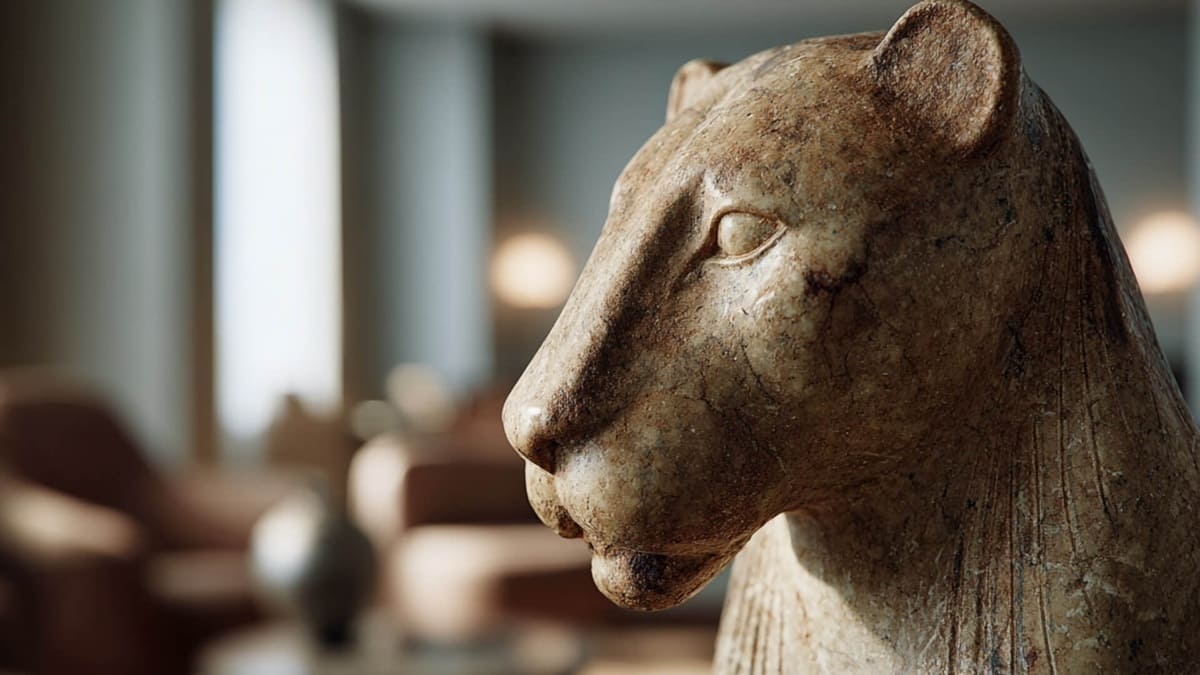
Mesopotamian Artifact of 8.3 cm Was Sold for Over US$ 57 Million at Auction and Sparked Criticism Over the Loss of Historical Context.
A small statuette carved over 5,000 years ago became the most expensive archaeological artifact ever sold at auction. The piece, known as the Guennol Lioness, was sold for over US$ 57 million in 2007, breaking all previous records and reigniting debates about the value, ownership, and fate of ancient pieces.
Carved Around 3000 B.C.
The Guennol Lioness stands only 8.3 centimeters tall, but carries immense symbolic and artistic weight. It is estimated to have been carved around 3000 B.C. in a region near modern-day Baghdad, in southern ancient Mesopotamia. Its shape is unusual: a muscular human body with the head of a lioness.
The name of the artifact comes from the Guennol Collection, owned by Alastair Bradley Martin. He acquired the piece in 1948, and it was loaned to the Brooklyn Museum in New York for decades before being sold. Experts point out that it represents a protective or magical figure, with strong symbolic connotations.
-
Goodbye iron: new technology from Xiaomi promises to revolutionize the way we iron clothes with 500 kPa steam, continuous flow of 120 g/min, heating in 65 seconds, and six smart modes for different fabrics.

-
Rio Pardo, the most mysterious city in Rio Grande do Sul: untouched Pampas castle, the missing treasure of the Devil Boy, bride’s saint, invisible tunnels, and a 200-year curse today.

-
China retires the J-7 fighter after years of military protection and can now transform military items into drones, following more than 60 years of operation of the J-7, derived from the MiG-21, with thousands of units produced and strategic use in the PLAAF and PLANAF.

-
Volunteers are sought to live in the mountains for a month: a study pays people to stay at 2,500 meters, with 24-hour monitoring of sleep, metabolism, and blood pressure.


Historical Sale at Sotheby’s
The auction that marked the sale took place on December 5, 2007, at Sotheby’s in New York. The statuette was listed as lot number 30 in the antiquities auction and sold for US$ 57,161,000. The buyer’s identity was not revealed.
According to Sotheby’s catalog, the statuette was “reportedly found near Baghdad.” Since 1931, it had circulated through private collections.
Having been displayed at the Brooklyn Museum from 1949 to 2007 elevated its prestige and increased its market value.
However, the exact archaeological context of the piece — the excavation site, the conditions, and associations with other artifacts — remains unknown. This has generated criticism from the scientific community, which considers this lack of information an irreversible loss for archaeology.
Ancient Pieces as Financial Investment
The case of the Guennol Lioness is not isolated. It is part of a broader trend of transforming archaeological objects into investment assets. In a 2009 article, archaeologist Morag M. Kersel analyzes how media coverage boosts the commercial value of antiquities, presenting them as lucrative investments.
Soon after the auction, Time magazine published an article titled “Antiquities: The Hottest Investment.” The piece highlighted the sale of the statuette as an example of a great opportunity and suggested that investors with less than US$ 10,000 a year could also enter this market.
This type of coverage helps to increase interest among collectors and investors, but also raises concerns among archaeologists. Many warn that the encouragement to purchase pieces without clear origins ends up stimulating the looting of archaeological sites and the destruction of important historical contexts.
What Is Lost When Context Is Ignored
The greatest criticism related to the Guennol Lioness is not about its aesthetic or monetary value but rather the absence of a reliable archaeological context. It is unknown whether it was found in a tomb, temple, or residence. There are also no records regarding surrounding objects or the original function of the piece.
Without this type of information, the scientific value of the statuette is lost. Modern archaeology depends on the context of discoveries to understand ancient societies. Mere commercial provenance, such as the ownership history, does not replace accurate archaeological documentation.
Kersel argues that pieces like this, when devoid of essential information, leave irreparable gaps in human history. The lack of data such as the exact location and excavation layer prevents more accurate conclusions about the cultural and social uses of the object.
From Public Display to Private Disappearance
For nearly 60 years, the Guennol Lioness was on display for the public at the Brooklyn Museum. Its presence there allowed it to be studied, photographed, and analyzed by experts and visitors. After the auction, the piece was withdrawn from public circulation and remains in the hands of an anonymous collector.
This shift raises concerns about access to heritage. Although some intellectuals argue that the private circulation of artifacts favors global cultural diversity, in practice, many of these objects disappear from the public domain.
The sale of the Guennol Lioness symbolizes this tension between the interests of the art market and the duty of cultural preservation. When an artifact is treated as private property, its function as a collective good may be compromised.
The Dispute Between Commercial Value and Cultural Value
The statuette remains one of the most discussed objects in the world of antiquities. It represents a convergence point between art, history, money, and ethics. Its beauty and uniqueness are undeniable, but its disappearance from the public space raises dilemmas about who should have access to humanity’s past.
Archaeologist Kersel asserts that the true value of an artifact lies in the story it can tell — and that story depends on context. A piece disconnected from its origins transforms into a decorative object or status symbol, losing much of its meaning.
The Guennol Lioness is an extreme example of what can happen when archaeological objects are viewed solely as commodities. With its sale for over US$ 57 million, it broke records and attracted global attention, but also provoked criticism and opened deep discussions about the fate of cultural heritage.
The final question remains open: should ancient artifacts belong to whoever pays the most, or to humanity as a whole?








Seja o primeiro a reagir!