






 Portuguese
  Spanish
  4 min of reading
  1 comment


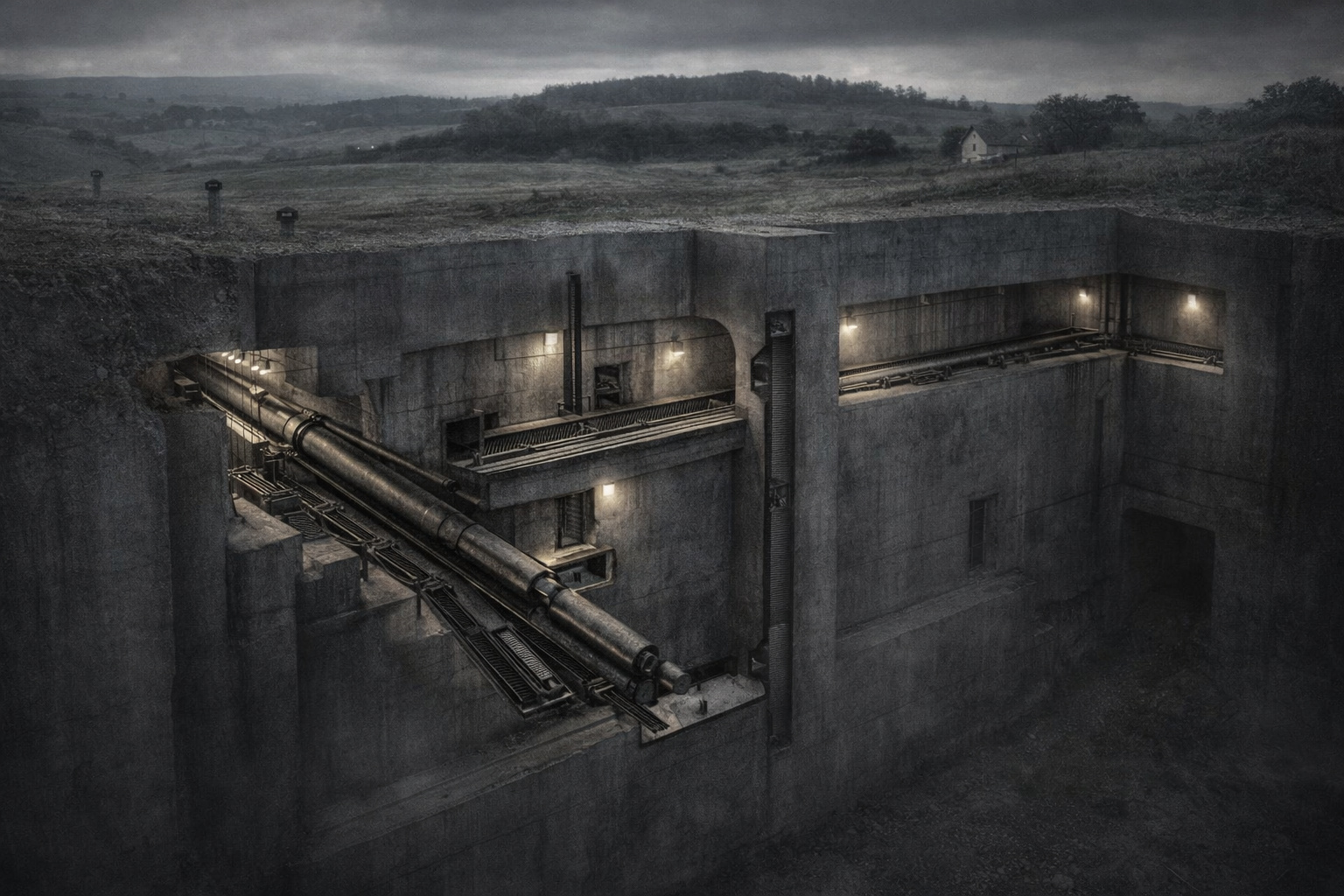


German Cannon With Up to 140 Meters in Length and Range of Over 160 Km Tried to Hit London Without Planes and Entered History as the Most Extreme Artillery Ever Conceived.
At the height of World War II, when German air supremacy was already compromised and Allied bombings were hitting the industrial centers of the Reich, Nazi engineers sought solutions that completely escaped traditional air warfare logic. It was in this context that the V-3 Hochdruckpumpe emerged, a project that relied not on planes or rockets, but on extreme ground artillery, capable of reaching targets at distances never attempted before.
The idea was to attack London directly from occupied France, using a fixed, buried, and virtually invisible system from the air. Had it worked as planned, the V-3 would have become the first weapon for continuous strategic bombing without the need for air platforms.
The Engineering Behind an Impossible Cannon
Conventional cannons face a clear physical limit: most of the energy from the shot is released in a single instant, at the moment of the propellant charge explosion. From there, the projectile begins to decelerate progressively. To break this barrier, German engineers adopted a radical concept: continuous acceleration along the barrel.
-
The military spaceplane that almost took the Cold War into orbit: Boeing X-20 Dyna-Soar was designed to re-enter above Mach 20, fly for up to 40 hours, land like a plane, and transform Titan rockets into a gateway to a new era of orbital warfare.

-
FAB bets on national drones and increases investments to strengthen the Brazilian aerospace industry

-
Six times, a luminous crescent the size of the Moon startled the Soviet sky at dusk: it seemed like a wave of UFOs, but it was a secret orbital weapon created to attack the United States via the South Pole and evade Cold War radars.

-
The United States government approved a potential sale of 100 portable Stinger anti-aircraft missiles to the Brazilian Army, in a package estimated at around 330 million dollars that still depends on negotiations between the two countries.




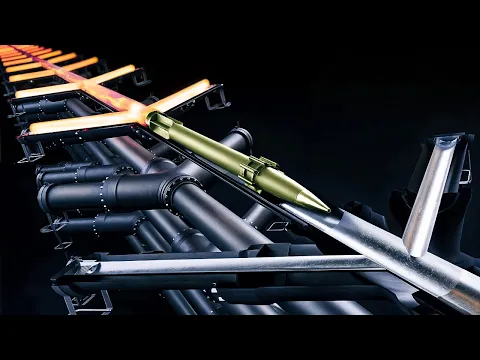

The V-3 was designed with dozens of side chambers, positioned along the main tube. Each contained explosive charges that were detonated in sequence, synchronized with the passage of the projectile. In this way, the shot did not receive just an initial boost but multiple energy reinforcements, maintaining acceleration for dozens of meters.
This system of multiple side charges had never been employed in an operational weapon before and required a level of mechanical precision and synchronization extremely high for the standards of the 1940s.
A Barrel Longer Than a Football Field
For continuous acceleration to work, the barrel needed to be gigantic. The most advanced versions of the V-3 envisioned tubes with 120 to 140 meters in length, inclined at a fixed angle within natural slopes. This size made the V-3 one of the largest pieces of artillery ever conceived in absolute terms.
The projectile, although relatively small compared to aerial bombs, was fired at speeds exceeding 1,500 meters per second, allowing a theoretical range between 160 and 165 kilometers. Under ideal conditions, this placed London directly within reach from northern France.
Mimoyecques: The Subterranean Fortress of the V-3
The main complex of the project was built in Mimoyecques, a limestone hill in northern France. The site housed internal railway tunnels, ammunition depots, ventilation systems, and multiple firing pits excavated directly into the rock.
Each pit was reinforced with thick layers of reinforced concrete, designed to withstand conventional bombings. The plan was to install several firing tubes operating together, creating a system capable of launching hundreds of projectiles per hour against the British capital, continuously and without warning.
Why the V-3 Never Fulfilled Its Strategic Role
Despite the ambition, the project faced nearly insurmountable problems. Synchronizing the side charges proved extremely difficult, barrel wear was accelerated, and accuracy dropped drastically at long ranges. Additionally, the Mimoyecques complex was identified by the Allies and attacked with “Tallboy” bombs, designed to destroy fortified underground structures.
The bombings caused internal collapses in the tunnels, preventing full operation before the system could be used strategically against London. Some reduced versions were fired at targets in Belgium and Luxembourg, but without significant military impact.
The Legacy of a Weapon Ahead of Its Time
Although it never fulfilled its original purpose, the V-3 Hochdruckpumpe entered history as the most ambitious cannon ever conceived. It anticipated concepts that decades later would be revisited in experimental electromagnetic acceleration projects, such as railguns, and in advanced studies of long-range ballistics.
More than a failed weapon, the V-3 represents the moment when military engineering tried to push beyond the known physical limits with just gunpowder, steel, and mathematical calculation — and discovered, in the hardest way possible, where those limits truly lay.




A história é feita de erros sucessivos e alguns acertos, até que por fim se chegue ao objetivo almejado.