





 Portuguese
  English
  Spanish
  5 min of reading
  1 comment


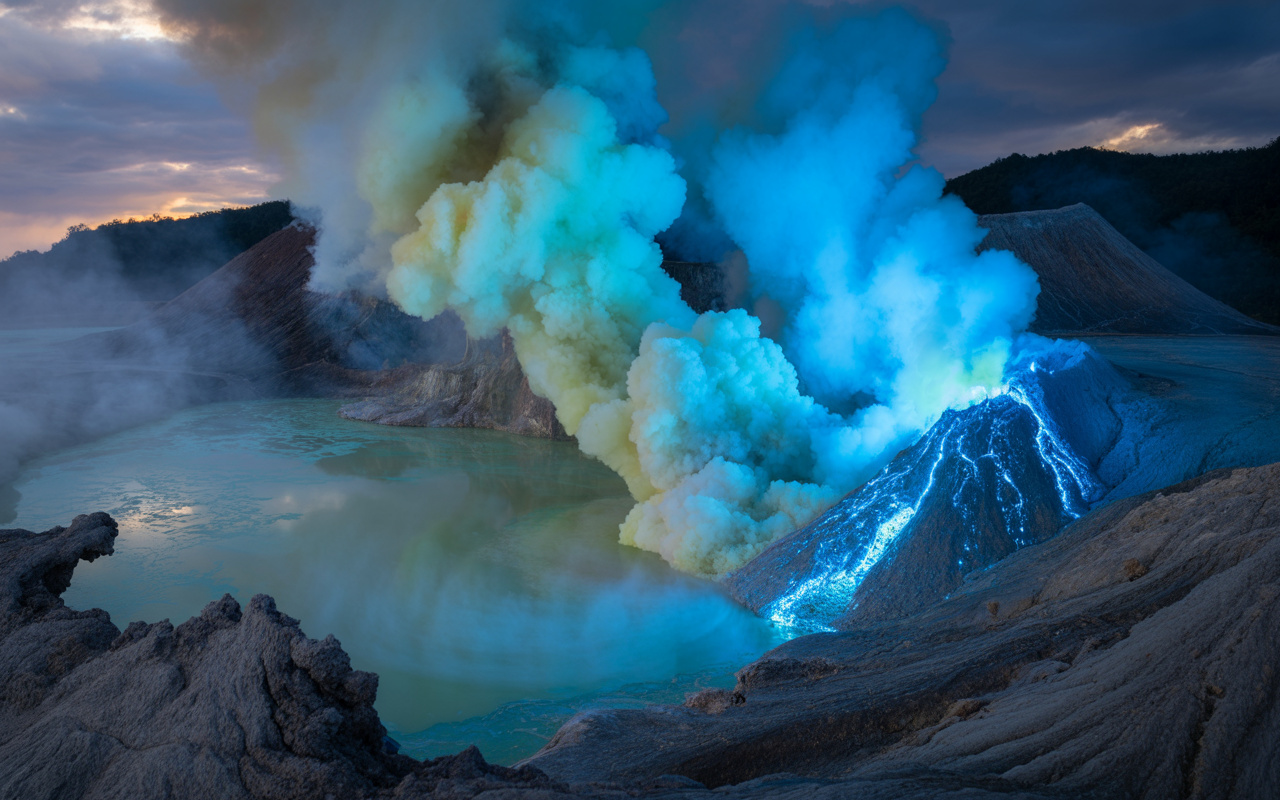


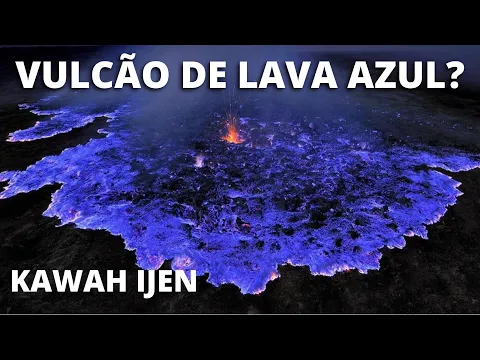
Located in Java, Indonesia, the Kawah Ijen volcano is famous for emitting blue fire at night, a rare phenomenon caused by the burning of sulfur gases at high temperatures.
Few places on Earth bring together as many contrasts as the Kawah Ijen volcano, located on the island of Java, Indonesia. It looks like a landscape out of science fiction — and it’s no wonder it has become one of the planet’s most rare and studied phenomena. Unlike any other volcano, Kawah Ijen not only expels incandescent lava but also emits rivers of blue fire, a spectacle that can only be seen at night and has intrigued scientists for decades.
The explanation lies in chemistry: the mysterious blue flames come not from magma, but from sulfur — an element abundant in Indonesia’s volcanic craters. When sulfurous gas ignites at temperatures above 360 °C, it releases an electric blue light, creating the visual illusion of blue lava flowing down the volcano’s slopes. The phenomenon is so intense that the flames can reach up to 5 meters high, visible from more than 3 kilometers away.
A Natural And Dangerous Spectacle
During the day, Kawah Ijen appears to be an ordinary volcano, but at night it transforms. Under the darkness, the burning gas creates a glow that spreads throughout the crater, reflecting off the turquoise acidic lake resting inside the volcano — considered the most acidic in the world, with a pH close to 0.5, according to the U.S. Geological Survey (USGS). This lake, about 1 kilometer in diameter, is formed by a mixture of molten sulfur and volcanic gases dissolved in water, and its blue-green color is due to the high concentration of minerals.
-
From Florianópolis to Antarctica non-stop at 60 years old: 1st Brazilian woman to sail solo makes history by facing one of the most dangerous routes on the planet.
-
A Brazilian recounted how a sudden malaise triggered the entire hospital machinery in the United States, with emergency protocols, tests to rule out a heart attack, and a bill that could reach $40,000.

-
Discovered just 4 meters deep, a 5,000-year-old submerged city with streets, tombs, and trade signs with Crete reveals how one of the oldest civilizations in the world lived before disappearing beneath the sea.
-
The new “monster” submarine of the United States Navy weighs nearly 8,000 tons, is 115 meters long, does not require fuel, and can operate for long periods submerged; meet the USS Massachusetts (SSN-798), which arrives to strengthen the military power of the U.S. amid global tensions.


But this beauty comes at a price. The environment inside the crater is extremely toxic, and even with masks, the air is nearly unbreathable. The heat, the strong smell of sulfur, and the constant risk of eruption make Kawah Ijen one of the most dangerous volcanoes to explore. Still, dozens of local workers descend into the crater every day to extract blocks of solid sulfur, an activity that supports many families in the region.
Life Inside The Crater
Working in the sulfur mines of Kawah Ijen is considered one of the hardest jobs in the world. Miners dig and carry up to 90 kilograms of sulfur on their backs, climbing over 800 meters to the crater’s edge, on trips that can last for hours. The material is sold to chemical and cosmetic industries, which use it in products such as gunpowder, fertilizers, and medicines.
Despite the risks, artisanal mining remains one of the main sources of income in the region. Many workers report that the blue glow of the flames is, for them, a constant reminder of the power of nature and the influence it has over their lives.
The Science Behind The Blue Fire
According to the Smithsonian Institution and National Geographic, the blue fire phenomenon was scientifically documented for the first time in 1964, but only gained global notoriety after the expeditions of French photographer Olivier Grunewald and Indonesian geologist Aris Yanto, who captured spectacular images of the volcano during nights in 2013 and 2014.
Grunewald reported that the temperatures inside the crater could melt the plastic of cameras and that even with protective gear, it was almost impossible to stay for long. “The blue fire is not lava — it is burning sulfur, a phenomenon so rare that it only exists in a few places in the world,” explained the photographer in an interview with BBC Earth.
Scientists emphasize that Kawah Ijen is unique because it combines the perfect conditions for this chemical spectacle: large amounts of gaseous sulfur, high temperature, and sufficient ventilation to keep the combustion visible at night.
One Of The Rarest Phenomena On The Planet
Although other volcanoes emit sulfur, none have the same visual impact as Kawah Ijen. Therefore, it is often described as the only active “blue fire” volcano in the world. At night, the site transforms into an almost extraterrestrial setting — a true flaming blue sea that attracts tourists, scientists, and filmmakers.
The NASA Earth Observatory has classified the volcano as “one of the most fascinating and dangerous places on Earth,” while the National Geographic Channel has produced entire documentaries about the phenomenon, highlighting its scientific and environmental value.
The Acid Lake That Challenges Life
In addition to blue fire, another element that makes Kawah Ijen remarkable is its acidic lake. With a turquoise-blue color and serene appearance, it hides a lethal reality. Its chemical composition includes sulfuric acid and hydrochloric acid in high concentrations, rendering it unable to harbor any known form of life.

Researchers claim that the lake emits corrosive vapors which, in large amounts, can cause burns on the skin and irritation in the eyes and lungs. Despite this, the crater receives hundreds of visitors every month, especially tourists and geologists seeking to understand the extreme balance between destruction and beauty.
Controlled Tourism And Constant Risk
In recent years, the Indonesian government has begun to restrict access to the volcano at night, due to the risks of poisoning and eruption. Even so, interest in the phenomenon continues to grow, and Kawah Ijen has established itself as one of the most exotic and photographed tourist destinations in Asia.
Local guides, equipped with masks and flashlights, lead visitors on trails that take them to the edge of the crater. From up there, it is possible to observe the blue glow dancing over the rocks — a silent and mesmerizing spectacle that lasts until dawn.
The Kawah Ijen volcano is a testament to how nature masterfully combines extremes. Its blue fire, fueled by sulfur, represents both the creative force and the destructive force of the Earth. A reminder that the planet still holds phenomena that challenge human understanding and that, even amidst toxicity and deadly heat, can produce one of the most beautiful and enigmatic sights ever witnessed by science.








Quanto espetáculo!! E ao mesmo tempo, quanto desequilíbrio.