





 Portuguese
  English
  Spanish
  5 min of reading
  0 comments


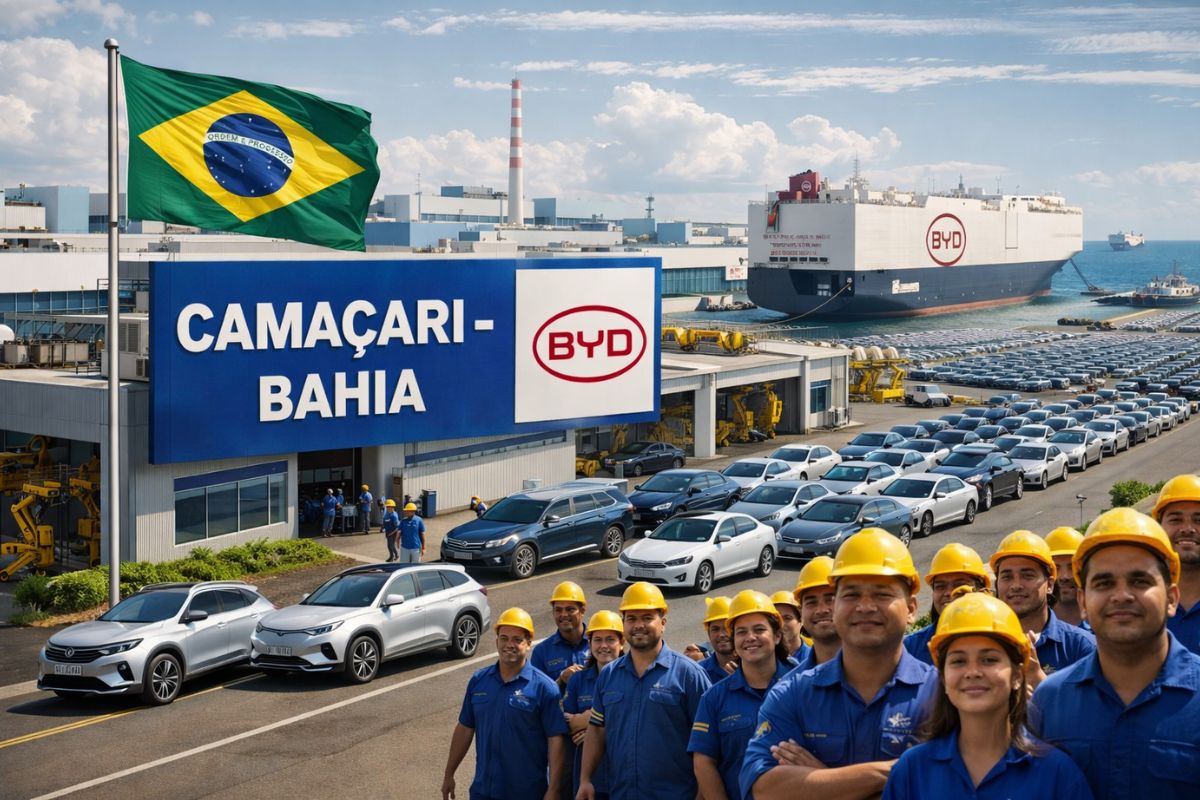
BYD cut about 10% of its global workforce of almost one million employees due to the price war in the Chinese electric car market, but in Brazil, the manufacturer maintains the schedule of the Camaçari factory and has also announced an investment of R$ 300 million in a research center in Rio de Janeiro.
BYD has just made one of the most drastic decisions in the recent history of the automotive industry: it cut approximately 100,000 jobs in its global operation, reducing its workforce from 970,000 to about 870,000 employees. According to information from the portal ndmais, The measure came along with the disclosure of the 2025 balance sheet, which showed a record revenue of US$ 116 billion but a 19% drop in net profit, which stood at around US$ 4.56 billion. BYD is earning more than ever but profiting less than it should.
What makes the situation even more intriguing is that the cuts mainly affect operations in China, while Brazil is moving in a completely opposite direction. BYD’s factory in Camaçari, Bahia, is keeping to its installation schedule and could generate up to 20,000 direct and indirect jobs. Instead of retreating, the Chinese manufacturer is doubling down on the Brazilian market, and the reason has to do with a strategy that goes far beyond selling cars.
Why is BYD laying off 100,000 people despite record revenue

image: BYD
The number seems contradictory at first glance: how can a company that sold 4.6 million new energy vehicles in 2025 and surpassed the US$ 116 billion revenue mark need to lay off 10% of its workforce?
-
The two largest powers of BRICS are putting rivalries aside: China and India are making historic advances in rapprochement and plan to use their consecutive presidencies of the bloc to deepen ties and reshape the global balance of power.

-
China alone accounts for 70% of trade within the BRICS, while Brazil establishes itself as an essential supplier of food and minerals: understand how the group, which already represents nearly 40% of the world’s GDP, is changing the game.

-
Starting in May, those who do not have registered biometrics will not be able to apply for Bolsa Família, sickness benefits, or unemployment insurance: understand the new rule that changes access to benefits for millions of Brazilians.

-
A new law being voted on in Brazil proposes a minimum fare of R$ 10 per trip and R$ 2.50 per kilometer for Uber and 99 drivers, and promises to ensure they earn as well as taxi drivers did during the golden age of taxis in the country.

The answer lies in the price war that dominates the Chinese electric car market, where local manufacturers have entered a spiral of aggressive discounts to compete for every consumer.
BYD was forced to pass on significant discounts to dealers, squeezing profit margins to an unsustainable point. The problem worsened with the reduction of state subsidies that the Chinese government offered for the purchase of electric vehicles.
Without these tax benefits, the cost of operations fell directly on BYD’s cash flow, and net profit fell by 19%, the first decline in four years. The 100,000 cuts are not a reaction to a demand crisis but a reorganization to align the company’s size with a reality of tighter margins.
What is happening with BYD in Brazil while China cuts
While the Chinese parent company cuts jobs, BYD’s Brazilian operation is moving in the opposite direction. The Camaçari factory in Bahia continues its installation pace, and the manufacturer has not indicated that the schedule or workforce will be affected by global cuts. On the contrary: the Bahia unit is treated as a strategic piece for BYD’s margin recovery.
The logic is clear. Producing in Brazil allows BYD to avoid high import taxes that make Chinese vehicles more expensive in the Latin American market.
In addition to the Camaçari factory, BYD announced an investment of R$ 300 million in a research and development center in Rio de Janeiro and the creation of 3,000 additional jobs in Bahia.
The strategy is not just to sell electric cars in Brazil; it is to transform the country into an export hub for all of Latin America, using local production as a competitive advantage.
The price war in China that forced BYD to cut 100,000 jobs
The Chinese automotive market is experiencing a moment that analysts describe as unsustainable. Dozens of electric car manufacturers are competing for the same consumer with discounts that erode margins across the sector.
BYD, even being the largest seller of new energy vehicles in the world ahead of Tesla in absolute numbers, could not escape this destructive dynamic.
With each discount offered to maintain sales volume, profitability decreases. With each government subsidy withdrawn, operational costs increase.
The restructuring of 100,000 jobs is BYD’s attempt to find a balance between the necessary scale to compete globally and the efficiency needed to survive in a market where selling more does not guarantee higher profits. According to experts consulted by international media, the 19% drop in profit was the trigger that made the cuts inevitable.
BYD’s plan to recover margins without increasing car prices
BYD does not intend to pass the pressure on profits to the end consumer. Instead of raising prices, the manufacturer’s strategy involves investments in technology that reduce production and logistics costs. This includes innovations in the chemical composition of LFP (lithium iron phosphate) batteries and modernization in the stamping and assembly stages of vehicles.
International expansion is the other leg of this strategy. In 2025, BYD surpassed 1 million units exported for the first time.
Producing in markets like Brazil, where the Camaçari factory can serve as an export platform for Latin America, allows BYD to capture margins that the saturated Chinese market no longer offers.
It is a long-term bet: while China experiences a price war, emerging markets with growing demand for electrification like Brazil offer space to grow profitably.
What BYD’s decision reveals about the future of electric cars
BYD’s restructuring is not an isolated case. European and North American automakers face similar challenges, and the sector as a whole is entering a phase where financial sustainability is as important as launching new models.
The era of growth at any cost in the electric car industry is giving way to a phase of stabilization, where those who cannot produce efficiently simply do not survive.
For Brazil, the scenario is paradoxically favorable. BYD needs production bases outside of China to protect margins, and Camaçari offers exactly that.
With up to 20,000 jobs at stake, investment in R&D in Rio de Janeiro, and the potential to become the manufacturer’s export hub in Latin America, Brazil could be one of the big beneficiaries of a crisis that originated on the other side of the world.
The question is whether the country will create the infrastructure, incentives, and regulatory stability to capture this opportunity while it is on the table.
What do you think: will the cuts in China affect BYD’s plans in Brazil, or will the Camaçari factory emerge strengthened from this restructuring?








Seja o primeiro a reagir!