





 Portuguese
  English
  Spanish
  3 min of reading
  0 comments


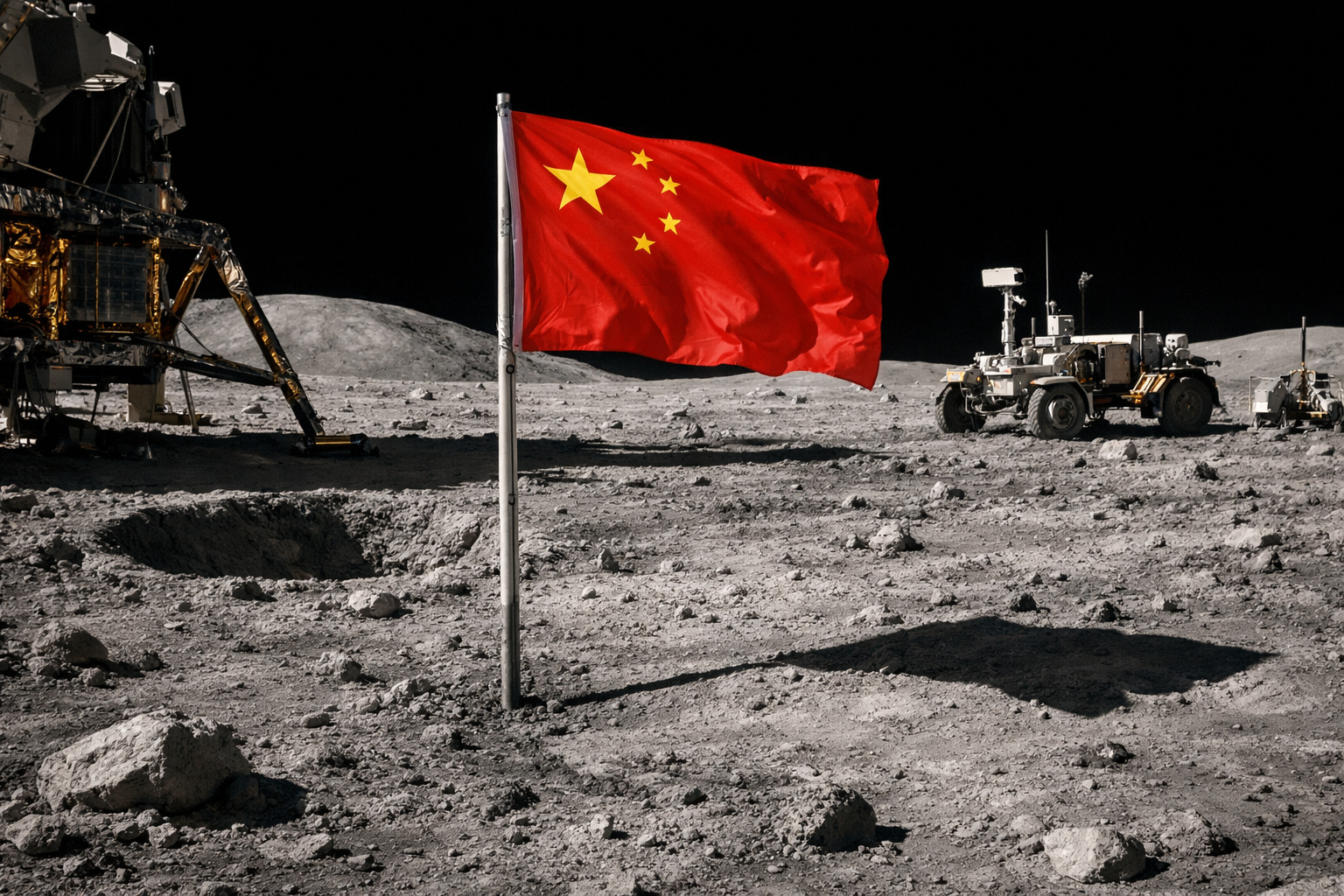
Chinese strategy with satellites at strategic points redefines space communication and challenges historical limits of missions on the lunar far side
Communication with the far side of the Moon has always been one of the greatest challenges faced by space missions over the past decades. This occurs because, when a spacecraft crosses this region, the Earth’s natural satellite completely blocks the radio signal, interrupting any direct contact with ground control centers, according to BBC News. However, amid an increasingly intense space race, China emerges with an innovative solution that could definitively change this scenario.
The information was released by China National Space Administration (CNSA) and reinforced by recent analyses of Chinese technological advancements, highlighting the country as one of the world’s major military and space powers. In this context, investment in space technology has proven strategic not only for scientific exploration but also for consolidating global influence.


Relay system with satellites puts China ahead in the space race
To overcome this historical limitation, China has implemented a system based on highly strategic relay satellites. The equipment known as Queqiao-1 and Queqiao-2 act as intermediaries between space probes and Earth, ensuring continuous communication even when there is a direct line-of-sight blockage.
-
China surprises the world by developing an engine that operates from takeoff to over Mach 6 using a counter-rotating compressor and shock waves to reduce weight and revolutionize hypersonic aircraft.

-
Avatar was right: scientists from the European Space Agency have proven that a laser beam can move objects in space without using a drop of fuel, and the discovery paves the way for ships that never need to refuel, satellites that never become junk, and interstellar travel that previously existed only in science fiction.
-
A student spent years dragging friends to see a solitary 1.8-meter stone in a forest in England until archaeologists decided to investigate and discovered a 3,700-year-old ritual site hidden beneath the ground, featuring five fallen stones, a ceremonial platform, and a spring that fed Bronze Age rituals.

-
With 80 kilometers in length and 152 meters in height, a gigantic underwater barrier could become the last resort of engineering to contain the Judgment Day Glacier and buy time against the rising oceans on the planet.

These satellites are positioned in extremely specific regions of space called Lagrange points—areas where gravitational balance allows them to remain practically stable. This way, they can maintain simultaneous visibility for both Earth and the far side of the Moon, something that represents a significant technological leap.
Moreover, this model has already been successfully applied in recent robotic missions conducted by China, demonstrating not only technical feasibility but also operational efficiency. Consequently, the country positions itself ahead of other nations that still face periods of silence during lunar missions.

Technological difference exposes limitations of other space powers
While China advances with sophisticated solutions, many international missions still suffer from temporary communication interruptions when crossing the far side of the Moon. This type of limitation results in silence windows that can compromise critical operations, in addition to reducing the efficiency of sending and receiving scientific data.
On the other hand, the Chinese system eliminates this problem by ensuring a constant communication bridge. Thus, even during flybys in regions not visible from Earth, the probes continue to transmit information in real-time. This technological edge reinforces China’s position as an emerging power that directly challenges the historical dominance of the United States in the space sector.
Ambitious plan aims for complete space network by 2030
In addition to current advancements, China is already projecting an even more ambitious future. The country intends to expand this system by creating a broader network of satellites, which will not only maintain communication but also provide support for navigation and monitoring in deep space.
The expectation is that this infrastructure will be fully consolidated by 2030, aligning with the Chinese government’s plans to send astronauts to the Moon. With this, the country will be able to establish a continuous and strategic presence in the lunar environment, further expanding its technological and scientific influence.
Thus, the Chinese advancement represents not only a technical solution to an old problem but also a strategic move that could redefine the balance of power in the new global space race.








Seja o primeiro a reagir!