






 Portuguese


Xiaomi SkyNomad N90 Max Studio Features Electric Roof, 2.29 m Interior Height, Two Sleeping Areas, Heated Floors, and a Range of 1,705 km.
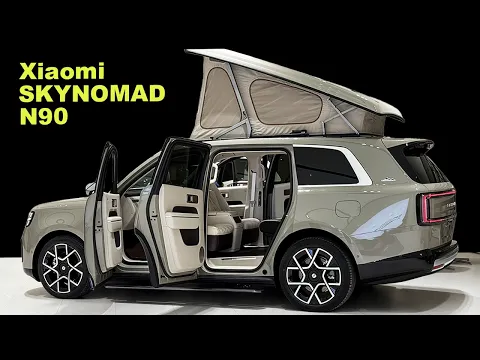
Xiaomi has transformed a 5.285-meter long SUV into a sort of two-story mobile home. The new SkyNomad N90 Max Studio features an electric roof integrated into the body that rises when the vehicle is parked, creating up to 2.29 meters of interior height and opens a superior space of approximately 2.08 m² capable of supporting 200 kg.
The transformation continues below. The second row can turn into a flat bed of 1.87 meters by 1.24 meters in about 30 seconds, while the vehicle also offers a 9-liter refrigerator, aluminum flooring that resembles wood, and heating on three levels. In the upper area, there are dedicated lighting, insect screens, charging points, and integrated air-conditioning vents within the vehicle’s system.
Xiaomi Created an SUV that Turns into a Two-Story House
The SkyNomad N90 Max Studio was unveiled in September 2026 as the most radical interpretation of Xiaomi’s new extended-range SUV family.
-
Chevrolet Cobalt LTZ 2020 Offers 563-Liter Trunk, 1.8 Engine from Spin, and 6-Speed Automatic Transmission for R$ 64,636, Lower than a Brand-New Renault Kwid

-
Peugeot’s Last Medium SUV of 2023 Sold for Nearly R$ 21,000 Below Fipe, Boasts 520-Liter Trunk, Delivers 165 hp, 24.5 kgfm, ADAS Package, Accelerates from 0 to 100 km/h in 8.9 Seconds, and Costs the Same as a New Renault Kardian

-
Hyundai Recalled 61,307 Palisade SUVs After A 2-Year-Old Died In The Third Row, And Six Months Later The Same Seat Defect Surfaced In Another Model

-
Gasoline Might Change Again in Brazil: Government Tests 35% Ethanol Blend, Up from 32%, Impacting Flex Car Consumption and Older Engines


The body still resembles that of a large SUV when the roof is closed. The difference is that the entire upper section was designed from the ground up to transform, without relying on an externally mounted rooftop tent.

The electric system raises the roof, creating an additional usable area above the main cabin. Xiaomi describes the outcome as a loft-style space, designed for camping, traveling, remote work, and extended stays away from hotels or residences.
This solution brings the N90 Max Studio closer to a small motorhome, while retaining the dimensions, appearance, and dynamics of a luxury SUV.
Electric Roof Integrated into the Body from the Factory
The roof is not an accessory placed over external bars. It was structurally integrated into the vehicle’s design, maintaining an almost conventional appearance when retracted.
When closed, the assembly adds approximately 100 mm to the vehicle’s height. The height increases to around 1.925 meters, allowing the SUV to remain compatible with many garages and parking lots that have a height limit close to two meters.


Even with the additional structure, the reported drag coefficient for the configuration reaches 0.245, a low figure for a vehicle of this size with a retractable roof.
When parked, simply activate the mechanism to lift the top and unlock the second level.
Interior reaches up to 2.29 meters in height
With the roof open, the key figure is the maximum interior height of approximately 2.29 meters.
This allows an adult to stand inside the vehicle, something virtually impossible in a conventional SUV. Xiaomi reports that even a person around 1.80 meters can stand upright even in the lower rear area of the overhead space.

This transformation completely changes the way the car is used when it reaches its destination.
Instead of simply reclining a seat to sleep, occupants now have sufficient vertical space to change clothes, organize equipment, work, and move around inside the vehicle.
Upper deck measures 2.11 meters by nearly 1 meter
The upper compartment offers approximately 2,110 mm in length by 985 mm in width.
This represents a usable area of nearly two square meters. The structure is designed to support up to 200 kg, allowing adults to use the space as a resting or sleeping area.
The elevated roof also incorporates five areas with insect screens, helping maintain ventilation while preventing mosquitoes from entering at night.
There are also dedicated lighting and power outlets for use on the upper level.
Even the air conditioning reaches the upper deck
Xiaomi integrated two air conditioning vents directly into the upper space.
They share a fan and ducts with the rear outlets of the first floor. The user can control the system via the central multimedia unit, voice commands, or controls available for rear passengers.
The upper vents have flaps that allow for adjusting the direction and volume of air.
They can also be closed individually. When no one is on the first floor, other rear outlets can be shut off to direct a greater volume of air to the upper deck.
This transforms the elevated roof into a real extension of the vehicle’s climate control, not just a fabric-covered shelter.
Second row converts to 1.87-meter bed in about 30 seconds
While the upper deck forms a second sleeping area, the main cabin can also convert into a bedroom.
The second row utilizes electric actuation and forms a flat surface of approximately 1.87 meters long by 1.24 meters wide. The transformation takes about 30 seconds.
The result allows for the creation of two independent resting areas within the same vehicle.
One person or couple can stay on the lower floor while other occupants use the upper structure. This versatile transformation is unusual for a conventional SUV.
The Studio abandons the seven-seat configuration of the standard N90 Max to prioritize this more flexible arrangement of five seats and increased interior height.
Floor Imitates Wood and Also Features Heating
The transformation doesn’t stop at the seats. Xiaomi installed approximately 1.7 m² of aluminum flooring with a wood-like finish.
The material was chosen to combine a home-like appearance with enough durability for automotive use and outdoor activities.
Beneath this surface lies a heated floor system with three intensity levels. The temperature can reach approximately 38 °C (100 °F).
On cold nights, the user can warm the area where they will walk or sleep, making the interior feel even more like a small residential space.
9-Liter Refrigerator Integrated into Interior Space
Another uncommon feature is the compressor refrigerator with a capacity of 9 liters.
In the SkyNomad family design, the central module can move along rails installed in the floor, allowing the space to be reorganized according to the number of passengers and usage type.
The refrigerator can carry beverages, food, and small items that need to remain chilled during travels.
The concept is directly linked to Xiaomi’s strategy of treating the interior not merely as a transport cabin but as a configurable space.
20-Liter Wardrobe Helps Organize the “Room”
The Studio also has a built-in wardrobe of approximately 20 liters.
It is integrated into the rear area and serves to store clothes and small objects during trips.
There are three additional independent areas for organizing, along with a small floating nightstand that has electrical outlets.
The structure offers 220 V and 12 V outlets, its own lighting, and magnetic points for securing accessories.
The idea is to allow electronic devices to continue working even when the car is parked and converted into a sleeping area.
11.5-Inch Mirror Transforms Cabin into a Small Room
Even a specific mirror has been incorporated into the design.
The piece measures 11.5 inches, uses soft lighting of approximately 4,000 K, and can remain open at different angles, reaching about 115 degrees.
This feature may seem minor compared to the electric roof, but it indicates the level of detail in the proposal.
Xiaomi has not just created a surface for sleeping. The interior has been designed to allow users to spend hours inside the car engaging in activities similar to those in a small room or studio.
30-Inch Screen Turns the Car into a Cinema
Among the available features, there is a 30-inch projection system with 1080p resolution.
The projector boasts a claimed brightness of 650 lumens, while the screen can rise or lower electrically in approximately 25 seconds.
Controls can be operated via remote or voice commands.
With the seats converted into a bed, the setup effectively creates a small cinema inside the vehicle, reinforcing the idea of staying in the car after reaching the destination.
SkyNomad N90 Max Measures Almost 5.3 Meters
This entire structure is built on a really large SUV.
The SkyNomad N90 Max measures 5,285 mm in length, 1,998 mm in width, and has a wheelbase of 3,080 mm.

CARVIEW
These dimensions are comparable to large premium three-row SUVs.
The enormous wheelbase helps create a nearly rectangular cabin, while the platform employs a flat floor and long tracks that allow for repositioning seats and internal modules.
Xiaomi itself defines the family as a set of SUVs with intelligent and reconfigurable space.
Two Electric Motors Deliver 310 kW
The nearly 5.3-meter size does not indicate slow performance.
The N90 Max employs two electric motors with a combined output of 310 kW, equivalent to approximately 421 hp.
The front electric motor delivers 210 kW, while the rear adds another 100 kW. Therefore, traction operates on all four wheels.
Even being a huge, heavy SUV designed to support the entire roof structure, the setup propels the vehicle from 0 to 100 km/h in approximately 5.9 seconds.
This performance resembles that of a sports car in a vehicle designed to also function as a sleeping space.
1.5 Turbo Engine Works as a Range Extender
The SkyNomad is not a conventional pure electric vehicle.
The architecture is of the EREV type, short for electric vehicle with a range extender.
A 1.5 turbo combustion engine produces around 112 kW, but its primary function is to generate electricity to power the system and extend the range. The wheels continue to be driven by the electric motors.
This allows for a large battery combined with the possibility of using gasoline during long trips.
76 kWh Battery Allows Up to 464 km on Electricity Alone
The battery has a capacity of 76 kWh and employs ternary chemistry of nickel, cobalt, and manganese.
Under the Chinese CLTC cycle, the all-electric range reaches 464 km.
This means that, during daily commutes, the combustion engine can remain off for extended periods.
For long trips, the range extender kicks in and drastically increases the available distance.
Combined range reaches an impressive 1,705 km
By combining battery and range-extending system, Xiaomi announces up to 1,705 km of combined range under the CLTC cycle for the N90 Max.
This is one of the most impressive figures for the vehicle.
The architecture allows for using electricity for daily trips while maintaining the flexibility of gasoline when crossing regions where fast chargers are still scarce.
With a depleted battery, the consumption certified by the WLTC cycle is approximately 6.26 liters per 100 km.
Fast charging adds hundreds of kilometers in 15 minutes
The electric system also supports fast charging.
Xiaomi reports that about 285 km of electric range can be recovered in 15 minutes, according to the methodology used by the manufacturer.

The combination of fast charging, a 76 kWh battery, and a gasoline extender reduces the need for long stops on trips.
For those planning to use the car as a small camper, this feature is even more important, as lighting, climate control, refrigerator, and electronic devices rely on power.
Air suspension allows for five height levels
The chassis employs double-wishbone front suspension and independent Multilink rear suspension of the H-arm type.
The system also includes air suspension with five height levels and continuously controlled shock absorbers.
The air suspension allows for adjustments in ground clearance depending on comfort, speed, or terrain needs.
This setup also helps manage the mass of a vehicle that approaches three tons in certain configurations.
SUV can handle up to 750 mm of water
Despite all the internal luxury, the N90 has also been developed with capabilities for off-road driving.
Xiaomi reports a maximum immersion depth of up to 750 mm, along with an emergency flotation mode intended for specific situations.
This feature combines elevated height, sealing of the electrical architecture, and electronic management.
While it doesn’t turn the vehicle into an extreme off-roader, it enhances safety for trips in areas with flooded roads or severe weather conditions.
Technology includes LiDAR and Nvidia chip with 700 TOPS
The electronic package is equally advanced.
The driving assistance system uses an Nvidia Thor processor with a capacity of 700 TOPS, along with front LiDAR, solid-state rear LiDAR, 4D radar, high-definition cameras, and ultrasonic sensors.
The architecture allows for advanced assistance features on highways and in cities, as well as automated parking.
Inside the cabin, the multimedia system features a central screen of 16.1 inches, paired with Xiaomi’s HyperOS.
Integration with the company’s ecosystem enables control of various internal equipment through voice commands.
The Studio version costs the equivalent of about R$ 231,000 in China
The SkyNomad N90 Max Studio was launched at 299,900 yuan in the Chinese market.
As of the exchange rate on September 18, 2026, this amounts to approximately R$ 230,700, before taxes, shipping, approval, or any costs associated with potential importation to Brazil.
The conventional N90 Max configuration is less expensive and prioritizes passenger transport, while the Studio focuses on camping features and internal transformation.
Xiaomi transforms the vehicle into a space to live, work, and sleep
The most unusual aspect of the SkyNomad N90 Max Studio is not just its isolated equipment.
It’s how all the systems work together.
The SUV measures 5.28 meters and offers a performance of approximately 421 hp, all-wheel drive, and accelerates from 0 to 100 km/h in 5.9 seconds, but it can stop and transform into a two-level space.
The electric roof creates up to 2.29 meters of interior height, the upper level provides an area of 2.11 by 0.985 meters and supports 200 kg. The second row converts into a bed measuring 1.87 by 1.24 meters, while the heated floor, refrigerator, cabinet, and electrical connections complete the lower environment.
Above, lighting, insect screens, charging, and air conditioning vents allow the roof to function as a true integrated second floor connected to the vehicle’s own climate control system.
With a 76 kWh battery, up to 464 km electric range, and 1,705 km of combined range, the N90 Max Studio takes the family SUV concept in an unusual direction: the vehicle no longer serves just to reach a destination; it offers a space designed for continued use after the trip ends.


