





 Portuguese
  English
  Spanish
  4 min of reading
  34 comments


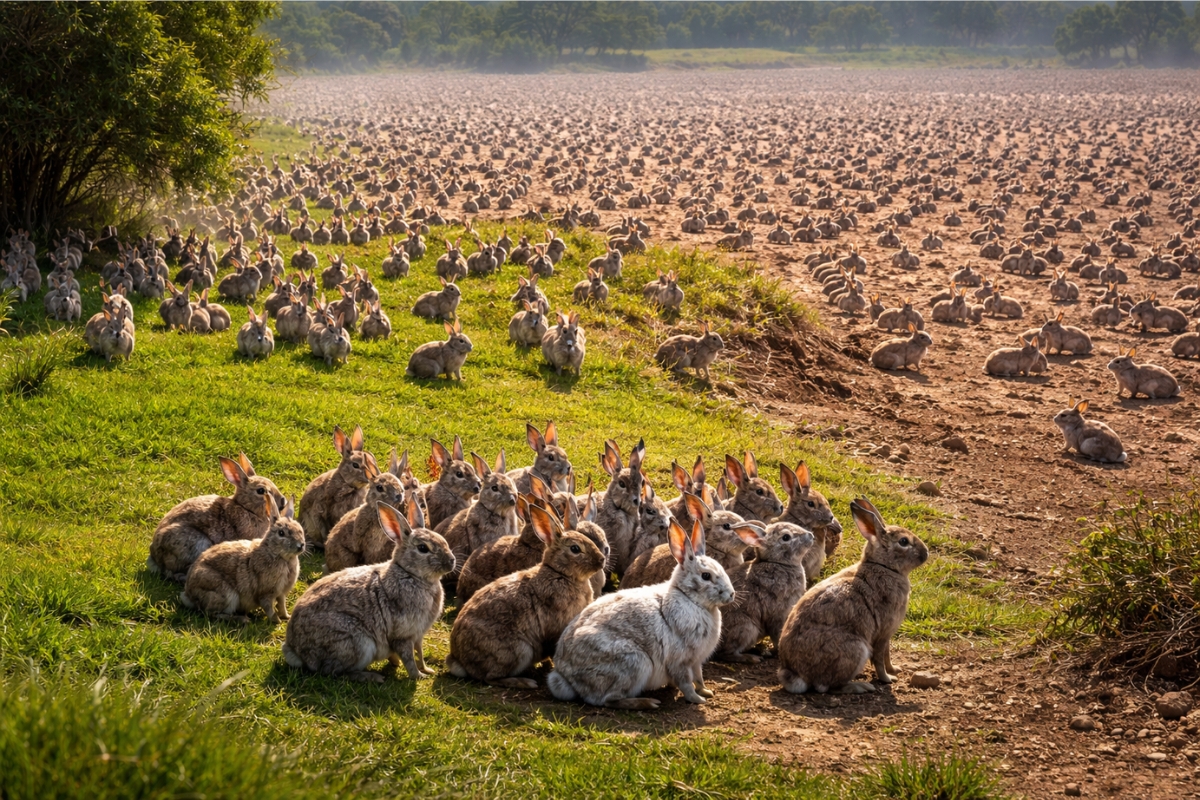


The Invasion of the European Rabbit Became an Environmental and Economic Crisis, Requiring About 3,256 km and the Use of Viruses to Reduce Out-of-Control Populations
The introduction of the European rabbit in Australia started as a simple decision and ended up being one of the country’s most expensive and persistent biological invasions.
In 1859, the initial release of 24 rabbits paved the way for explosive expansion. Within a few decades, the species spread across vast areas, affecting pastures, agriculture, and entire ecosystems.
The practical impact was direct: exposed soil, loss of native vegetation, accelerated erosion, and ongoing costs to manage the problem in the long term.
-
Tourists on Everest were poisoned by guides who mixed substances in food to provoke false symptoms of altitude sickness while helicopter operators and hospitals charged inflated rescue fees to insurance companies.

-
Few people know this, but Neil Armstrong, one of the most famous NASA astronauts in history, survived the Korean War after jumping from the plane during his seventh combat mission aboard the USS Essex aircraft carrier of the United States.

-
Diving with a camera in Lake Furnas reveals a submerged city with an entire street, almost intact houses, a preserved bridge, a wood stove, a Kombi, and even a bus at the bottom of the largest lake in the Southeast.

-
Iceland accidentally drilled into a magma pocket at 2,100 meters and revealed that the extreme heat beneath the crust could pave the way for a new source of continuous energy.


What Happened and Why It Caught Attention
The modern invasion began in 1859 and rapidly gained scale. The scenario favored multiplication, with ample food availability and a lack of predators capable of consistently limiting the population.
In less than 70 years, rabbits occupied about two-thirds of the continent. The occupied area reached approximately 5.3 million km², close to 70% of southern Australia.
The population peaked at 600 million, creating constant pressure on pastures and native vegetation.

Why Reproduction Got Out of Control So Quickly
The European rabbit combines early maturity with high reproductive capacity, which accelerates population outbreaks when food and shelter are available.
A commonly used parameter to illustrate this speed is straightforward: one pair can become 184 in 18 months under favorable conditions. This explains why slow actions almost always come too late.
The practical result is an invasion that quickly re-establishes itself. Even after sharp declines, the population begins to rise again in regions with favorable climate and pasture.
How Millions of Fertile Hectares Became Degraded Soil
The damage is not limited to eating grass. The constant pressure affects shoots and young plants, precisely the phase that sustains vegetation regeneration.
When ground cover decreases, the soil becomes vulnerable. The exposure increases erosion from wind and rain, reduces the organic layer, and worsens the quality of productive areas.
This process pushes entire landscapes into a cycle that is difficult to reverse, with soil degradation and prolonged impacts on rural productivity.
The Fence of About 1,834 km That Tried to Contain the Invasion and Why It Didn’t Solve the Problem

The most visible response was the construction of the Rabbit Proof Fence. The project began in 1901 and the first line was about 1,834 km, crossing Western Australia.
Over time, the fence system accumulated approximately 3,256 km. The structure aimed to reduce the entry of rabbits into agricultural areas, but it did not eliminate the problem.
The invasion continued because control through physical barriers requires constant maintenance and does not prevent recolonization. The dynamics of rapid reproduction maintained pressure on the protected areas.
The Use of Viruses, 1950s, 1996, 2017, and the Evolutionary Race That Changed the Game
Starting in the 1950s, myxomatosis drastically reduced populations, reaching over 90% in some regions. The effect diminished over time, with the emergence of resistance in rabbits and changes in the virus dynamics.
Another milestone came in 1996 with the release of RHDV1. The strategy also had a high initial impact but lost efficiency in part of the territory over time.
The reinforcement included RHDV1a in 2017 and the presence of RHDV2 detected since 2015. The scenario turned into a continuous biological struggle, with outbreaks, resistance, and a need for ongoing adaptation.
What Changes in Practice for the Field and What May Happen From Now On
The agricultural cost remains heavy. The recurring estimate indicates losses exceeding A$ 200 million per year associated with the presence of rabbits and related impacts.
Effective control depends on a combination of actions and repetition, as recolonization happens quickly. A common parameter used in the field helps to quantify the pressure on pastures: 7 rabbits are equivalent to one dry sheep in consumption.
The need for new cycles of biocontrol appears every 10 to 15 years, with the invader returning when the measures lose effectiveness. The pressure tends to continue as long as shelter and food are available.
The case also solidified a practical lesson for environmental management: preventing introduction costs less than containing an invasion that already dominates millions of square kilometers.
The history of rabbits in Australia remains a technical and economic warning. 1859, 600 million, and 70% of the occupied southern territory show how an initial small choice can turn into a structural problem for generations.










Una locura, ahora los uruguayos deberíamos combatir contra 14 canguros y 200 conejos, cada vez más difícil.
Aguante el conejo europeo , que mamen guevo
Coincido con Gloria Nascimento y Wilber, Creo que si ofrecieran todos los conejos a empresarios con transporte para cazarlos y venderlos barato a consumidores que gustan de la sana carne del conejo se ahorrarías dolores de cabeza. A los empresarios les encanta ganar dinero fácil y rápido, no creo que despreciaron la oportunidad ! Graciela de Buenos Aires Argentina, 9/01/2026.
Comparto contigo,demasiada ignorancia,acá en Patagonia se quejan del guanaco,salvo santa cruz,tenés carne y pelos para uso textil