





 Portuguese
  English
  Spanish
  4 min of reading
  0 comments


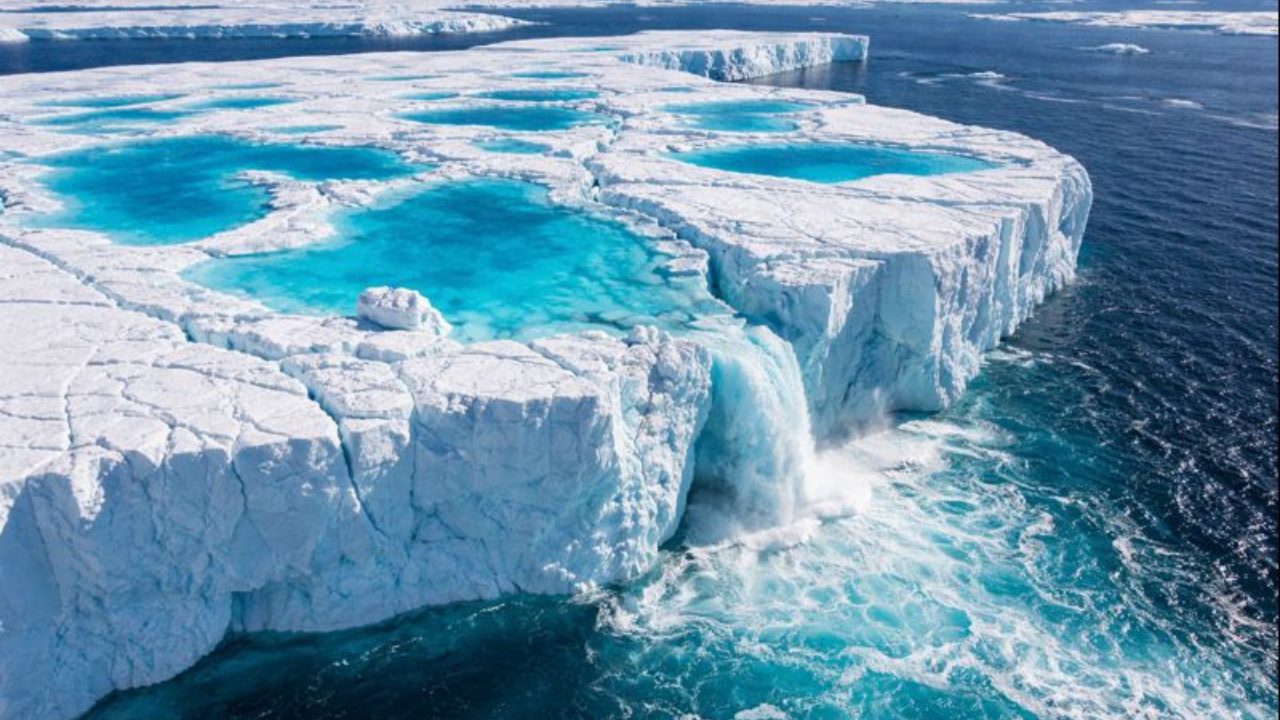
Images From NASA Reveal Accelerated Melting of Iceberg A-23A in Antarctica and Reinforce Warnings About Global Warming.
The iceberg A-23A, one of the largest ever monitored by science, is facing accelerated melting and may completely disintegrate in the coming days or weeks, according to images from NASA.
The phenomenon is occurring in Antarctica, has been monitored by satellites since late 2025, and is directly linked to the advancement of global warming, which intensifies meltwater accumulation and ice fragmentation.
In the most recent records released by NASA, the surface of A-23A appears taken over by extensive bluish areas, a clear sign of structural weakening.
-
With a water crisis on the radar, Sabesp invests in reclaimed water for data centers and transforms sewage treatment into a solution that saves millions of liters and protects public supply.

-
Foresea achieves 100% offshore waste reuse in 2025, eliminates landfill disposal, and consolidates sustainable strategy with 1,500 tons recycled.

-
With earth, bamboo, straw, and lime mortar, a specialist builds a house for just over $460 and draws attention for its cost being much lower than traditional construction.

-
Rodrigo de Freitas Lagoon advances in environmental recovery with sanitation, elimination of irregular sewage, and the resumption of water sports in Rio de Janeiro.


Thus, scientists warn that the iceberg has entered its final phase, after nearly four decades adrift in the Antarctic Ocean.
Iceberg A-23A and the Advancement of Accelerated Melting
The accelerated melting of iceberg A-23A is associated with the accumulation of large volumes of liquid water on top of the ice.
This water forms from surface melting and settles in natural depressions, creating true “pools” visible in NASA’s images.
According to researchers, the additional weight of the water forces internal cracks, widening already existing fissures.
As a result, the iceberg loses cohesion and begins to fragment more rapidly, a typical collapse process in large ice blocks.
A Giant of Antarctica in Its Final Moments
The iceberg A-23A broke away from the Filchner Ice Shelf in Antarctica in 1986. At the time, it was about 4,000 km², an area more than double that of São Paulo city.
Therefore, its longevity has drawn the attention of the scientific community from the beginning.
Data from the U.S. National Ice Center indicate that, by early January 2026, the iceberg had already shrunk to 1,182 km².
This reduction occurred after successive breakages throughout 2025, intensified by the accelerated melting.
The Role of NASA Images in Monitoring
The images from NASA, captured on December 26, 2025, by the Terra satellite, reveal crucial details about the state of iceberg A-23A.
In addition to the bluish coloration, it is possible to observe linear patterns that indicate structural fragility.
“The blue coloration is not paint or sediment. It comes from meltwater accumulated in natural depressions of the ice,” explained scientist Ted Scambos from the University of Colorado Boulder.
According to him, “the weight of this water presses the internal fissures, forcing them open and favoring the collapse of the iceberg.”
Old Marks That Accelerate Wear
Another point highlighted by scientists involves striations formed hundreds of years ago, when the ice was still part of a glacier in contact with the rocky bed of Antarctica.
These marks created grooves that now function as natural channels.
Thus, meltwater follows specific paths, concentrating wear in already vulnerable areas. This process directly contributes to the accelerated melting currently observed in iceberg A-23A.
Freshwater Leak and Signs of Collapse
The NASA images also suggest that the iceberg has already begun to release freshwater into the ocean. A whitish stain next to A-23A may indicate a “blowout,” when internal pressure breaks the side of the ice.
This type of leak is considered a clear sign that the iceberg has entered its final phase. Furthermore, it temporarily alters the local ocean salinity, although global impacts are limited.
Antarctic Summer and Global Warming
The summer in the southern hemisphere is expected to be decisive for the fate of iceberg A-23A. Currently, it is in waters around 3 °C, relatively warm by Antarctic standards, and follows currents that push it toward even warmer regions.
These areas are known among specialists as an “iceberg graveyard.”
In this context, global warming acts as an aggravating factor, accelerating natural melting processes and reducing the lifespan of these ice giants.
An Expected But Symbolic End
For the scientific community, the disappearance of iceberg A-23A was expected, but carries strong symbolism.
According to NASA, its trajectory helped to better understand the behavior of so-called “megabergs,” enormous icebergs that periodically break away from Antarctica.
Meanwhile, other large ice blocks continue adrift or stationed along the Antarctic continent.
They await, silently, the moment to begin similar journeys in an increasingly warming-influenced scenario.









-

-

2 pessoas reagiram a isso.