





 Portuguese
  English
  Spanish
  4 min of reading
  0 comments


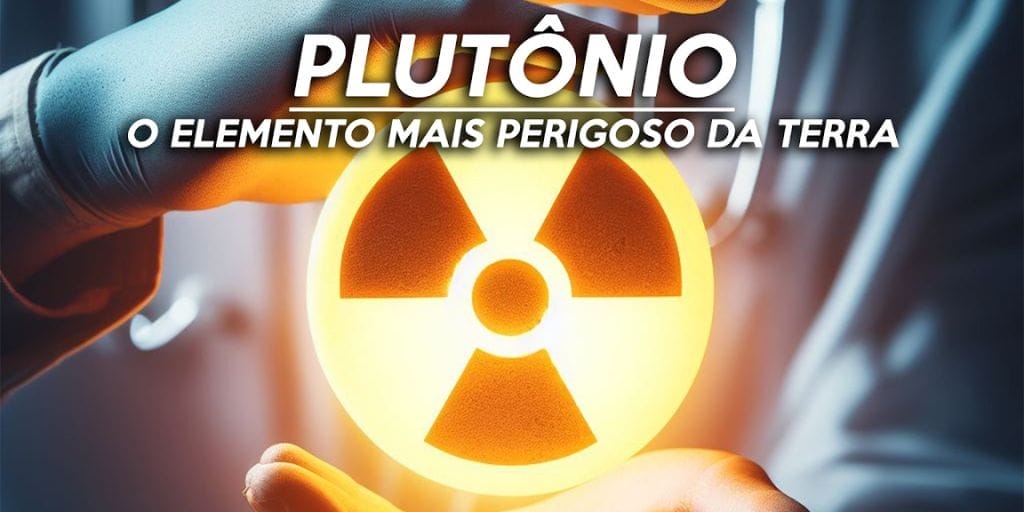
Considered by the Guinness World Records as the most dangerous element due to its potential use in atomic bombs, plutonium is one of the most intriguing elements in the periodic table.
Despite its notoriety, it is extremely rare in nature, making it difficult to find naturally. Its danger, according to research conducted by the Click Petróleo e Gás team, is influenced by various factors such as dose, concentration, solubility, size, contact form, time and frequency of exposure, in addition to individual sensitivity to the substance.
The Characteristics of Plutonium
Plutonium, symbolized by “Pu” and with atomic number 94, has 94 protons in its nucleus. This metallic element is solid at room temperature and can exist in several different forms called allotropes.
The most common form is plutonium-239. Known for its nuclear properties, plutonium has an unstable nucleus capable of undergoing nuclear fission.
-
The Himalayas continue to grow to this day, with tectonic plates advancing 5 cm per year, mountains rising up to 10 mm annually, and the 2015 earthquake that killed 9,000 people may have increased the risk of an even larger seismic mega-event.

-
At an altitude of 400 km by astronauts from the International Space Station, Paris transforms at night into a golden mesh so precise that it reveals the outline of the Seine River, avenues, and entire neighborhoods like a luminous map drawn over the Earth.

-
iPhone 17 reaches historic low price with 256 GB, 120 Hz display, and drops to R$ 5,703 on Shopee, featuring A19 chip, dual 48 MP cameras, battery life of up to 30 hours, and advanced AI features.

-
Trip to Mars getting closer: Pulsar Fusion, from the UK, advances with plasma ignition in fusion engine and could drastically reduce space travel time, making crewed missions faster, safer, and economically viable.
This characteristic is crucial in the nuclear industry, where plutonium-239 is used as fuel in nuclear reactors. However, its use in nuclear weapons raises serious global security and non-proliferation concerns.
History and Discovery of Plutonium
Discovered in 1940 by a group of scientists led by Glenn T. Seaborg and Ralph A. James at the University of California, in the United States, plutonium was synthesized by bombarding uranium-238 with neutrons in a particle accelerator.
The element was named after the dwarf planet Pluto, discovered in 1930. This discovery marked a significant moment in history, as it enabled the development of nuclear technology and had profound implications during the Second World War, contributing to the production of the first nuclear weapons. The impact of the element on science and history significantly shaped the course of nuclear energy and events in the twentieth century.
Production and Extraction of the Element
Unlike other minerals, the element is not extracted directly from the Earth. Being a transuranic element, it is artificially produced in nuclear reactors or particle accelerators.
To produce plutonium, according to the sources consulted, uranium-238 is typically bombarded with neutrons, transforming it into uranium-239.
This isotope is unstable and quickly converts to plutonium-239 through beta emission, becoming the most common and useful isotope of plutonium.
Nuclear Reprocessing: Separation of Plutonium
The separation of plutonium from uranium, known as nuclear reprocessing, is a complex process that involves several steps. A common method is solvent extraction.
First, irradiated nuclear fuel, which contains both uranium and plutonium, is dissolved in nitric acid, turning the solid material into a liquid solution.
Next, an organic extracting substance that has an affinity for plutonium is used, selectively extracting it from the solution.
The organic solution containing plutonium is then separated and subjected to a “scrubbing” process, where the element is converted from its oxidized state to a reduced state, typically with the addition of metallic iron.
The reduced plutonium is precipitated as plutonium oxide and undergoes a purification process to remove remaining impurities, ultimately being converted into a suitable form for use, such as plutonium oxide or metal.
Applications of Plutonium in Engineering
Plutonium has various applications in engineering, the most significant being in the production of electricity in nuclear reactors.
Plutonium-239 is used as fuel, where nuclear fission releases a large amount of thermal energy, converted into electricity. Plutonium-238 is used in Radioisotope Thermoelectric Generators (RTGs), providing electricity for long-duration space missions, such as space probes and rovers.
As plutonium-238 decays, it generates heat, which is converted into electricity. A historical example of its use is the “Fat Man,” the nuclear bomb that devastated Nagasaki during World War II.
In addition to these applications, some isotopes of plutonium are used in non-destructive testing to inspect the integrity of materials, such as welds in metal structures, using industrial radiography techniques.
Due to its radioactivity, plutonium allows for the detection of hidden failures in materials without the need to destroy them. It is also used in thickness gauges through radiation, ensuring accuracy in the thickness of materials in industrial processes, such as the production of metal sheets.
Plutonium in Brazil
In Brazil, the use of plutonium is closely linked to the country’s efforts to develop and maintain a robust nuclear program. The National Nuclear Energy Commission (CNEN) regulates all nuclear activities in the country, including the production and use of the element.
Brazil has research and power nuclear reactors, such as Angra 1 and Angra 2, where advanced nuclear technologies are applied. Although plutonium-239 is produced on a small scale for research purposes, the country does not have a nuclear weapons program, committing to nuclear non-proliferation.
Brazil also participates in international agreements that promote the peaceful use of nuclear energy, being a signatory to the Treaty on the Non-Proliferation of Nuclear Weapons (NPT).
According to CMEM, research with plutonium in Brazil focuses primarily on areas such as nuclear medicine, energy generation, and the development of new technologies for the treatment of nuclear waste. In this regard, the entity states that these efforts are part of the country’s commitment to utilizing nuclear technology safely and efficiently, contributing to scientific and technological advancement.
Below you will find the sources consulted for the preparation of the article:









-

Uma pessoa reagiu a isso.