





 Portuguese
  English
  Spanish
  4 min of reading
  0 comments


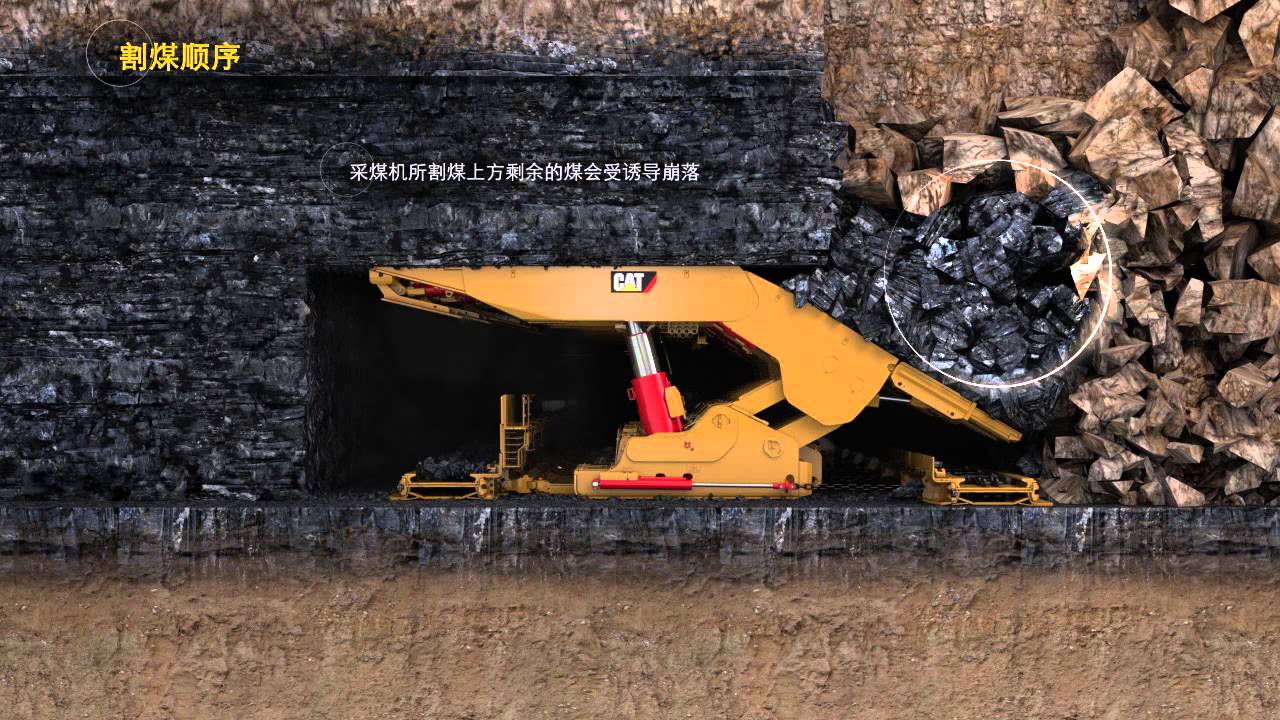
China Operates Longwalls Up to 301 Meters Wide and 4.4 Kilometers Long, with 7 Meters of Mining Height and Controlled Ceiling Collapse in Extreme Underground Mining.
According to technical studies published in mining engineering journals, reports from Chinese state-owned coal companies, and geotechnical surveys conducted in the Shendong Coalfield, China has scaled the longwall mining method beyond traditional standards employed in other countries. What in many places is a face of a few dozen or a few hundred meters has become, in northern Chinese regions, a continuous operation of almost territorial dimensions, capable of advancing kilometers underground while maintaining constant and predictable production.
The result is a form of extreme underground construction: an infrastructure that not only removes ore but also plans, executes, and controls the collapse of the ceiling itself, converting rock mass deformation into part of the productive process.
The Longwall Taken to the Physical Limit
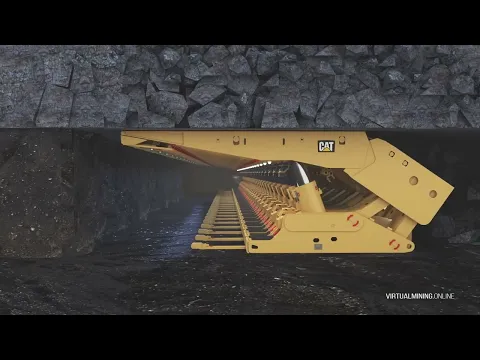
The longwall method consists of excavating a continuous face of coal, temporarily supported by hundreds of hydraulic mobile props. As the face advances, these props are shifted, and the previously mined area behind them is left for controlled subsidence, forming what is called a gob.
-
After China, it’s now the turn of the USA to ‘secure’ a share of Brazil’s natural resources: the country buys critical rare earths for R$ 3 billion and enters the center of the global technology dispute.
-
Rare earths are in everything, from cell phones to bullet trains, and what almost no one realizes is why they have become the target of such a delicate global war.

-
Brazil extracts 26.3 million tons of ore from what was previously treated as waste, transforming residues into wealth, producing over 3 million tons of sand, and demonstrating how national mining is relearning to generate value.

-
A $3.5 billion megaproject in Latin America pumps desalinated seawater at 1,050 liters per second over 194 km to keep a copper supermine in the Andes operational for another 20 years.


In China, particularly in Shendong, this concept has been aggressively expanded. There are documented panels with widths approaching 301 meters, lengths that exceed 4.4 kilometers, and mining heights between 6.6 and 7 meters, technically classified as super-large working faces.
These dimensions turn each panel into a linear underground structure comparable to a continuous urban corridor.
Kilometer Panels and Continuous Production
Instead of operating multiple small panels, the Chinese strategy has focused efforts on extremely long panels, capable of sustaining production for years without frequent equipment relocation.
A panel over 4 kilometers long, advancing between 9 and 13 meters per day, can operate almost continuously, with highly predictable logistical and geotechnical planning.
This approach reduces downtime, improves efficiency, and maximizes coal recovery, but requires unprecedented support engineering and monitoring, as any failure propagates over hundreds of meters of active face.
Extreme Mining Height and the Weight of the Mass

Working with mining heights of up to 7 meters means removing enormous volumes of material for every linear meter of advance. At relatively shallow depths—180 to 210 meters in many cases in Shendong—this significantly increases the redistribution of stresses in the rock mass.
The ceiling above the face does not “collapse” chaotically. It is induced to collapse progressively, controlled, and predictably, based on rock strength calculations, prop spacing, and advance speed. The collapse becomes part of the structural design, not an accident.
Hydraulic Props as Mobile Pillars
To support such wide and tall faces, the mines use powered roof supports of high capacity, designed to withstand extreme overhead loads. These props function as mobile pillars, advancing step by step with the face and maintaining a safe working space.
In faces with hundreds of meters of width, the number of props can reach several hundreds operating simultaneously, synchronized to advance, lock, release, and advance again. It is a collective mechanical system, where the failure of one set can compromise the entire face.
When Underground Collapse Reaches the Surface
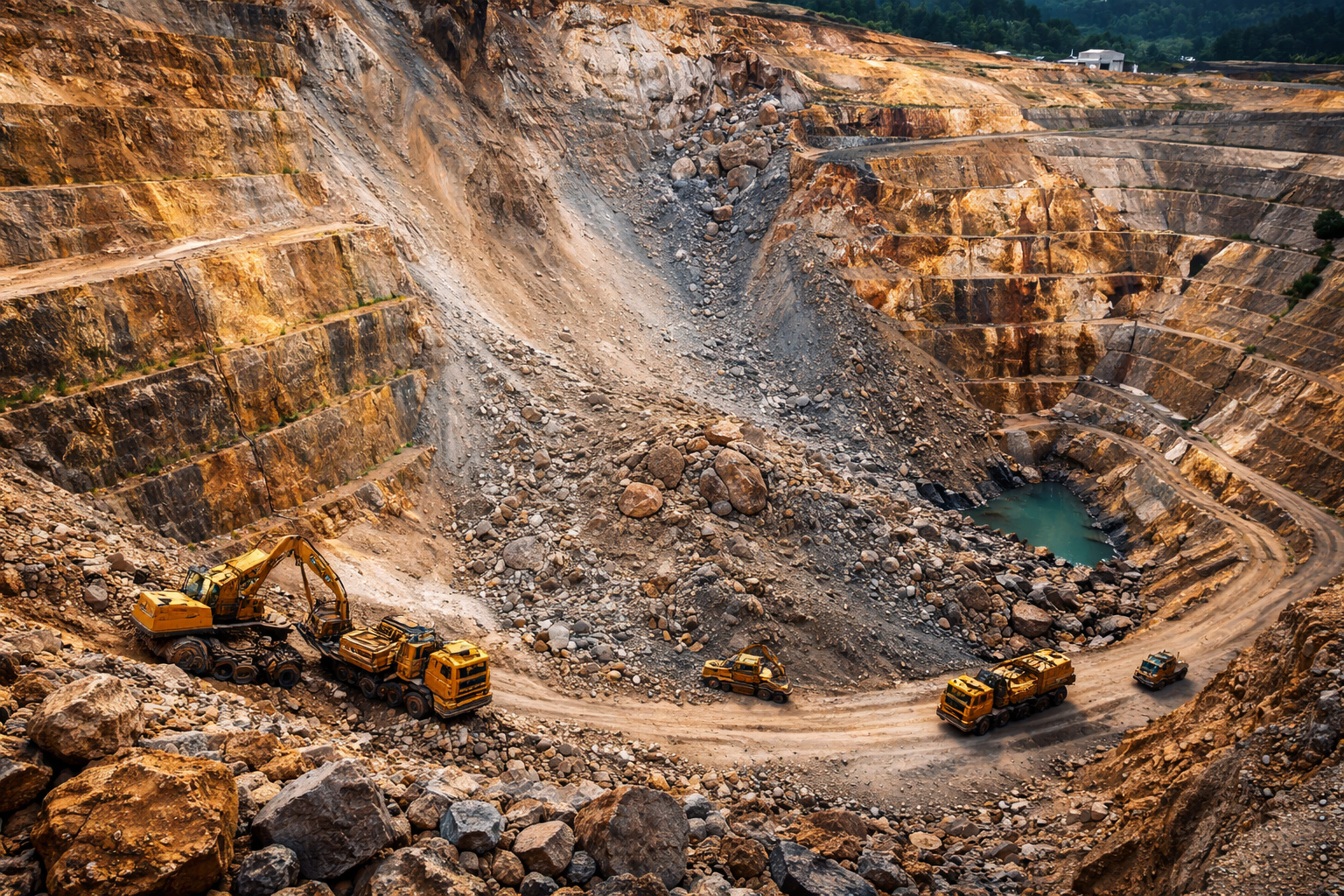
An inevitable effect of large-scale longwall mining is surface subsidence. As kilometers of ceiling collapse underground, the terrain above deforms, gradually sinking. Studies in Shendong show that, in high-intensity operations, subsidence can occur relatively quickly, tracking along with the face advance.
This deformation is no surprise to engineers. It is modeled, anticipated, and monitored, with subsidence curves estimated even before mining begins. In areas where the surface is used for agriculture or light infrastructure, the process is accepted as part of the territorial costs of mining.
LTCC: When the Seam is Too Thick for a Single Cut
In areas where coal seams exceed 6 to 16 meters in thickness, China also applies the LTCC (Longwall Top-Coal Caving) method. In this system, only the bottom part of the seam is mechanically cut, while the upper coal is controlledly collapsed behind the props.
This technique allows for the recovery of enormous volumes of coal without excavating the entire thickness at once, but further increases the volume of induced collapse, requiring rigorous geomechanical control and precise sequencing planning.
An Infrastructure That Builds Itself by Destroying
The most unique aspect of these mines is that they operate as works that build themselves as they destroy.
Every meter advanced creates a new operational gallery ahead while systematically eliminating the structure immediately behind.
Unlike tunnels or subways, where permanent stability is the goal, here stability is temporary by design. The success of the work depends on knowing exactly when and how to allow the underground to collapse.
Mining as Territorial Engineering
In the end, China’s gigantic longwall faces are not merely mining operations. They are subterranean territorial interventions, capable of altering the geometry of the underground and surface over areas of square kilometers.
It is heavy engineering applied at the physical limit of the rock mass, where concrete and steel give way to stress, deformation, and controlled collapse calculations. An extreme form of invisible construction, which turns collapse itself into a productive tool and redefines what it means to “build” underground.









-

-

6 pessoas reagiram a isso.