





 Portuguese
  English
  Spanish
  7 min of reading
  0 comments


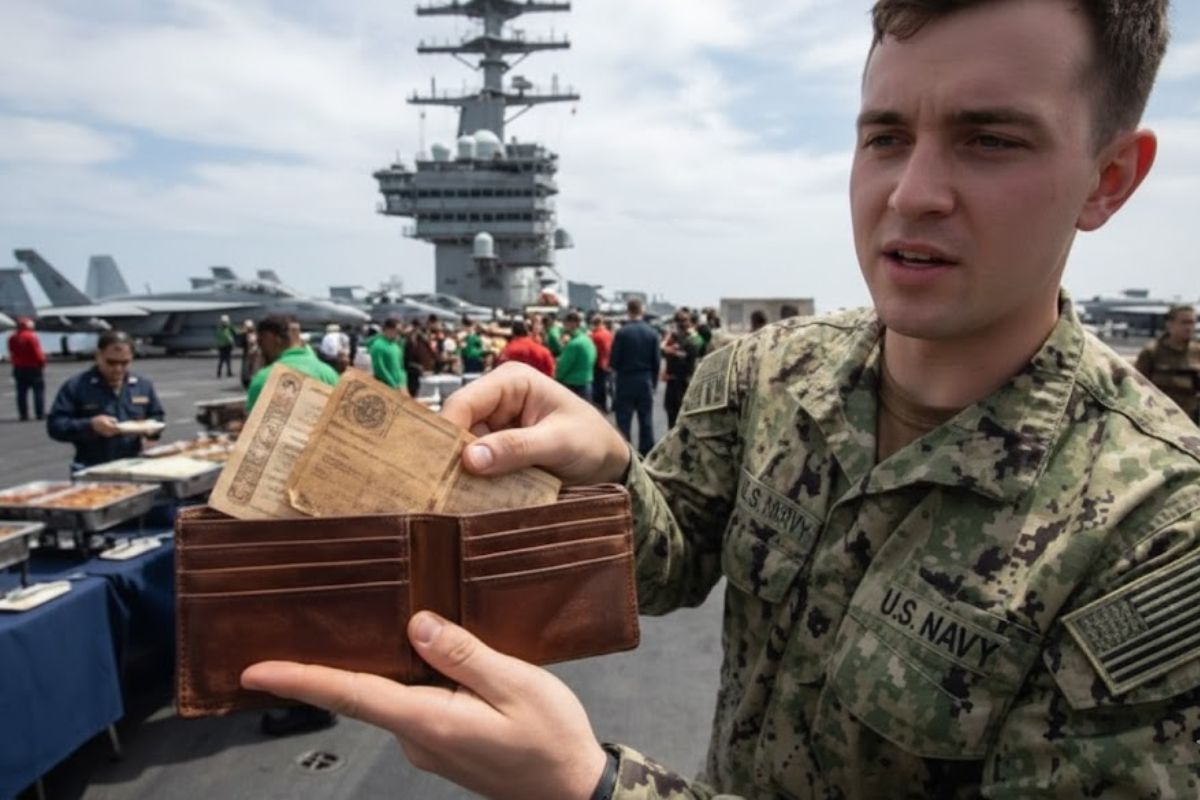
In Missions of Up to Six Months, US Aircraft Carriers Became Floating Cities: 5000 Sailors Buy Snacks, Laundry, and Haircuts with Navy Cash, a Debit Card that Works in Closed Circuit On Board and Connects to the Treasury Department, Reducing Cash and Operational Security Risks.
In the depths of the Pacific Ocean, a nuclear-powered aircraft carrier, comparable in size to three football fields, sails across the sea like a fortress. On board, about 5000 sailors live, and on US aircraft carriers, physical cash is virtually non-existent: purchases and services follow an electronic system that handles transactions without banks, ATMs, or cash on deck.
The starting point is logistical and security-related. On deployments of up to six months, hundreds of miles from the nearest coast, common demands arise such as buying a chocolate bar, paying for laundry, or getting a haircut. Carrying large amounts of cash heightened the risk of theft and complicated control; in 2001, the answer came with partnership with the Treasury Department and the adoption of Navy Cash on US aircraft carriers.
The Problem: Paying 5000 People Without Bank, ATM, or Secure Safe

For much of naval history, cash was the standard onboard, supported by a disbursing office responsible for distributing payments and fulfilling exchange demands.
-
“No one will make us change the Pix,” says Lula after the US report.

-
Lula responds directly to Trump and says that Pix is from Brazil and will not change under pressure from anyone, after a report from the United States pointed out the Brazilian payment system as an American trade barrier.

-
Amazon has just announced a new fee on all deliveries, and your online purchases will become more expensive starting April 17, including for those buying from the United States here in Brazil.

-
He sold his share for R$ 4 thousand, saw the company become a giant worth R$ 19 trillion, and missed the opportunity of a lifetime.


The arrangement, however, created a paradox: it was necessary to transport and protect enough cash for an embarked population, in international waters, for months on end.
On US aircraft carriers, the scenario was further complicated by visits to foreign ports.
Currency exchange became another step of risk and cost, with fees and conversions under time pressure, increasing the incentive for a solution based on debit cards and traceability.
2001: Partnership with the Treasury Department and Pilot on the USS John F. Kennedy

The turnaround came in 2001, when the US Navy partnered with the Treasury Department to launch Navy Cash.
The system began as a pilot onboard the USS John F. Kennedy and was designed for an environment where external connections may be unstable or non-existent, especially in combat zones.
The aim was not to create a unique currency, but to replace the need to carry cash onboard the ship.
In the context of US aircraft carriers, this meant reducing dependence on physical cash and standardizing purchases and payments in a proprietary network.
How Navy Cash Operates: Closed Circuit On the Ship and Open Circuit Outside It

The Navy Cash system combines two layers. The first is the closed circuit: a chip embedded in the card stores electronic value for exclusive onboard use.
This architecture allows transactions even when the ship is isolated from the outside world, keeping operational terminals on an internal network.
The second layer is the open circuit.
The magnetic stripe connects the card to the sailor’s bank account on land, functioning as a debit card accepted as Mastercard in millions of establishments.
In practice, the same debit card serves the closed circuit onboard and the conventional use outside of it.
Loading Balance on the Debit Card: Payment Split, Terminals, and Treasury Form 2887

To load money into the system, the sailor fills out a specific document, the Treasury Form 2887, which authorizes electronic transfers.
The most common method is the payment split: a portion of the military salary is automatically directed to Navy Cash on each payday.
When they need to replenish the balance, the sailor uses electronic terminals spread throughout the ship.
They do not dispense cash and function like ATMs without cash, transferring funds from the bank account on land to the debit card within the US aircraft carrier, keeping the closed circuit operating continuously.
Where Navy Cash is Accepted On Board: Ship Store, Barbershop, Laundry, and Dining Areas
With available balance, Navy Cash becomes the standard wallet on the US aircraft carrier.
The routine includes vending machines, barbershops, laundries, and onboard stores.
The ship’s store functions as a combination of convenience store and mini department store, with items ranging from toothpaste and shampoo to electronics, gym equipment, and themed clothing.
The retail is managed by the Navy Exchange system, and profits are redirected to morale, welfare and recreation programs, funding quality of life improvements onboard.
In specific dining areas, officers and chiefs pay for meals with Navy Cash, and private dining areas and guest meals follow the same logic of charging by debit card.
On some ships, micro markets have been installed.
On the USS Dwight D. Eisenhower, the Navy adopted self-service points with checkout kiosks, where the sailor picks a snack, pays with Navy Cash, and proceeds, with electronic transaction records.
Operational Security: PIN, Deactivation, and Temporary Cards for Visitors
The design prioritizes security. Each debit card is protected by a PIN number, and lost or stolen cards can be deactivated through the ship’s disbursing office.
On a US aircraft carrier, this reduces the impact of losses and eliminates the scenario of cash disappearing in the middle of the ocean.
For visitors, contractors, and maintenance crews, the Navy issues temporary cards.
They operate under the same closed circuit and are returned at the end, with a refund of the remaining balance, maintaining control over who transacts inside the ship.
Upon Docking: Mastercard, 23 Million Locations and More Than 2 Million ATMs
When the US aircraft carrier docks in ports such as Greece, Japan, or Bahrain, the same card can be used as a standard debit card.
The operation in local currency happens automatically, with deductions from the linked account and standard exchange rates.
The described reach for the network is vast: over 23 million locations accept Mastercard in more than 210 countries and territories, along with access to over 2 million ATMs worldwide.
For sailors, this reduces the need to seek currency exchange and carry cash during leave outings.
Embarked Financial Control: Closed Circuit Limits and Family Payment Split
The closed circuit also functions as a control mechanism.
Instead of exposing the entire salary to immediate spending, the system allows them to allocate a portion for use onboard, keeping the remainder secured in bank accounts on land.
For young sailors on their first mission, the structure limits spending to the designated balance while the majority of the money remains offshore.
For families, the payment split facilitates direct resource transfers to the spouse, preserving a manageable balance in Navy Cash for personal needs on the US aircraft carrier.
The Scale of Change: Easy Pay, Eagle Cash, and Cutting US$ 4.1 Billion in Physical Cash
The Treasury Department manages three stored value card programs for the military: Easy Pay, launched in 1997; Eagle Cash, launched in 1999; and Navy Cash, focused on ships at sea.
Together, these programs eliminated the need for US$ 4.1 billion in physical cash.
In scenarios like the Iraq War, transporting cash incurred a cost of approximately US$ 60,000 in security and logistics for every US$ 1 million sent, an administrative cost of 6% just to handle bills.
On US aircraft carriers, the reduction of physical cash also meant less risk and a lighter control burden.
Operational Results: Less Cash, Conversion of US$ 660 Million, and Intact Reserves
With the expansion of Navy Cash, ships that previously carried hundreds of thousands of dollars in cash began to deploy with 75% less cash.
There were cases where they returned from deployments with more than 80% of the minimum cash reserves still untouched.
In the large-scale implementation, the Navy converted over US$ 660 million from physical cash to electronic value.
On US aircraft carriers, this represents a shift in custody and financial tracking at sea, supported by everyday use of debit cards.
Modernization and Transition: Electronic Receipts and Migration to Eagle Cash Navy Cash
The system has undergone updates. Among the improvements, electronic receipts for transactions outside the ship emerged, something the initial version did not offer, as well as expanded compatibility with more ATMs worldwide.
There is also a planned transition from Navy Cash to an updated system called Eagle Cash Navy Cash, maintaining the dual functionality logic but with enhanced technology and security features.
The central justification remains operational: communication blackouts and hostile environments can occur where conventional financial networks become vulnerable.
US Aircraft Carriers as Self-Sufficient Cities and the Embarked Economy
A US aircraft carrier operates as a self-sufficient city.
It generates power from nuclear reactors, produces fresh water from seawater, and maintains internal services such as hospital, post office, television, and radio.
In this ecosystem, Navy Cash closes the economic cycle: the closed circuit ensures local transactions, and the debit card allows integration when the ship touches land.
The population size reinforces the necessity of the system.
The USS Gerald R. Ford houses approximately 4,500 sailors during normal operations and approaches 6,000 when including the air wing, maintaining steady consumption and services while at sea.
US aircraft carriers have not created a currency in the classical sense, but they operate an embarked financial system that replaces almost all cash circulation.
With Navy Cash, debit cards, closed circuits, and the governance of the Treasury Department, the Navy has reduced risk, simplified logistics, and kept the economy functioning even when the ship is isolated.
If you work in logistics, payments, or security, it is worth noting how a closed circuit supports consumption and services without stable internet in a mission environment, and how Navy Cash shapes financial decisions within the US aircraft carrier.
What detail of this US aircraft carriers system do you think is hardest to replicate outside the military environment?







Seja o primeiro a reagir!