





 Portuguese
  English
  Spanish
  5 min of reading
  0 comments


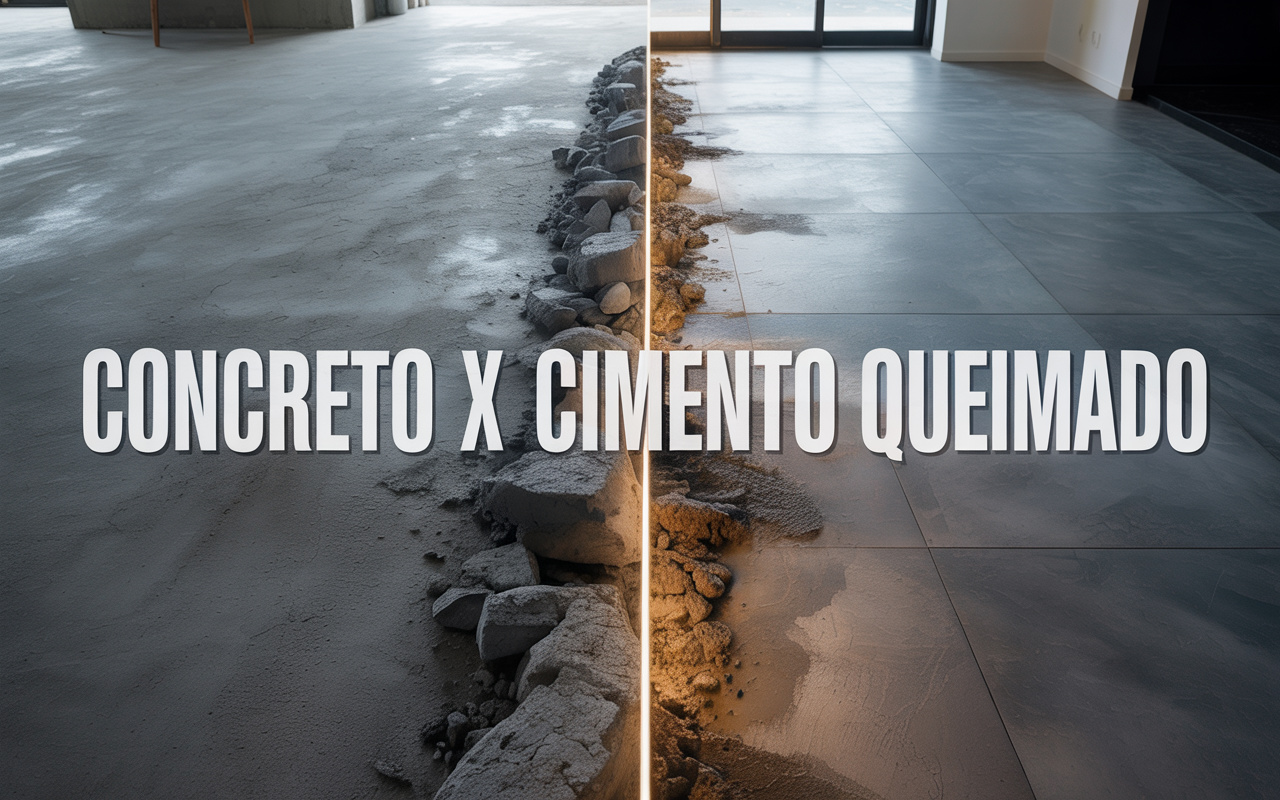
Real Differences Between Concrete Floor and Burnt Cement Show When Each One Pays Off More in Resistance, Cost, Aesthetics, and Durability.
With the advancement of economic reforms in Brazil, the debate between concrete floor and burnt cement has returned to the center of discussions. Both have gained enormous popularity in recent years, both for their reduced cost and for their cleaner and more modern aesthetics. However, despite being visually similar, they belong to completely different categories from a technical point of view, which makes all the difference when choosing the ideal finish.
Specialized sites such as Mapa da Obra, Qualy Pisos, and HRCamargo highlight that the resistance, composition, and durability of each are very distinct, and that poor choices can lead to cracks, premature wear, and greater expenses in the future.
The Concrete Floor: A Robust Structure Before It Becomes Finish
The concrete floor is, essentially, a structural slab. It is molded from a mixture of cement, sand, gravel, and water, and may receive synthetic fibers and additives that increase its resistance.
-
Neither the Pyramids nor the Great Wall of China, this gigantic construction in Spain is the human mark on planet Earth that intrigues the most when seen in images from space.
-
Surrounded by cliffs, mist, and chilling stories, the ancient Hotel del Salto has been reborn as a museum while still unable to shake off its reputation as a haunted place.
-
This star-shaped fortified construction, hidden near the border of Spain, may be the largest fortress on the planet.

-
Congonhas receives the monorail promised for the 2014 World Cup after more than a decade of delays and becomes the first airport in Brazil with integrated subway.


The average thickness varies between five and twelve centimeters, which allows it to work as a rigid monolith capable of supporting high loads, constant pressures, and the impact of heavy vehicle traffic. Therefore, it is the type of floor found in garages, parking lots, industrial warehouses, and any area subject to intense wear.
When it receives mechanical polishing, the concrete gains shine and appears visually more sophisticated, but its essence is resistance: a well-executed floor can last from twenty to forty years with little maintenance. This makes concrete one of the most durable solutions on the market, especially when exposed to sun, rain, and temperature variations.


Burnt Cement: Industrial Aesthetics with Minimal Thickness
Traditional burnt cement follows a different path. Although it is also made of cement and sand, its thickness is much thinner, usually between five and ten millimeters, which means it has no structural function.
The finish is created from a thin layer of mortar smoothed by hand, in which a burn of powdered cement is thrown to achieve the characteristic look.
The result is a continuous, modern floor at a much lower cost, which has become a trend in living rooms, kitchens, balconies, hallways, and residential areas with low traffic. However, its durability is lower, and the risk of cracks is higher, especially when the base has imperfections or when the floor is applied in areas subject to moisture, vibration, or impact.
Resistance: Two Categories That Do Not Compete with Each Other
The difference in resistance between concrete and burnt cement is striking. While concrete withstands impact, abrasion, and high loads due to its thickness and density, burnt cement is more fragile, more susceptible to scratches, and more sensitive to the weight of heavy furniture or falling objects.
Experts consulted on engineering portals point out that, even with good layers of resin or varnish, burnt cement will never come close to the performance of polished concrete.
Durability: Concrete Wins with a Great Advantage
In terms of durability, concrete again stands out. Under normal conditions, it lasts for decades, requiring only occasional cleaning or reapplication of sealants in specific cases. Conversely, burnt cement requires periodic reinforcements, such as acrylic resin or PU varnish, to maintain shine and reduce wear.
In indoor environments, burnt cement holds up well for several years, but loses performance in outdoor areas, where it suffers from sun, rain, and thermal expansion.
Cost: Who Really Offers Better Cost-Benefit
The initial cost of burnt cement is lower. The application is quick, requires less material, and usually ranges from fifteen to thirty reais per square meter in the traditional version.
Concrete, on the other hand, has a higher initial cost due to requiring more labor, curing time, and a larger quantity of materials, with prices ranging from thirty-five to seventy reais per square meter, depending on the thickness.

However, when analyzed in the long term, concrete tends to be more advantageous for those looking to avoid future renovations. In low-traffic indoor environments, burnt cement remains the most economical choice, but for exposed areas or surfaces that require resistance, concrete offers superior cost-benefit.
Aesthetics and Maintenance: Which Combines Best with Each Type of Environment
Burnt cement leads in aesthetics. It creates a continuous, matte, and minimalist look that aligns with contemporary industrial architecture. It can be pigmented in different colors and provides a handcrafted appearance that many homeowners seek.
Polished concrete, on the other hand, excels in maintenance. It hardly releases dust, does not stain easily, does not absorb water with the same intensity, and is more weather-resistant.
Both can receive final finishes, such as sealers, acrylic resins, or industrial varnish layers, but the need is greater for burnt cement due to the porosity and fragility of the surface layer.
The Final Decision: When to Choose Concrete and When to Choose Burnt Cement
The choice between the two floors directly depends on the objective. Concrete is the ideal alternative for those who need resistance, for those who want to avoid constant maintenance, or for those intending to apply the floor in garages, outdoor areas, parking lots, or locations subject to impact. Meanwhile, burnt cement stands out in indoor environments prioritizing aesthetics, quick execution, and low budget, provided there are no heavy loads or excessive moisture.
The technical comparison makes it clear that concrete and burnt cement do not compete with each other. One is structural, thick, durable, and focused on resistance.
The other is aesthetic, lightweight, accessible, and design-oriented. The correct decision requires understanding the behavior of each material, its limitations, and its performance over the years — something that reformers, bricklayers, and engineers now frequently explain on social media as interest in low-cost solutions grows across the country.








Seja o primeiro a reagir!