





 Portuguese
  English
  Spanish
  3 min of reading
  2 comments


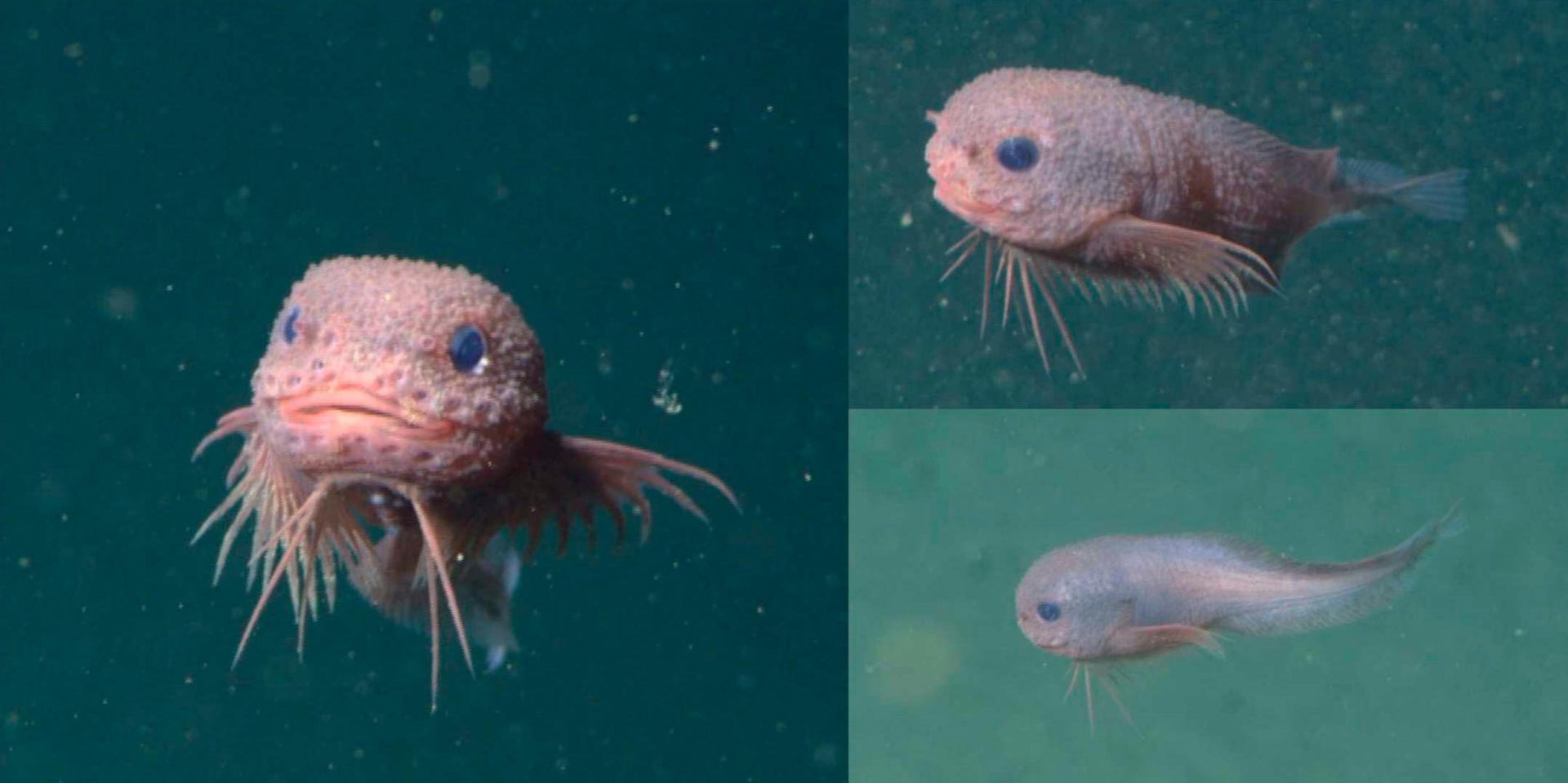


The Identification of Three New Abyssal Snailfish Species in the Eastern Pacific, Collected Between 3,268 and 4,100 Meters Depth with Manned and Remote Vehicles, Expands Knowledge About the Family Liparidae, Which Now Includes 450 Valid Species, and Highlights the Still Little-Known Dimension of Deep Ocean Biodiversity
Three new species of abyssal snailfish have been described in the eastern Pacific Ocean after collections between 3,268 m and 4,100 m depth, raising the number of valid species in the family Liparidae to 450 and highlighting persistent gaps in the knowledge of deep marine biodiversity.
Family Liparidae and Its Ecological Distribution
Snailfish from the family Liparidae inhabit temperate to cold environments in different ocean basins. The group occurs from the intertidal zone to hadal trenches over 6,000 m deep, playing relevant roles in multiple marine ecosystems.
The broad distribution is attributed to the high evolutionary rate of the group, which allowed adaptations to varied habitats. In shallow waters, many species use a specialized ventral suction disc to adhere to rocks, adopting a curled posture that originated the common English name.
-
Goodbye iron: new technology from Xiaomi promises to revolutionize the way we iron clothes with 500 kPa steam, continuous flow of 120 g/min, heating in 65 seconds, and six smart modes for different fabrics.

-
Rio Pardo, the most mysterious city in Rio Grande do Sul: untouched Pampas castle, the missing treasure of the Devil Boy, bride’s saint, invisible tunnels, and a 200-year curse today.

-
China retires the J-7 fighter after years of military protection and can now transform military items into drones, following more than 60 years of operation of the J-7, derived from the MiG-21, with thousands of units produced and strategic use in the PLAAF and PLANAF.

-
Volunteers are sought to live in the mountains for a month: a study pays people to stay at 2,500 meters, with 24-hour monitoring of sleep, metabolism, and blood pressure.


According to researchers, the family comprises 31 accepted genera and 450 valid species, of which 43 have been described in the last ten years. Liparids are distinguished by their scaleless bodies, ventral suction disc derived from pelvic fins in several genera, and elongated body forms.
Collection at Great Depths in the Eastern Pacific
Two of the new species, Paraliparis em and Careproctus yanceyi, were collected at 4,100 m depth using a suction sampler. The collections occurred with the manned vehicle Alvin, operated from the R/V Atlantis.
The third species, Careproctus colliculi, was collected at 3,268 m depth using a remotely operated vehicle. The ROV Doc Ricketts operated from the R/V Western Flyer, in an area located less than 100 km from the coast of Monterey Bay, California.
Sampling at extreme depths evidences the advancement of ocean exploration technologies and the capability to access habitats that were previously little studied. These environments continue to reveal a significant diversity of marine vertebrates.
Morphological Characteristics of the New Species
To describe the species, the authors used microscopy, micro-computed tomography, and detailed measurements. Size, shape, and physical characteristics such as the number of fin rays and vertebrae were analyzed, composing precise taxonomic diagnoses.
Careproctus colliculi can be identified by its pink coloration in life, 22 rays in the pectoral fin, rounded head, eight caudal rays, large eyes, and well-developed pterygiophores that form a wide suction disc.
Careproctus yanceyi features a moderate ventral suction disc, unique nostrils, and six branchiostegal rays. The species distinguishes itself from other deep-water snailfish in the eastern Pacific by its entirely black body, rounded head, and horizontal mouth.
Paraliparis em is distinguished by its long, black, laterally compressed body, absence of suction disc, sharply angled jaw, single pectoral radial, anteriorly positioned anus, and five branchiostegal rays, forming a distinct morphological set.
Genetic Analysis and Taxonomic Relevance
In addition to morphology, researchers sequenced the DNA of the specimens for comparisons with other snailfish. The genetic data allowed for positioning the new species in a broader evolutionary context within the Liparidae family.
The authors emphasize that taxonomy is essential for understanding the organisms that share the planet and for the study and conservation of global biodiversity. The deep oceans harbor expressive diversity and remarkable adaptations, still little known.
The discovery was described in an article published in the journal Ichthyology & Herpetology, reinforcing that even in 2025, knowledge about deep marine life remains incomplete and dependent on continuous and systematic exploration.










Parece meu amigo
Baixo **** da prr