





 Portuguese
  English
  Spanish
  6 min of reading
  1 comment


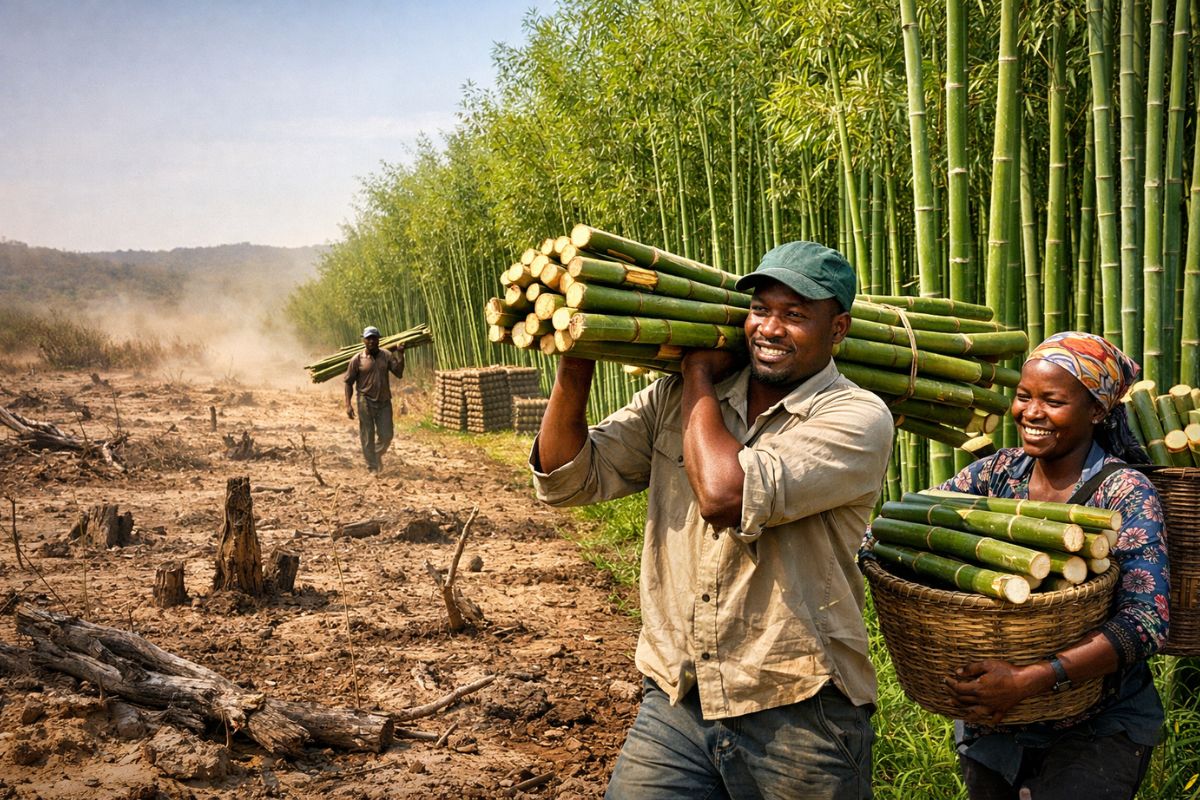


In Cameroon, areas previously called “dead land,” where yields fell below 200 kg per hectare, received bamboo on more than 200 hectares. The pilot started in 2020, with technical support and cooperatives, generated tea, neem oil, and reported annual income of US$ 150 to US$ 1,200.
Bamboo emerged as a practical response to a problem that had been accumulating for decades: depleted soil, erosion, droughts in the north, and heavy rains in the south, with families watching agriculture lose the ability to sustain food, income, and even school fees.
The less obvious point is that the turnaround wasn’t just about “planting and waiting.” There was selection of areas, choice of species, technique of spacing, training, harvesting rules, and a clear path to transform plants into products, with cooperatives taking on the hardest parts: market, processing, and reinvestment.
From “Dead Land” to Bamboo at Scale: What Was Breaking Rural Life

In various regions, degradation appeared as a cycle: forest cover decreased, water carried away nutrients, the soil became loose and yields plummeted.
-
A Brazilian recounted how a sudden malaise triggered the entire hospital machinery in the United States, with emergency protocols, tests to rule out a heart attack, and a bill that could reach $40,000.

-
Discovered just 4 meters deep, a 5,000-year-old submerged city with streets, tombs, and trade signs with Crete reveals how one of the oldest civilizations in the world lived before disappearing beneath the sea.

-
The new “monster” submarine of the United States Navy weighs nearly 8,000 tons, is 115 meters long, does not require fuel, and can operate for long periods submerged; meet the USS Massachusetts (SSN-798), which arrives to strengthen the military power of the U.S. amid global tensions.

-
In Sweden, Embraer subjects the KC-390 to rigorous testing in extreme cold, conducts operations in the snow with 100% success, and expands its presence among NATO countries.


In more degraded areas, production fell to less than 200 kg per hectare, a level that, in practice, dismantles the basics of rural life: constant food and stable income.
When productivity falls and fertilizer becomes expensive, the math doesn’t add up. Some families start opening new forest edges in search of “better” soil, which accelerates deforestation and pushes the problem forward.
In some places, the result is abandonment of areas, migration of youths to cities, and communities becoming more vulnerable with each failed season.
Why Bamboo Thrives Where Other Crops Fail

Bamboo stands out for a difficult combination to find in perennial crops: rapid growth and the ability to structure the soil.
While hardwoods can take decades, bamboo reaches maximum height in 3 to 5 years and continues producing year after year, with cutting of culms stimulating new shoots in the following season.
The ecological gain is not “mystical”; it is physical. The underground network of roots and rhizomes functions like a living mesh, holding the soil, reducing erosion, and cushioning the impact of rain that previously opened ravines and carried away the fertile layer.
Furthermore, the leaves return organic matter to the soil, helping to rebuild fertility in places where almost nothing else can survive.
How the Planting Was Set Up: 2020, Selected Areas, and Five Species
The pilot kick-off took place in early 2020, when teams from IUCN and local partners conducted surveys in exhausted fields around Umbalo and Waza. The logic of choice was tough and straightforward: to select plots where “nothing else was growing,” with thin topsoil, nutrients already taken away, and cracks during the dry season.
The technical design was also simple and replicable. The lines were spaced about 1.5 meters apart, open enough to let light in and narrow enough to “stitch” the ground when the bamboo matured.
Five species were selected to adapt to poor climates and soils, with some enduring prolonged droughts in the north and others responding better to heavier rains in the south.
Seedlings, Management, and Routine: Bamboo as a System, Not a Bet

The seedlings arrived in the thousands, produced in local nurseries from stakes and root divisions. The fieldwork followed a repetitive but essential pattern: dig, plant to the correct depth, water, and move on to the next hole.
The plots varied from fractions of a hectare to several hectares, mapped by GPS and marked with simple stakes—the goal was scale: over 200 hectares spread across dozens of communities.
The first signs didn’t all come at the same pace. In some spots, sprouts appeared in weeks; in others, the response was slower.
What mattered was the visual and functional change: where there had been dust and exposed ground for years, lines of green returned, creating conditions to hold the soil and initiate the cycle of organic matter that helps “reset” fertility.
Training and “Local Network” of Technicians: The Detail That Decides the Outcome
Even before the first sprouts broke the soil, training began.
Jermaine Embach, director at the National School of Water and Forestry, led a curriculum that went beyond planting: selecting healthy seedlings, soil assessment, irrigation management in the dry season, pest control, composting, and, mainly, the timing of harvest to keep the clump productive for years.
The goal was to train local experts, not just temporary labor. Among around 1,600 rural participants, over 300 completed the entire cycle; 120 were women, many without prior land management experience outside subsistence crops.
The “train to train” model accelerated dissemination, creating people capable of guiding neighbors, recording growth in simple notebooks, and solving typical problems in the field, such as pest outbreaks and irrigation failures.
Cooperatives and Marketable Products: Bamboo Tea and Neem Oil
The economic turnaround gained a face when a women’s cooperative entered the scene: the Green Leaf Sisters. The strategy was pragmatic: convert bamboo and neem into marketable items with local processing, starting with dried bamboo leaves for tea.
In a modest workshop near Embalmayo, they adjusted drying time to preserve flavor and nutrients, and by the end of 2023, they packaged 500 kg for the first sale batch, priced at €2.5 per kilo.
Meanwhile, the neem planted between the bamboo lines used for shade and pest control generated seeds and opened another revenue stream.
The cooperative invested in a small press and extracted two tons of neem oil over a few months, priced at US$ 12 per liter in 2024, catering to farmers and small cosmetic producers.
The central point is that restoration became a cash flow, “kilo by kilo, liter by liter,” and this changes the decision to remain in the field.
Rural Income, Reinvestment, and What Prevents the Model from Becoming an Empty Promise
The reported income numbers from the pilot highlight the leap: before bamboo, many farmers hovered around US$ 150 a year; after initial harvests and cooperative products, some reported earnings of US$ 1,200 annually or more within four years.
It’s not just about “earning more”: it’s about being able to choose to buy school uniforms, medicine, make repairs, and save for a rainy day.
To reduce the risk of the improvement disappearing in the first crisis, the cooperative model adopted a clear rule: 40% of profits would be reserved for reinvestment in new seedlings, processing equipment, and training new producers, with oversight from the Bamboo Green Alliance Board.
This financial architecture transforms occasional income into stability, because it creates a buffer for poor seasons and gradual improvements in productivity and quality.
What Can Be Learned and Where Bamboo Still Hits Limits
The pilot in Cameroon has been described as a starting point in the face of a continental scenario: over 12 million hectares degraded in Africa, with estimates that a large portion would have climate and rainfall suitable for the needs of bamboo.
Countries like Nigeria, Ghana, and Kenya emerge as examples of territories already mapping restoration zones focused on economic return, and Ethiopia appears as another case cited where bamboo could play a central role.
But bamboo is not a universal cure. It can compete for water in very dry regions if poorly managed, requires clear rules for harvesting and selling, and depends on markets and quality to avoid “production without buyers.”
Moreover, productive restoration needs to coexist with real environmental goals: holding soil and capturing carbon is valuable, but it does not replace, on its own, the complexity of native forest ecosystems when the aim is broad biodiversity.
The story of Cameroon showcases a rare point in rural projects: bamboo was introduced to hold the soil and, at the same time, create income with frequency and predictability.
When restoration pays off early, it stops being discourse and becomes a rational choice for those living on the land, especially if there is training, governance, and cooperatives capable of bringing products to market.
If your region had degraded areas, would you bet on bamboo as a “bridge” to recovery or would you prefer another path? And if it were to replicate the model, what do you consider indispensable for success: technical training, strong cooperative, 40% reinvestment rule, or a guaranteed market for tea and oil?









Formidável, muito responsavel