





 Portuguese
  English
  Spanish
  6 min of reading
  1 comment


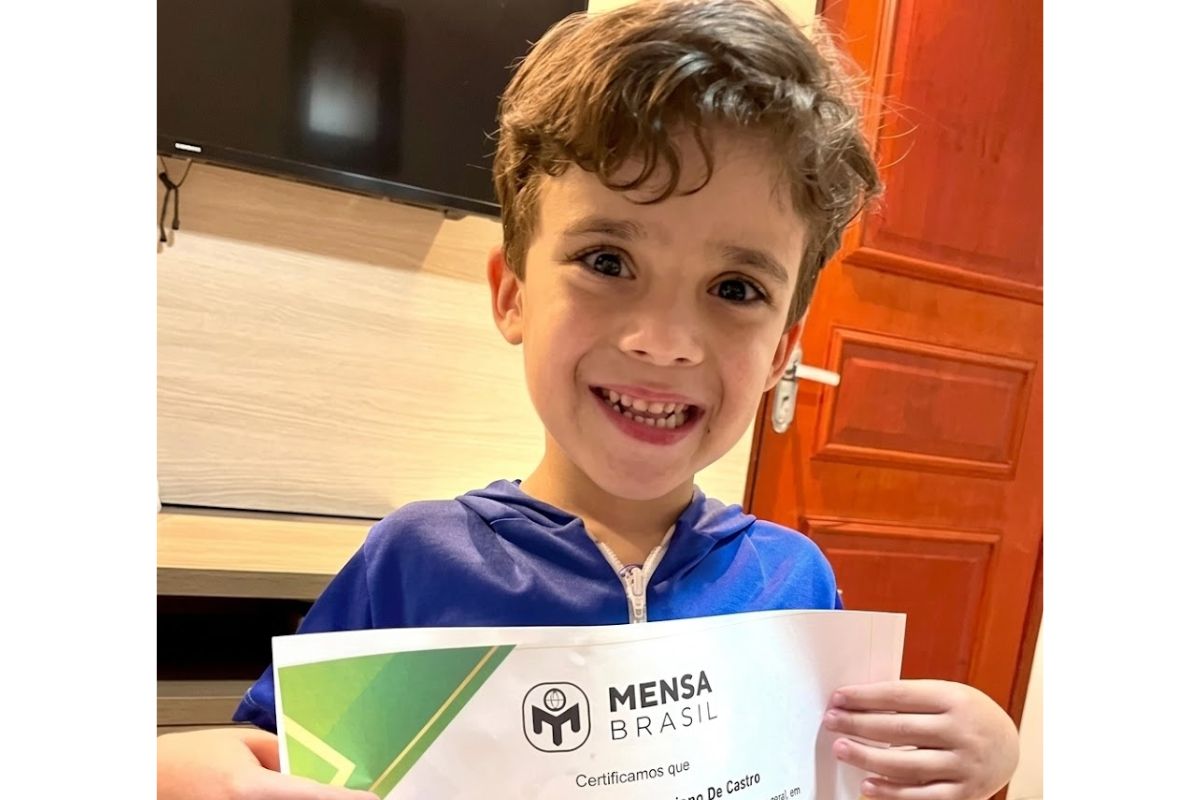


João Vítor de Castro, from Paraíso, surprised his family by recognizing letters at 18 months, learning the alphabet in Libras at 2 and a half years old, and reading signs at 3. With an IQ of 137, this Brazilian boy was accepted into Mensa after a detailed neuropsychological evaluation and maintains a carefully structured childhood routine.
João Vítor de Castro is 5 years old and, for those who live with him in Paraíso, the idea of “waiting for school to get moving” has become too small. The Brazilian boy has been reading since he was 3, writes notes, communicates in English and Libras, and has been recognized with an IQ of 137, a set of signs that led the family to seek specialized evaluation.
The acceptance into Mensa Brazil placed João Vítor’s name in an international circuit for high abilities, but what stands out the most is the daily life behind the result: a real childhood, with intense curiosity, an organized routine, and careful choices so that intellectual development does not progress in isolation.
Signs Very Early: Curiosity That Appeared in Small Things
Even before entering traditional school, João Vítor was already displaying a pattern of interest beyond what is expected for his age. At 1 and a half years old, he recognized letters and slogans; at 2 and a half, he learned the alphabet in Libras by himself. These milestones did not arise as formal “training,” but as part of a constant curiosity, perceived in common everyday situations.
-
These are the drivers who may stop paying tolls on highways in a project that promises to reduce costs for those who live from transportation in Brazil.

-
(Video): Italian pilot lands plane on moving train at 120 km/h and achieves unprecedented feat in aviation, even with a narrow runway and without direct visual contact.

-
It seems to have come out of a science fiction movie: A Brazilian city where it rains almost every day, recording over 4,000 mm per year, driven by climatic factors — a direct result of its strategic location in the Amazon.

-
The water crisis that could change everything this year has already begun; it’s not just about the climate, it affects technology, raises product prices, and can halt entire companies without warning.


An emblematic episode occurred when, at 3 years old, he read street signs that surprised his parents, such as “João do Gás” and “Unimed.” Shortly after, he left a written note for his twin brother: “don’t eat, José.” For his mother, Gisele Castro, the dynamic is clear: “playing, for him, is learning”, and this manifests in the way he spontaneously seeks challenges.
The Path to the Assessment: What Was Evaluated and Why It Matters
When teachers noticed that his progress was well above grade level, a recommendation for a neuropsychological evaluation was made.
This type of evaluation is not limited to “measuring intelligence”: it involves observing performance and cognitive profile across different areas, crossing tests and behaviors to understand how the child learns, regulates emotionally, and communicates.
In João Vítor’s case, there were about ten sessions with specialists, involving tests of memory, language, reasoning, and behavior.
The result confirmed high abilities/giftedness. The strength of the assessment lies in the consistency of the set, as it provides a technical basis to guide the school and family with more precision, rather than relying solely on impressions.
Mensa Brazil and the 98th Percentile: What It Means to “Enter” This Network
With the assessment in hand, the family submitted documentation to Mensa Brazil, an organization that brings together individuals in the 98th percentile or higher on intelligence tests. The confirmation of acceptance connected João Vítor to an international network focused on individuals with intellectual performance well above average in multiple areas.
For a 5-year-old Brazilian boy, this does not mean a defined “career” or an automatic path to success. It primarily means formal recognition of a profile and the opportunity to access references, experiences, and exchanges with people who understand the typical challenges of high abilities.
In many cases, the gain is guidance and belonging, something that can alleviate the feeling of “disconnection” that some children experience when the environment does not match their way of thinking.
To Advance or Not to Advance: Why the Family Chose Caution
Despite mastering content typical of 2nd and 3rd grade students, João Vítor remains enrolled in Pre-K 5. The family could accelerate his educational journey but chose to proceed cautiously. The justification does not stem from denying his ability but rather from considering holistic development: emotional growth needs to keep pace with intellectual growth.
Additionally, there is the bond with his twin brother, a factor that weighs on emotional and social stability. In families with gifted children, this is a recurring dilemma: how much to accelerate to avoid demotivation and boredom, and how much to hold back to preserve social interaction, sense of belonging, and emotional maturity. The alternative found was to offer extra cognitive challenges without sacrificing a childhood routine.
Organized Routine, Controlled Anxiety, and “Hunger to Learn” in Daily Life
At home, the routine is visible: a board in the kitchen organizes therapy schedules, tests, and activities. The structure serves as practical and emotional support, helping to control anxiety and provide predictability.
And there is a repeated request in daily life: “Mommy, print activity.” It’s not just the desire to get it right: it’s a necessity to explore, as if learning itself were the toy.
João Vítor’s interests go through intense phases, described as obsessions with specific themes: planets, light-years, mathematical calculations.
He also enjoys chess and board games with advanced rules, as well as English with “touches” of Spanish and even Russian, according to the family. Outside of the intellectual sphere, he continues activities such as swimming and physical recreation, which help balance energy, socialization, and well-being.
Socialization and “Older” Conversations: When Intellectual Maturity Does Not Match Age
A characteristic that appears in many gifted children is the asymmetry of development: language and reasoning can advance very quickly, while emotional age remains that of a small child.
João Vítor gets along well with peers his age but also seeks complex conversations with older students and adults, because he finds more “material” to sustain his level of curiosity and argumentation.
For a Brazilian boy with this profile, the challenge is not to interpret this search as “distancing” or “arrogance,” but as a legitimate attempt to connect through shared interests.
When the environment recognizes this without labeling, the child tends to navigate better among peers, family, and school, with less frustration and less unnecessary pressure.
Living in the Countryside with Few Options: Improvisation, Technology, and Tailored Support
Paraíso, João Vítor’s hometown, offers few specific options for gifted children. Even courses like Kumon are not available, which limits structured alternatives and often forces the family to create homemade solutions.
The response was to improvise with private lessons, educational games, online research, and interactions with Alexa, always trying to align stimulation with the boy’s real interests.
The mother summarizes the priority clearly: invest in whatever is necessary, but without stifling potential or turning childhood into a performance agenda.
The focus is not on producing results to impress, but rather to maintain a sustainable path where learning remains enjoyable and the child remains a child, even when the world insists on seeing him only as “talent.”
A Case That Raises a Bigger Question: How Can School and Family Walk Together?
João Vítor’s story stands out for bringing together signs very early, technical validation, and institutional recognition, but also for highlighting a common truth: the school system is not always ready to identify and support profiles that deviate from the norm with balance.
When teachers observe and refer, when the family seeks evaluation, and when both cooperate, the chance of a healthy journey increases.
At the same time, the decision not to accelerate immediately shows that not every answer needs to be “skipping steps.” For a 5-year-old Brazilian boy, preserving bonds, routine, and emotional stability can be just as crucial as offering cognitive challenges.
The central point is to calibrate stimulation and affection, without haste and without labels that weigh more than they help.
In your opinion, what should come first when a child shows high abilities so early: accelerating the school life to avoid demotivation or maintaining their class and reinforcing emotional health? And, if you are a parent or educator, what kind of practical support would make a difference in daily life?







Meu neto lê desde 3 anos. No tablet aprendeu inglês, alfabeto russo, alfabeto grego, contas matemáticas e agora está aprendendo tcheco algo assim. Lê fluente desde os 4 e escreve. Tem TEA